
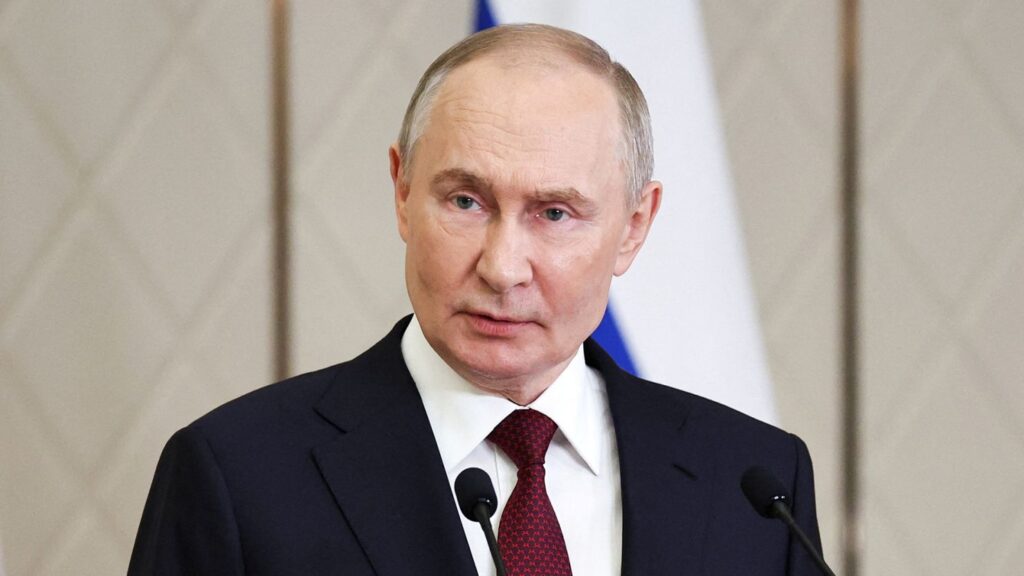
Image: from Ounka X @OunkaOnX
By Open Chronicle Staff | Monday, March 9, 2026
MOSCOW / TEHRAN — Russian President Vladimir Putin has moved swiftly to solidify the Kremlin’s strategic partnership with Iran’s new leadership, pledging “unwavering support” to Ayatollah Mojtaba Khamenei just hours after his ascension to the position of Supreme Leader.
In a formal message reported by AFP, Putin characterized Russia as a “reliable partner” and expressed deep solidarity with Tehran as it navigates the “armed aggression” of the U.S.–Israeli coalition. The Russian leader noted that Mojtaba’s tenure would require “great courage and dedication,” given the decapitation of Iran’s previous leadership on February 28.
The New Guardian of the Revolution
Mojtaba Khamenei, 56, was formally appointed as the third Supreme Leader by the 88-member Assembly of Experts shortly after midnight Monday (2030 GMT Sunday). Despite having held no prior official government post, the Mashhad-born cleric has long been considered the architect of the “House of the Leader,” maintaining a discreet but powerful grip over the Islamic Revolutionary Guard Corps (IRGC) and domestic security.
His elevation to the rank of Ayatollah upon appointment signals a rapid consolidation of clerical and military authority. The IRGC, the judiciary, and President Masoud Pezeshkian all issued immediate declarations of loyalty to the new leader, who is the only one of the late Ali Khamenei’s six children to hold such a prominent public role.
A Legacy of Hardline Continuity
Analysts suggest Mojtaba’s rise represents a direct continuation of his father’s defiant foreign policy and “Look to the East” strategy.
-
Wartime Veteran: A veteran of the Iran-Iraq War, Mojtaba wears the black turban of the seyyeds, denoting descent from the Prophet Mohammed.
-
Sanctioned Status: The United States had already signaled its opposition to his influence in 2019, imposing sanctions for his role in advancing regional ambitions and suppressing internal dissent.
-
Personal Loss: The transition is marked by personal tragedy; Iranian authorities confirmed that Mojtaba’s wife, Zahra Haddad-Adel, was killed in the same February 28 strikes that claimed his father’s life.
The “Hereditary” Challenge
While the late Ali Khamenei had historically rejected the notion of hereditary succession, the swift appointment of his son suggests a pragmatic move by the clerical establishment to ensure stability during a period of existential threat.
However, the appointment has already drawn a “hand of steel” warning from Israel. Israeli authorities stated Monday that they would “continue to follow any successor,” implying that Mojtaba himself remains a high-priority target for the coalition’s “relentless barrage” of strikes.
Moscow’s Strategic Bet
By backing Mojtaba, Putin is signaling that Russia will not retreat from its Middle Eastern alliances despite the volatility of the war. With oil prices surging past $100 and global supply lines at risk, the Moscow–Tehran axis remains a critical—and increasingly militarized—counterweight to Western influence in the region.