
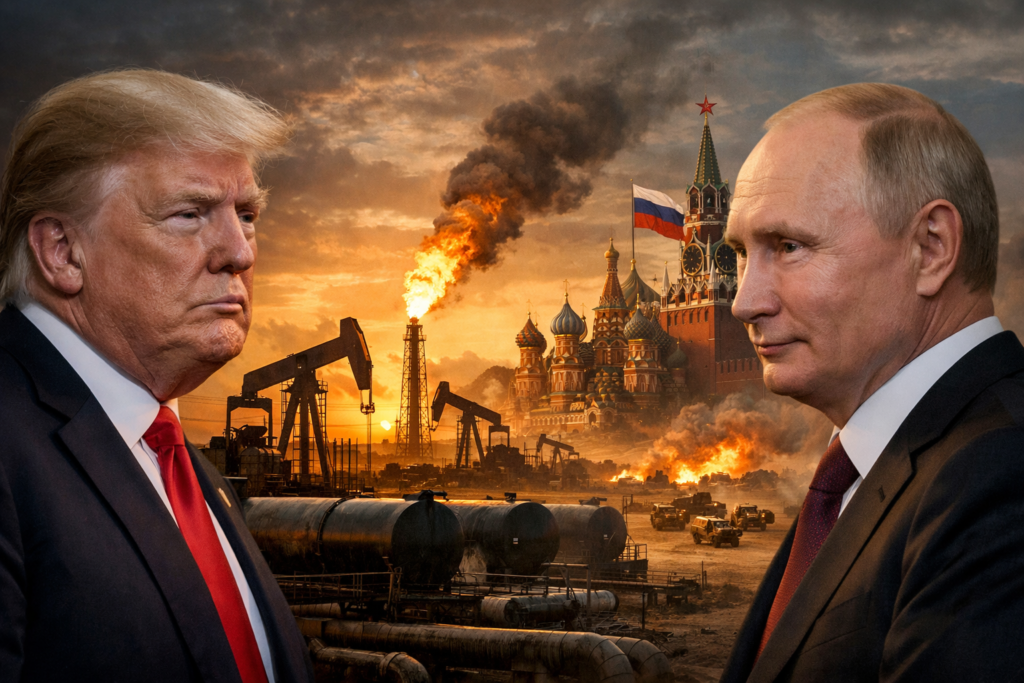
Image Credentials: Image Title: Vacinómetro: THE KREMLIN’S WINDFALL: TRUMP PULLS OIL SANCTIONS AS PUTIN CAPITALIZES ON IRAN CRISIS Source: (sora.openai) Date: March 2026. Attribution: This image was created using AI-generated imagery (sora.openai) and does not depict a real-world scene.
By Open Chronicle Staff | March 11, 2026
WASHINGTON, D.C. / MOSCOW — In a move that has sent shockwaves from the halls of the Verkhovna Rada in Kyiv to the trading floors of Wall Street, President Donald Trump announced late Tuesday that the United States will begin waiving oil-related sanctions on “certain countries”, a move widely understood to be a massive olive branch to Vladimir Putin’s Russia.
The announcement followed a high-stakes telephone call between the two leaders, their first of 2026. As the conflict in Iran chokes global energy supplies and keeps the Strait of Hormuz effectively shuttered, President Trump appears to be prioritizing domestic fuel prices over the long-standing strategy of isolating the Kremlin for its war in Ukraine.
“WE NEED THE SUPPLY”
Standing before reporters in Miami, the President was blunt about the economic reality facing his administration. With benchmark crude prices having recently surged past $120 a barrel, the “inflationary fire” of the Iran war is threatening the American economy.
“We have sanctions on some countries. We’re going to take those sanctions off until this straightens out,” Trump stated, referring to the regional chaos. “We need the supply. We’re waiving certain oil-related sanctions to reduce prices… then who knows, maybe we won’t have to put them back on. There will be so much peace.”
A LIFELINE FOR THE RUSSIAN WAR MACHINE
For Vladimir Putin, the timing could not be more fortuitous. According to reports in The Independent, the easing of sanctions, specifically targeting Russian oil giants Rosneft and Lukoil, could add an estimated $50 billion to the Kremlin’s coffers annually.
While much of the world reels from the energy crunch, Russia is “leisurely enjoying the benefits,” with its Urals crude jumping from $50 to over $100 a barrel in a matter of days. Analysts warn that this financial windfall directly subsidizes Russia’s ongoing military campaign in Ukraine, precisely at a moment when Kyiv claimed to be regaining the tactical initiative.
KYIV’S FEARS: THE SECOND FRONT
The reaction from Ukraine has been one of deep “vulnerability and betrayal.” President Volodymyr Zelensky, who recently sent Ukrainian drone experts to assist U.S. bases in Jordan and Gulf allies in Saudi Arabia, warned that the Middle East conflict is being manipulated by Moscow to serve as a “second front.”
“If Trump lifts oil sanctions, it will only provide a lifeline to the Russian war machine,” noted Oleksandr Morezkho, chair of the Ukrainian parliament’s foreign affairs committee. “It will translate into more civilian casualties in Ukraine.”
The diplomatic fallout is already tangible: a planned round of U.S.-brokered peace talks between Russia and Ukraine, originally scheduled for this week, has been indefinitely postponed at Washington’s request.
DIPLOMATIC GAMBIT OR GEOPOLITICAL BLUNDER?
The White House maintains that the move is a necessary temporary measure to prevent a global economic collapse. Treasury Secretary Scott Bessent noted that “hundreds of millions of barrels of sanctioned crude” are currently sitting on the water, and “un-sanctioning” them is the fastest way to stabilize the market.
However, critics argue that by rewarding Putin for his “help” in the Iran crisis, the U.S. is signaling that its commitment to Ukrainian sovereignty is negotiable when weighed against the price of gasoline. As the B-52s continue their “pulses” over Tehran, the shadow of the Kremlin looms larger than ever over the outcome of the war.