
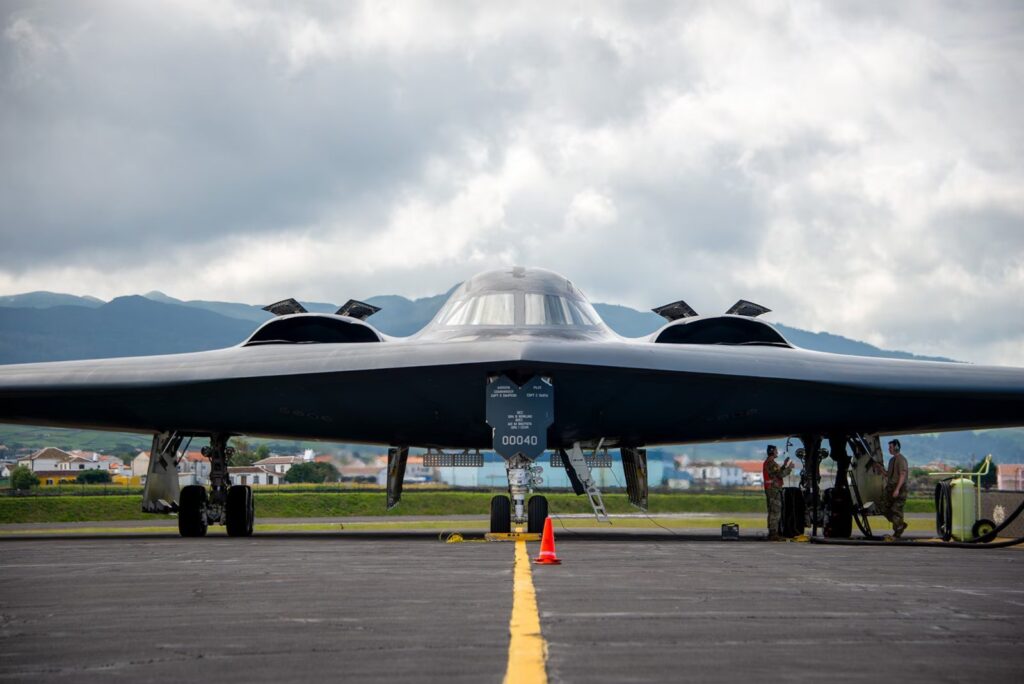
Image: from The Cradle X @TheCradleMedia
By Open Chronicle Staff with Agencies| March 11, 2026
RAF FAIRFORD, UNITED KINGDOM — The quiet Gloucestershire countryside has been transformed into the primary launchpad for American strategic power as the U.S. Air Force completes one of its largest coordinated bomber deployments to Europe in decades.
As of Wednesday, at least 11 strategic bombers are now forward-deployed at Royal Air Force Fairford and other regional hubs. The arrival of the heavy metal marks a “dramatic surge” in Operation Epic Fury, the ongoing U.S.-led air campaign against Iranian military and nuclear infrastructure.
THE ARRIVAL OF THE ‘HOOKY’ FLIGHT
The final piece of the current deployment fell into place Monday, March 9, when three B-52H Stratofortress bombers, using the callsigns HOOKY21, 22, and 23, touched down at Fairford. Originating from the 23rd Bomb Squadron at Minot Air Force Base, North Dakota, these “venerable giants” were spotted carrying full external loads of AGM-158 JASSM stealthy cruise missiles.
They join a formidable contingent of eight B-1B Lancer bombers that arrived over the weekend. While five of the “Bones” are currently stationed at Fairford, three others were forced to divert to Ramstein Air Base in Germany on Sunday due to “very low visibility” and thick fog in the UK.
A STRATEGIC SHIFT IN LONDON
The concentration of bombers at RAF Fairford follows a significant policy shift by the British government. Prime Minister Sir Keir Starmer approved the use of UK bases for direct offensive strikes against Iran only after a March 2 drone attack on the British sovereign base at Akrotiri, Cyprus.
The move to forward-deploy these assets to England—and reportedly to Diego Garcia in the Indian Ocean, effectively cuts flight times to Tehran in half. Previously, bombers were forced to fly grueling 20,000-kilometer round-trip missions from the continental United States, requiring up to nine aerial refuelings per mission.
THE “BOMBER PULSE”
The deployment is the physical manifestation of a warning issued last week by U.S. Secretary of Defense Pete Hegseth, who stated that strikes were about to enter a “more aggressive phase.” Pentagon officials describe the strategy as a series of “bomber pulses”—sustained, high-intensity strike waves designed to dismantle Iran’s missile production capability permanently.
According to U.S. Central Command (CENTCOM), B-1, B-2, and B-52 aircraft have already struck over 200 targets deep inside Iran, including command-and-control bunkers and ballistic missile silos near Tehran. With the bombers now positioned just 4,500 kilometers from their targets, military analysts expect the frequency of these “pulses” to accelerate significantly in the coming days.