
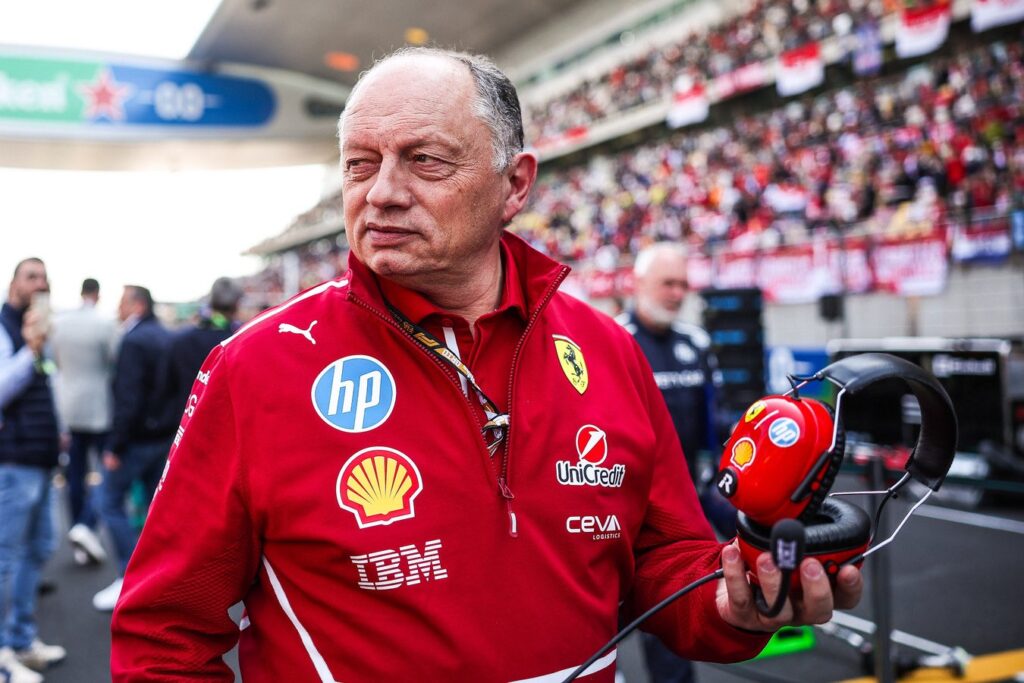
Image: from This is Formula 1 X @ThisIsFormu1a1
OPEN CHRONICLE: SPORTS
By Open Chronicle Staff | March 12, 2026
SHANGHAI / MARANELLO — As the 2026 Formula 1 season enters its high-stakes Asian leg, the technical battle lines between Mercedes and Ferrari have never been clearer. However, according to former Haas F1 mechanic Mark Slade, Ferrari’s struggle to catch the “Silver Arrows” isn’t necessarily a lack of raw talent or horsepower; it’s a fundamental lack of internal integration.
Slade, who worked intimately with Maranello-sourced hardware and engineers during his tenure at Haas, recently detailed the systemic “silo” culture that he believes keeps the Scuderia a step behind their rivals in the developmental race.
DEPARTMENTS AT ODDS: THE “SILO” EFFECT
Speaking on Peter Windsor’s YouTube channel, Slade highlighted a recurring issue: Ferrari’s specialized departments often operate as independent islands rather than a cohesive unit.
“Ferrari have never quite been as integrated across the different areas of the car,” Slade explained. “Integrating aero with suspension, and then with the power unit, has been a bit of a problem. Each department has tended to have its own ideas about what it should do.”
THE AERODYNAMIC VS. MECHANICAL CLASH
This lack of synergy manifests most dangerously when the mechanical suspension does not complement the aerodynamic concept.
-
The Consequence: While Mercedes designs their suspension specifically to stabilize the aero platform (ensuring consistent downforce throughout a corner), Ferrari’s departments have historically delivered components that fight one another, leading to the “bouncing” and unpredictable handling seen in recent years.
-
The Engine Exception: Slade was quick to praise Ferrari’s power unit department, noting they remain “world-class” in energy recovery and management—the primary reason they are currently the only team capable of challenging Mercedes’ early 2026 dominance.
VASSEUR ON THE VESTIBULE: A TITLE OR THE TOE?
The pressure in Maranello has reached a fever pitch. With 23 race weekends remaining, the “18-year itch” for a championship (last won in 2008) has turned into an ultimatum for Team Principal Fred Vasseur.
Reports from Italy suggest that Vasseur’s job security is now tethered strictly to a championship trophy. The stakes are compounded by a restless driver lineup:
-
Charles Leclerc: After a frustrating 2025, the Monegasque’s patience is reportedly at its limit. Rumors of a late-2026 exit to a rival team are intensifying if Ferrari cannot bridge the development gap.
-
Lewis Hamilton: While reinvigorated by the SF-26’s “Macarena” wing, Hamilton’s age means he is in “win-now” mode. Any sign of the mid-season developmental “stall” Slade predicts could lead to an early retirement for the 41-year-old legend.
2026 STANDINGS: THE CHASE FOR THE BENCHMARK
| Team | Points | Status |
| Mercedes | 78 | Current Benchmark: High Upgrade Frequency |
| Ferrari | 58 | “Next Best”; Strong ERS; Integration Weakness |
| Red Bull | 45 | Recovering from internal 2025 turmoil |
THE “CLAWBACK” CHALLENGE
The most sobering part of Slade’s analysis centers on the “moving target” nature of F1. “The big problem is that once the season starts, even if [Ferrari] progress, Mercedes will be progressing as well,” Slade noted.
For Ferrari to win in 2026, they don’t just need to develop their car; they need to fundamentally change how their engineers talk to one another across the factory floor. If the suspension department and the aero department don’t start “singing from the same hymn sheet,” Hamilton and Leclerc may find themselves watching Mercedes celebrate yet another era of dominance.