
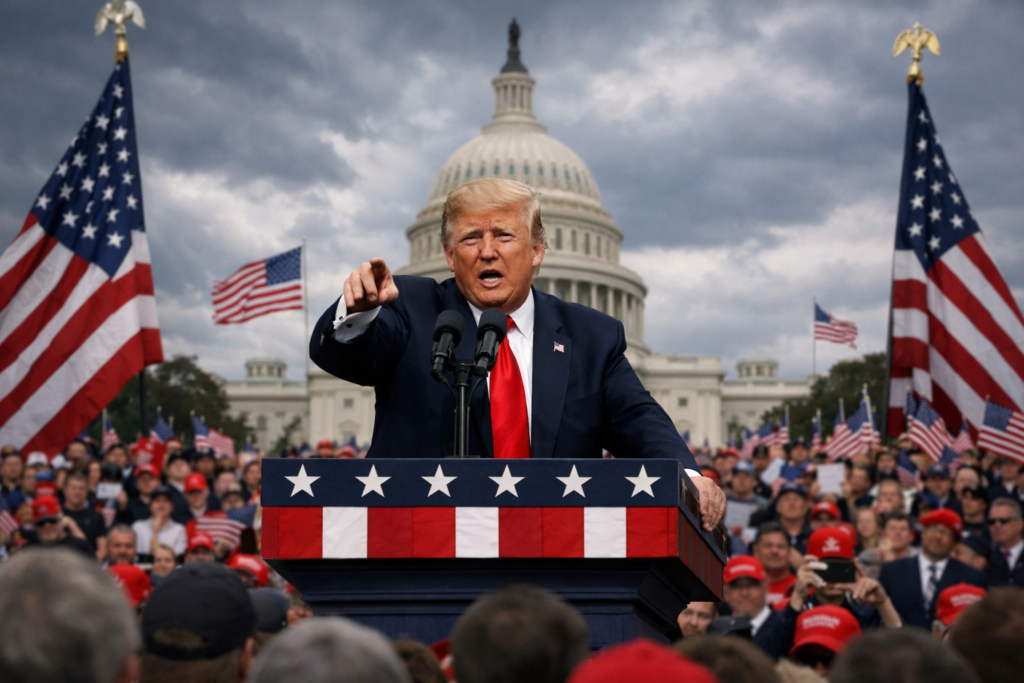
Image Credentials: Image Title: Exodus of the Elite: The “SAVE America Act”: Trump’s Hardline Push for Election Reform Source: (sora.openai) Date: March 2026. Attribution: This image was created using AI-generated imagery (sora.openai) and does not depict a real-world scene.By Open Chronicle Staff
WASHINGTON — President Donald Trump has placed the Safeguard American Voter Eligibility (SAVE) America Act at the absolute center of his legislative agenda for 2026. While the bill’s stated goal is to ensure only U.S. citizens participate in federal elections, it has evolved into a sweeping vehicle for Trump’s broader “culture war” and election integrity priorities, creating a high-stakes standoff in the Senate.
The bill, which passed the House last month, is now being heavily amended at the President’s insistence, adding provisions that critics say have more to do with social policy than ballot boxes.
What is in the Bill?
The core of the legislation focuses on proof-of-citizenship and voter identification, but the “pie-in-the-sky” version Trump is currently demanding includes several major shifts in American life:
1. Strict Proof of Citizenship
Individuals would be required to present physical documents, such as a birth certificate, U.S. passport, or naturalization certificate, in person to register to vote.
-
The Impact: The Brennan Center for Justice estimates that 21.3 million eligible voters (about 10% of the voting-age population) do not have ready access to these documents.
-
Demographic Breakdown: Research indicates this burden falls disproportionately on specific groups:
-
Low-income Americans: Approximately 15% of those earning less than $25,000 a year lack these documents.
-
Minority Voters: Black and Hispanic voters are significantly more likely to lack government-issued photo ID or birth certificates compared to white voters.
-
Young Voters: Student IDs are explicitly excluded from the list of “valid” IDs in the current draft.
-
2. The End of No-Excuse Mail-In Voting
Trump has demanded that the bill effectively end the era of mail-in voting. Under his proposal, absentee ballots would be restricted to the disabled, the ill, active-duty military, and those traveling.
-
The Context: Currently, 36 states and D.C. allow no-excuse mail voting. In the 2024 election, roughly 46% of all voters cast their ballots via mail or early in-person, a practice Trump claims is rife with fraud despite a lack of empirical evidence.
3. “Culture War” Riders
In a move that has surprised some Senate Republicans, Trump has ordered the inclusion of provisions unrelated to election logistics:
-
Transgender Sports Ban: Language that would “permanently” ban transgender women and girls from competing in female sports.
-
Minor Surgery Ban: A federal prohibition on gender-affirming surgeries for minors (which medical associations note are already exceedingly rare for that age group).
Why is this so important to Donald Trump?
For the President, the SAVE America Act is as much about political narrative as it is about policy.
-
Validation of 2020/2024 Claims: By codifying strict citizenship requirements, Trump seeks to validate his long-standing claims that non-citizen voting is a widespread threat.
-
The Reality Check: Data from the right-leaning Heritage Foundation shows only fewer than 100 confirmed cases of non-citizens voting between 2000 and 2025, an infinitesimal fraction of the hundreds of millions of ballots cast.
-
Consolidating the Base: By attaching transgender policies to an election bill, Trump is forcing a “packaged” vote that appeals to his base’s social conservatism while painting any opposition as being “against election security.”
The Senate Roadblock
Despite the President’s pressure, Senate Majority Leader John Thune has remained a “clear-eyed realist.” With a narrow Republican majority, the GOP lacks the 60 votes required to overcome a Democratic filibuster, and Thune has confirmed there are not 50 votes to “nuke” the filibuster rule entirely.
“He’s got to be a leader,” Trump said of Thune on Wednesday, signaling that he expects the Senate to use aggressive procedural maneuvers, like a “talking filibuster”, to force the bill through.
If enacted, the bill would take effect immediately, potentially causing massive disruptions to the upcoming 2026 midterm elections by requiring millions of currently registered voters to re-verify their citizenship status or face removal from the rolls.