
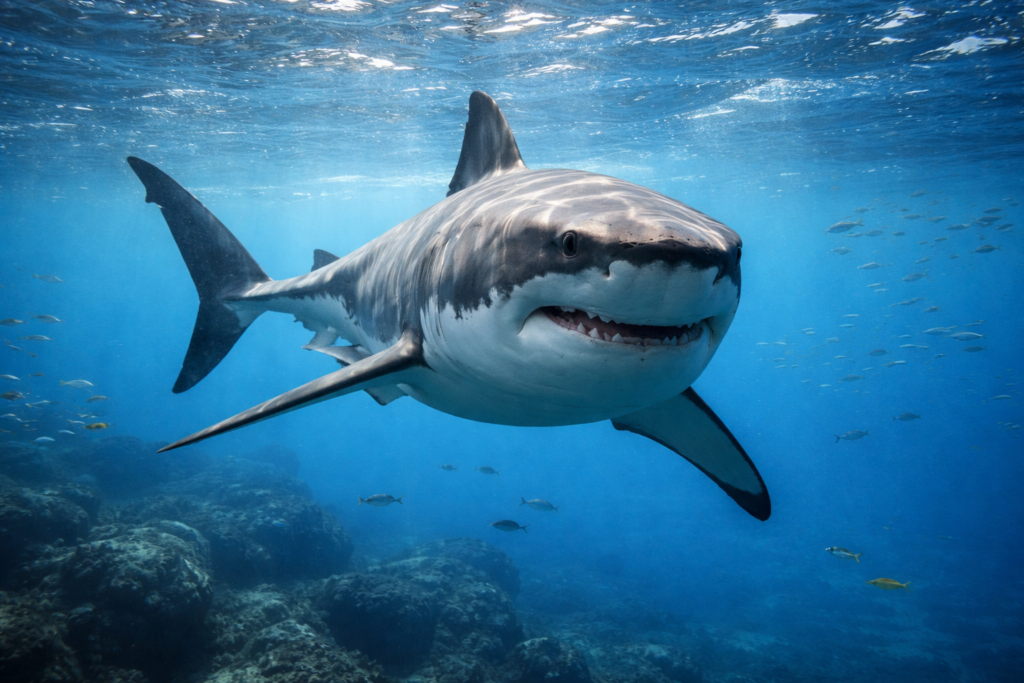
Image Credentials: Image Title: A “Ghost” Great White Shark Just Reignited a Mediterranean Mystery Source: (sora.openai) Date: March 2026. Attribution: This image was created using AI-generated imagery (sora.openai) and does not depict a real-world scene.
By Open Chronicle Science
The Mediterranean Sea has long held a secret: the presence of a “ghost” population of great white sharks. For decades, sightings have been so rare that many feared the species had vanished from these historic waters. However, a recent discovery of a juvenile great white shark has sent shockwaves through the scientific community, suggesting that these legendary apex predators are not only present but may still be actively reproducing in the region.
The Unexpected Discovery
The breakthrough came when researchers, led by Dr. José Carlos Báez, documented the capture of a young specimen. This “unexpected catch” serves as a critical biological marker. While historical records spanning the last 160 years confirm the great white’s presence in the Mediterranean, the sightings have been so sporadic that the population earned the “ghost” moniker.
“Determining the presence of juvenile individuals is of particular importance,” explains Dr. Báez. “The occurrence of juvenile specimens raises the question of whether active reproduction may be occurring in the region.”
Why Juveniles Matter
In marine biology, the presence of young animals is often a stronger indicator of a local population’s health than the sighting of a wandering adult. While an adult great white can travel thousands of miles across oceans, a juvenile is more likely to be found near a “nursery” area, a specific region where sharks are born and spend their first years of life.
Finding younger sharks suggests that somewhere in the vast Mediterranean, a breeding ground exists. Identifying these areas is vital for conservation efforts, as the great white shark is currently classified as Vulnerable on the IUCN Red List, with global numbers in a steady decline.
A Resident “Ghost” Population
For years, scientists debated whether Mediterranean great whites were mere visitors from the Atlantic or a distinct, resident group. The latest evidence leans toward the latter. Instead of being extinct in the region, the sharks appear to exist in low densities, behaving like a mysterious shadow population that evades modern tracking and fishing nets.
This discovery reignites a Mediterranean mystery that has puzzled biologists for over a century. If a breeding population still exists, it changes the conservation priority for the entire basin. Protecting these “ghosts” will require international cooperation to ensure that the Mediterranean remains a viable home for one of the ocean’s most misunderstood and majestic predators.
Story Source:
Materials provided by Pensoft Publishers. Note: Content may be edited for style and length.
Journal Reference:
- José Carlos Báez, Miguel A. Puerto, Davinia Torreblanca, José L. Varela, Leila Carmona, David Macías. New record of white shark, Carcharodon carcharias (Elasmobranchii, Lamniformes, Lamnidae), from the Mediterranean Spanish coast. Acta Ichthyologica et Piscatoria, 2026; 56: 27 DOI: 10.3897/aiep.56.173786