
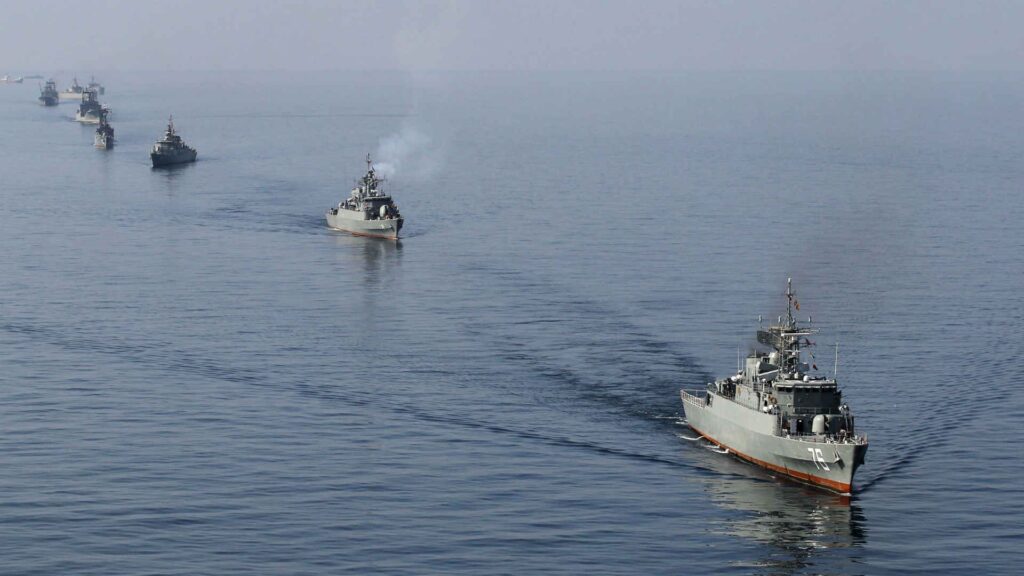
Image: from BPI News X @BPINewsOrg
By Open Chronicle Staff with Agencies | Monday, March 16, 2026
WASHINGTON — The Trump administration is reportedly finalizing plans to announce a multinational naval coalition aimed at escorting commercial vessels through the Strait of Hormuz, a critical maritime artery currently snarled by the ongoing conflict between the United States, Israel, and Iran.
According to reports from The Wall Street Journal and Anadolu Agency, the White House could unveil the initiative as early as this week. The move comes as the administration faces mounting domestic pressure to stabilize global energy markets, with oil prices surging past $100 per barrel and domestic gas prices climbing following the outbreak of hostilities two weeks ago.
The “Demand” for Collective Security
President Donald Trump has been vocal in his expectation that nations dependent on Persian Gulf oil should take the lead in securing the waterway. Speaking to reporters aboard Air Force One on Sunday, the President stated he has “demanded” that approximately seven countries join the policing effort.
“I’m demanding that these countries come in and protect their own territory, because it is their own territory,” Trump said, referring to the shipping lanes. He specifically highlighted China, noting that while the U.S. has achieved energy independence, Beijing receives a vast majority of its oil through the Strait.
The administration has reached out to a diverse group of potential partners, including the United Kingdom, France, South Korea, Japan, and China. While the U.S. has pledged to provide “a lot” of support—ranging from intelligence to logistical backing—the President’s “America First” approach emphasizes that the physical presence of warships should be a shared global responsibility.
A “Tactically Complex” Environment
The proposal arrives amid a volatile battlefield. Despite U.S. claims that much of Iran’s naval capability has been degraded, the Strait remains a “tactically complex environment,” according to General Dan Caine, Chairman of the Joint Chiefs of Staff. Iran has allegedly deployed sea mines and utilized small, fast-attack craft to “gum up” the narrow passage, which measures only 21 nautical miles at its narrowest point.
While the Trump administration remains optimistic about an imminent opening, military officials have cautioned that active escort missions while hostilities are ongoing could lead to further escalation. “We’ll get it open, safe, and free,” Trump posted on Truth Social, though he acknowledged that the mission could change depending on developments on the ground.
International Hesitation
The international community’s response has been measured. While British Prime Minister Keir Starmer has held “intensive” talks with Washington regarding the disruption to global shipping, other allies have shown reluctance. Japan and Australia have both signaled they have no immediate plans to deploy naval assets, citing constitutional constraints and the lack of a formal request, respectively.
China’s Foreign Ministry stated it is in communication with all parties but remains focused on “cooling down” the situation. The success of the coalition may hinge on a planned summit between President Trump and Chinese President Xi Jinping later this month, with Trump suggesting his visit to Beijing could be delayed if cooperation on the Strait is not forthcoming.
As hundreds of tankers sit idle in the Gulf of Oman, the world watches to see if the proposed “Hormuz Coalition” can successfully restore the flow of 20 percent of the world’s oil supply or if it will simply add more warships to an already crowded and dangerous theater of war.