
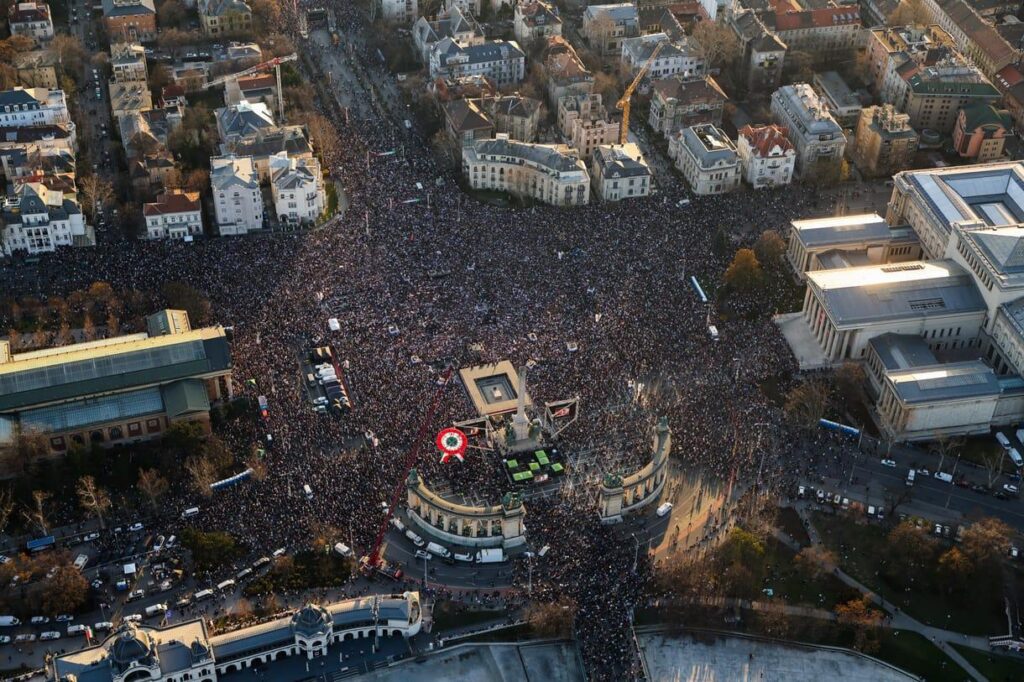
Image: from NOELREPORTS X @NOELreports
By Open Chronicle Staff with Agencies | Monday, March 16, 2026
BUDAPEST – The streets of Budapest became a battlefield of political ideologies this weekend as Prime Minister Viktor Orbán and his chief political rival, Péter Magyar, held massive concurrent rallies, signaling the start of a high-stakes showdown for the future of Hungary.
With the national elections looming, the demonstrations served as a potent display of the deep polarization currently gripping the Central European nation. The events marked one of the largest political mobilizations in Hungary’s recent history, with tens of thousands of citizens flooding the capital.
Thousands of opposition supporters fill central Budapest along Andrassy Avenue for over a kilometer behind Peter Magyar, as Orban's supporters gather at parliament. A poll gives Magyar's Tisza party a 20-point lead among decided voters, Bloomberg reported. #Europe pic.twitter.com/1BjYfGGOVE
— NOELREPORTS 🇪🇺 🇺🇦 (@NOELreports) March 15, 2026
Orbán: “Defending National Sovereignty”
Addressing a sea of supporters waving national flags, Prime Minister Viktor Orbán delivered a fiery speech focused on “national survival” and resistance against “Brussels bureaucrats.” Orbán, who has governed Hungary since 2010, framed the upcoming election as a choice between sovereignty and submission to foreign interests.
“We are the David to the globalist Goliath,” Orbán told the cheering crowd. He doubled down on his “peace mission” regarding the conflict in Ukraine, accusing the European Union and NATO of attempting to drag Hungary into a “senseless war.” His rhetoric remains centered on traditional family values, strict migration controls, and economic populism—pillars that have secured his Fidesz party a decade-plus of dominance.
The Rise of the Challenger
Just a few kilometers away, the atmosphere was markedly different at the rally held by Péter Magyar and his “Tisza” party. A former insider within the Fidesz administration, Magyar has rapidly transformed into the most significant threat to Orbán’s leadership in years.
Magyar’s message focused heavily on dismantling what he calls the “mafia state.” He promised to root out systemic corruption, restore the independence of the judiciary, and repair Hungary’s fractured relationship with the European Union.
“The fear is gone,” Magyar shouted to a crowd largely composed of younger voters and disillusioned former Fidesz supporters. “For fourteen years, they told us there was no alternative. Today, you are the alternative.”
A Nation at a Crossroads
Political analysts suggest that while Orbán maintains a strong grip on rural heartlands, the momentum in urban centers, particularly Budapest, has shifted significantly toward the opposition. The “Magyar phenomenon” has forced Fidesz to recalibrate its campaign strategy, shifting from a position of comfortable dominance to a defensive posture.
The international community is watching the proceedings with intense scrutiny. The outcome of the upcoming vote will determine whether Hungary continues its path of “illiberal democracy” and friction with the EU, or pivots back toward the European mainstream.
As the rallies dispersed into the night, the message from the streets was clear: Hungary is no longer a one-sided political landscape. The upcoming election will not just be a vote for a leader, but a referendum on the very identity of the nation.