
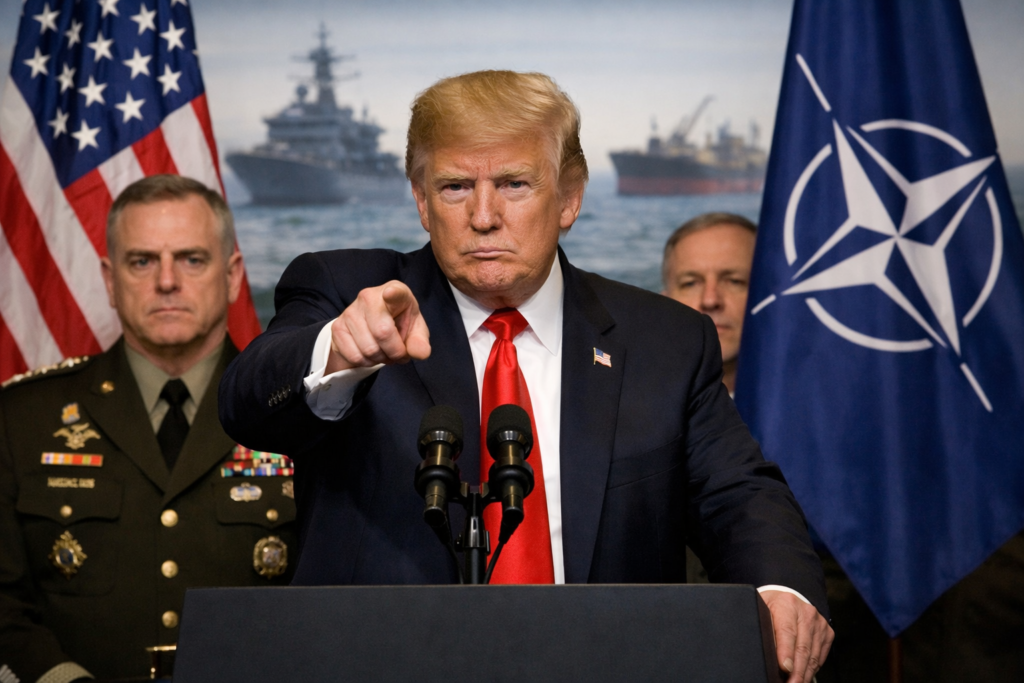
Image Credentials: Image Title: TRUMP ISSUES NATO ULTIMATUM: Support Hormuz Coalition or Face “Consequences” Source: (sora.openai) Date: March 2026. Attribution: This image was created using AI-generated imagery
By Open Chronicle Staff with Agencies | Monday, March 16, 2026
WASHINGTON — President Donald Trump has escalated his rhetoric against European allies, warning NATO member states of significant “consequences” if they fail to provide military and financial support for the burgeoning multinational naval coalition in the Strait of Hormuz.
The warning, delivered via social media and reinforced by White House officials, underscores the President’s growing frustration with what he perceives as “asymmetric burden-sharing” regarding global energy security.
The “Fair Share” of Energy Security
In a series of pointed statements, President Trump argued that European nations, which rely heavily on Middle Eastern oil and gas, are not doing enough to secure the maritime arteries currently under threat from Iranian activity.
“NATO countries want the protection, they want the oil, but they don’t want to pay the bill or send the ships,” the President stated. “I am telling them now: the United States will not carry the world on its back for free. If you want the Strait open, you need to show up. If not, there will be consequences regarding our broader commitments.”
While the President did not explicitly define these “consequences,” administration insiders suggest they could range from a reduction in U.S. troop presence in Europe to a reassessment of mutual defense funding under Article 5.
Friction Within the Alliance
The ultimatum has sent ripples through Brussels. While some NATO members, led by the United Kingdom, have already signaled a willingness to join the “Hormuz Coalition,” heavyweights like Germany and France remain cautious. European diplomats have expressed concern that joining a U.S.-led escort mission could be viewed as a direct provocation by Tehran, potentially dragging the continent into a wider Middle Eastern war.
“The security of the Strait is a global concern, but we must act through established international frameworks,” a senior EU official noted, requesting anonymity. “Ultimatums between allies rarely produce the strategic stability we are all seeking.”
A Strategy of “Transactional Diplomacy”
The move is a hallmark of the Trump administration’s “America First” foreign policy, which treats military alliances as transactional arrangements. By linking NATO’s internal cooperation to the crisis in the Persian Gulf, the White House is attempting to force a pivot in European defense spending toward global maritime security.
The timing is critical. As the U.S. Navy prepares for “Operation Sentinel II” to begin escorting tankers, the President is determined to ensure that American taxpayers and sailors are not the only ones bearing the risk.
“We have our own oil now,” Trump reminded reporters on Monday. “We’re doing this for the world. It’s time the world started doing it for themselves.”
What’s at Stake
If NATO allies balk at the demand, it could lead to the most significant rift in the alliance since its inception. Conversely, a unified front could create the largest naval blockade and escort mission in modern history. With oil prices fluctuating wildly on the news, the global economy hangs in the balance of this diplomatic high-stakes poker game.