
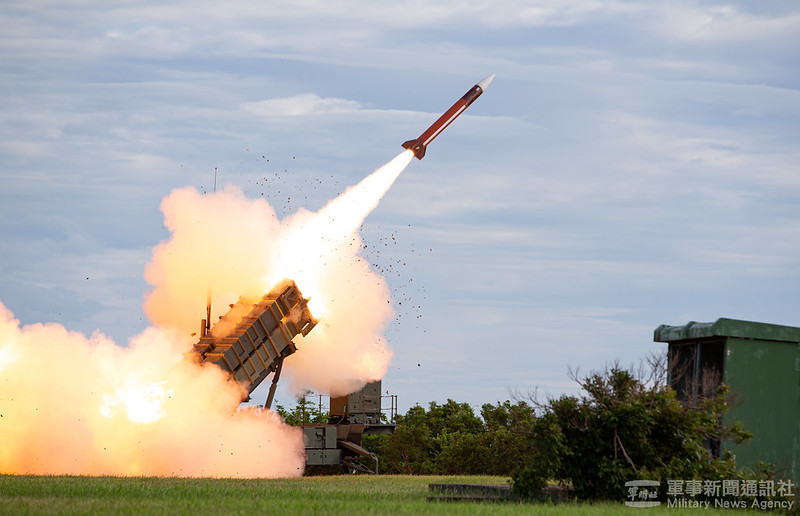
Image: from Jaime Ocon 歐海美 X @JaimeOcon1
By Open Chronicle Staff with Agencies
Monday, March 16, 2026
TAIPEI – In a major move to solidify its “asymmetric warfare” capabilities, Taiwan has announced plans to complete its multi-layered, integrated air defense network—dubbed the “T-Dome”—by next year. The initiative, revealed in a report to the Legislative Yuan today, represents a significant leap in the island’s ability to defend against saturation strikes and ballistic missile threats.
The project is the centerpiece of President Lai Ching-te’s unprecedented defense modernization effort, coming at a time when regional tensions are at an all-time high, and the Trump administration has repeatedly pressed allies for greater “burden-sharing” and self-reliance.
Building the “Strong Bow”
At the heart of the T-Dome is the domestically produced Strong Bow (Sky Bow IV) missile system. Developed by the National Chung-Shan Institute of Science and Technology (NCSIST), the Strong Bow forms the outermost layer of the network with an interception altitude of up to 70 kilometers.
Military officials confirmed that the Strong Bow utilizes advanced Active Electronically Scanned Array (AESA) radar technology. Unlike older systems, this allows for the detection of targets at greater distances and higher altitudes with lethal precision. The Ministry of National Defense (MND) noted that the system is comparable to the U.S. THAAD and Israel’s Arrow-2, making Taiwan one of the few nations in the world to field such high-level defensive technology.
Integration with U.S. Systems
While the T-Dome is a domestic triumph, it is designed for global interoperability. The network will integrate the Sky Bow III and Sky Sword II platforms through the U.S. Integrated Battle Command System (IBCS). This digital backbone will allow Taiwan’s homegrown missiles to work in seamless coordination with U.S.-made Patriot PAC-3 and NASAMS batteries.
The MND emphasized that the “T-Dome” is built for “dispersed survivability.” The systems are mobile and designed to operate effectively even in GPS-denied or heavy electromagnetic interference environments, a direct counter to the electronic warfare capabilities often displayed during People’s Liberation Army (PLA) exercises.
The Cost of Protection
The announcement comes as the Trump administration continues to push Taipei to raise its defense spending toward a target of 10 percent of GDP. While that figure remains a political and economic challenge, Taiwan has already increased its military budget to over 3 percent of GDP, backed by a massive NT$1.25 trillion (US$39.16 billion) special defense budget.
“Taiwan has met what the U.S. has demanded,” said KMT legislator Wang Hung-wei, though she noted the absence of Taiwan in recent Washington strategy documents has caused some local anxiety. “The T-Dome shows we are serious about taking primary responsibility for our own defense.”
A Regional Deterrent
As hundreds of vessels participate in PLA sorties across the median line and tensions simmer in the South China Sea, the completion of the T-Dome is viewed as a critical “no-fly zone” insurance policy. By creating a layered shield capable of denying aggression along the First Island Chain, Taipei aims to preserve a military overmatch that makes any potential invasion “impossible.”
With mass production of the Strong Bow system already underway, the 2027 completion date sets a firm deadline for what analysts call the most advanced domestic air defense network in Asia.