
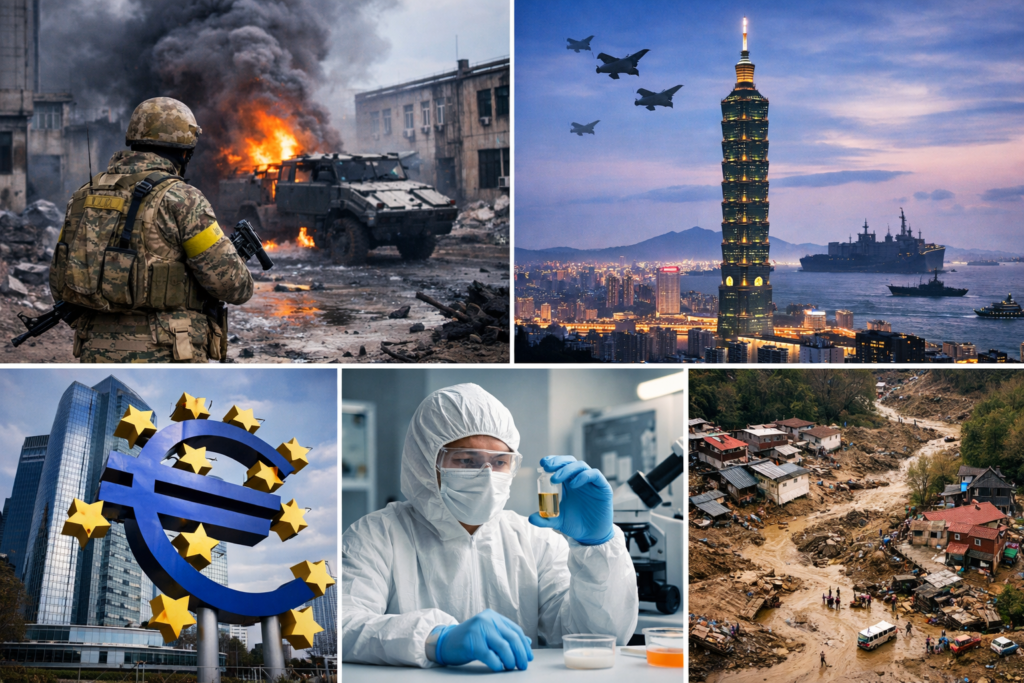
Image Credentials: Image Title: Global News Brief: Key Events and Developments for March 18, 2026 Source: (sora.openai) Date: March 2026. Attribution: This image was created using AI-generated imagery
By Open Chronicle with Agencies
A dramatic escalation across the Middle East defines the global landscape this Wednesday, as high-level assassinations, expanding military campaigns, and disruptions to critical maritime routes deepen fears of a broader regional war. From Tehran to Beirut and the strategic waters of the Gulf, the pace and scale of developments continue to intensify.
Top Stories
Iran confirms killing of Ali Larijani in Israeli strike
Iranian authorities have confirmed the death of Ali Larijani, secretary of the Supreme National Security Council, following an اسرائیלי airstrike near Tehran. In an official statement, the council said Larijani was “martyred” alongside his son, aide Reza Bayat, and several associates.
Earlier, the Israeli military announced it had carried out what it described as a “precise strike,” claiming Larijani had been “eliminated.” Israeli officials characterized him as a central figure within Iran’s power structure, referring to him as the regime’s “de facto leader.”
In a parallel development, Iran’s Islamic Revolutionary Guard Corps reported that Basij commander Gholamreza Soleimani was also killed in what it described as a joint US-Israeli strike, further signaling the depth of coordinated operations targeting Iran’s leadership.
Israeli military expands offensive in southern Lebanon
The Israeli army has launched a new wave of attacks across southern Lebanon, intensifying its campaign against positions it claims are linked to Hezbollah. The strikes follow evacuation orders issued to residents in the coastal city of Tyre and nearby areas, urging civilians to relocate north of the Zahrani River.
This escalation comes after earlier airstrikes hit central Beirut, killing six people and injuring dozens, according to Lebanon’s Health Ministry. The widening scope of Israeli operations has displaced large populations and significantly raised the humanitarian toll, with over 900 reported deaths in Lebanon since early March.
US targets Iranian missile infrastructure near Strait of Hormuz
The United States confirmed it conducted strikes on Iranian missile installations along the coastline near the Strait of Hormuz, a critical artery for global energy shipments.
According to US Central Command, the operation employed heavy “deep penetrator” munitions designed to destroy hardened facilities. Officials said the targeted anti-ship cruise missile systems posed a direct threat to international shipping in the region.
Iran has not yet issued an official response to the strikes, though tensions in the Gulf continue to mount amid increasing military activity and constrained maritime traffic.
News in Brief
Regional leaders are urging de-escalation, with Recep Tayyip Erdogan calling the war “senseless” and pressing for an immediate end to hostilities. Meanwhile, Gulf states, including Kuwait, the UAE, and Saudi Arabia, reported intercepting drones and missiles launched from Iran.
In Israel, two civilians were killed in a missile strike in Ramat Gan, underscoring the growing reach of Iranian retaliation. Diplomatic fractures are also emerging among Western allies, as Donald Trump criticized UK Prime Minister Keir Starmer for refusing to support Washington’s military campaign.
Elsewhere, Russia’s nuclear agency Rosatom condemned a strike near Iran’s Bushehr nuclear facility, warning of the risks of escalation around sensitive infrastructure. The United Nations, led by Secretary-General Antonio Guterres, reiterated calls for restraint as the conflict spreads across multiple fronts.
Business & Economy
Jet fuel prices surge amid conflict
The economic fallout is becoming increasingly visible, particularly in global aviation. According to the International Air Transport Association, jet fuel prices have surged nearly 83% over the past month, reaching approximately $175 per barrel.
The sharp increase reflects both supply concerns and heightened geopolitical risk, placing significant financial strain on airlines already navigating a volatile operating environment.
Shipping through Hormuz remains constrained
Maritime traffic through the Strait of Hormuz remains severely limited. Data from MarineTraffic shows only 15 vessels transited the strait over the past three days, including bulk carriers, tankers, and LPG ships.
The reduced flow highlights the growing disruption to one of the world’s most critical energy corridors, raising concerns over supply chains and global energy stability.
As military operations expand and diplomatic divisions deepen, the situation across the Middle East remains highly volatile. The convergence of strategic strikes, leadership losses, and economic disruption suggests a conflict entering a more dangerous and unpredictable phase.