
OPEN CHRONICLE | TECHNOLOGY | CYBERSECURITY INVESTIGATION
NOVEMBER 17, 2026 | GLOBAL CYBERSECURITY
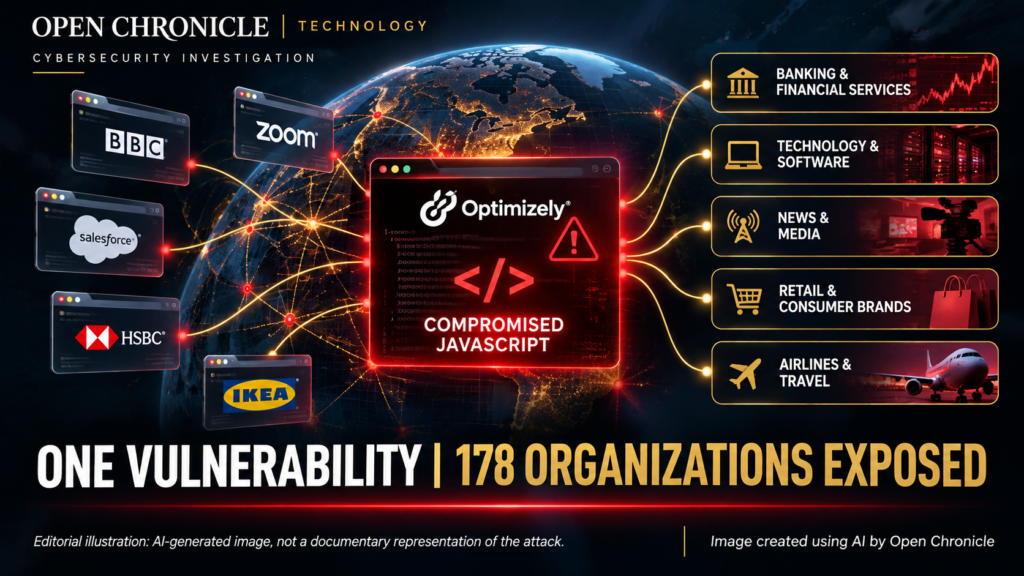
Malicious JavaScript distributed through a trusted website technology provider reached projects associated with some of the world’s biggest brands, including the BBC, CNN, Zoom, HSBC and Salesforce. The incident reveals how a single compromised software dependency can threaten millions of website visits without attackers directly breaching every company involved.
By Open Chronicle Technology Desk
November 17, 2026
A Cyberattack That Crossed Corporate Boundaries
Some of the world’s most recognisable websites became potential delivery channels for malicious software on November 16, after attackers exploited a vulnerability in Optimizely, a widely used digital experimentation platform.
The incident affected scripts associated with at least 178 organisations, including major financial institutions, technology companies, news organisations, retailers and airlines.
Among the names identified by cybersecurity researchers were the BBC, CNN, Zoom, Salesforce, GitLab, HSBC, Equifax, IKEA, Ledger and Air France-KLM.
But this was not a conventional attack in which hackers separately infiltrated 178 corporate networks.
Instead, the attackers exploited a weakness in a shared technology provider whose JavaScript was already trusted by those organisations’ websites.
Security researcher Scott Helme, founder of Report URI, identified malicious code distributed through Optimizely’s Web Experimentation platform. His investigation found 188 compromised scripts among 1,611 examined, associated with 178 organisations.
The malicious code was capable of replacing cryptocurrency wallet addresses, attempting to steal payment card information, collecting accessible browser cookies and screenshots, and directing vulnerable Apple devices towards exploit infrastructure.
Optimizely subsequently confirmed that an unauthorised party had exploited a vulnerability in its Experimentation platform and inserted malicious JavaScript into customer projects.
The company said it had corrected the vulnerability, removed the injected code and introduced additional security protections.
The discovery illustrates an increasingly important cybersecurity reality:
A company does not necessarily have to suffer a direct intrusion for its customers to encounter malicious software on its website.
The Optimizely Incident | Key Figures
The investigation identified malicious JavaScript across projects associated with major international organisations. These figures illustrate the potential scale of the incident, while important uncertainties remain concerning actual data theft and financial losses.
Associated with affected scripts
Among 1,611 examined
Central estimate, not confirmed victims
Not a measure of total losses
The 178 organisations were associated with affected scripts, not necessarily independent corporate network breaches. The estimated 34 million page visits represent potential exposure rather than confirmed victims. The approximately $7,000 in observed cryptocurrency transfers should not be interpreted as the total financial impact of the incident. All figures remain preliminary and may change as investigations continue.
November 16 to 17, 2026. Report URI investigation and subsequent reporting. Figures are preliminary and subject to revision.
1. How One Software Vulnerability Reached 178 Organisations
Optimizely provides software that allows businesses to experiment with different versions of websites, personalise digital experiences and measure how visitors interact with online content.
To deliver these capabilities, websites may load JavaScript hosted by Optimizely.
This creates an important technical relationship.
A visitor opening a legitimate website may unknowingly execute software supplied by several external providers.
Those scripts can be essential to the website’s functionality, but their execution also creates a security dependency.
In the November 16 incident, attackers were able to insert malicious code into Optimizely customer projects.
When affected websites loaded the compromised scripts, visitors’ browsers could execute the injected code.
The attack therefore exploited trust in a shared software component rather than requiring separate compromises of each customer’s infrastructure.
Optimizely’s content delivery infrastructure served the modified project content. Report URI specifically distinguished the incident from a conventional content delivery network cache poisoning attack.
The exact technical path used to obtain the necessary access has not been fully established in the public evidence reviewed.
Optimizely has acknowledged exploitation of a vulnerability, but a comprehensive public explanation of the underlying root cause remains outstanding.
The attack chain
1. Vulnerability exploited
Unauthorised access to modification capabilities in Optimizely Experimentation
2. Malicious JavaScript injected
Customer project scripts modified to load attacker-controlled code
3. Trusted websites distribute the scripts
Visitors’ browsers retrieve modified third-party content
4. Browser-level attacks attempted
Cryptocurrency manipulation, payment skimming, data collection and exploit delivery
This mechanism is known as a software supply chain attack.
Its defining characteristic is that the attacker compromises a dependency or distribution mechanism that other organisations already trust.
2. The Malware Was Designed for Multiple Forms of Theft
The injected JavaScript was not limited to a single malicious function.
According to Report URI, the attacker deployed a collection of capabilities intended to exploit different types of website visitors and online transactions.
Cryptocurrency wallet substitution
One component monitored cryptocurrency addresses and attempted to replace legitimate destination addresses with wallets controlled by the attacker.
This technique, sometimes called clipboard or address hijacking, can redirect payments without the victim necessarily realising that the destination has changed.
Report URI identified cryptocurrency transactions associated with attacker-controlled wallets.
The observed amount was approximately $7,000, although the total financial damage remains unknown.
Payment card skimming
Another component was designed to capture payment information entered into accessible website forms.
Potentially exposed information included card numbers, expiration dates and security codes.
The actual risk depended on how individual websites implemented their payment systems.
Payment fields hosted inside properly isolated third-party frames, such as certain Stripe or Adyen implementations, would not ordinarily be readable by JavaScript executing in the surrounding page.
Researchers have not established how many payment cards, if any, were successfully stolen during this incident.
Browser cookie theft
The malicious code also attempted to collect browser cookies.
Cookies can contain session identifiers that allow websites to recognise users who have already authenticated.
If an attacker obtains a reusable session token, it may be possible to impersonate a logged-in user without entering the original password.
However, this depends on the token’s accessibility and the website’s security controls.
Cookies protected with the HttpOnly attribute cannot ordinarily be read directly through JavaScript.
The presence of cookie-stealing functionality does not prove that every visitor’s account was compromised.
Screenshot collection
The malware also contained capabilities intended to capture visual information from affected browser sessions.
Depending on the content visible and the technique used, screenshots can expose personal details or sensitive information.
The extent of any successful collection has not been independently quantified.
Attacks targeting Apple devices
The investigation identified attempts to direct certain iPhones and iPads towards infrastructure associated with the Coruna and DarkSword exploit kits.
These components targeted devices running vulnerable versions of Apple’s operating systems.
This represents a different category of threat from payment skimming or cryptocurrency address substitution.
Rather than manipulating a website transaction, an exploit kit attempts to take advantage of software vulnerabilities on the device itself.
Researchers observed the attempted delivery mechanism, but publicly available evidence does not establish a confirmed number of successfully compromised iPhones or iPads.
3. The Attack Evolved During a Single Day
The Report URI investigation provides a detailed technical timeline showing how the malicious infrastructure developed on November 16.
Anatomy of the Optimizely Cyberattack
The following timeline reconstructs selected observations from November 16, 2026, documenting the emergence of malicious JavaScript, the addition of attack capabilities and the subsequent removal of compromised scripts. The timestamps represent researcher observations and do not constitute a complete forensic reconstruction.
First Observed Optimizely Injection
An affected BBC script was observed loading attacker-controlled code.
Cryptocurrency Component Appears
Researchers identified an early build of the cryptocurrency address substitution script and observed it in an affected website snippet.
Zoom Script Modified
The recorded modification time of a Zoom-associated snippet indicated further distribution.
Payment Skimmer Added
The malicious payload gained functionality intended to capture card details.
Additional iOS Delivery Infrastructure
Researchers observed changes involving exploit delivery for older iOS versions.
Broad Research Sweep
Report URI detected infected scripts during its large-scale scan of Optimizely projects.
Mass Cleanup
Previously compromised snippets began returning clean content.
Residual Infection Detected
One of the 188 affected snippets was still observed carrying the injection at this point.
The timeline reflects selected technical observations recorded by researchers on November 16, 2026. The appearance of additional malicious components does not establish that each capability was successfully used against visitors. Similarly, the cleanup observations describe changes in affected scripts rather than a complete assessment of the incident’s consequences.
Report URI also documented earlier malicious activity involving other third-party script providers.
That finding raises the possibility of a broader campaign against software dependencies, rather than an isolated operation targeting Optimizely alone.
However, the full identity of the attacker, the precise initial access mechanism and the relationship between all observed incidents remain subjects for further investigation.
4. Which Major Organisations Were Potentially Affected?
The scale of the incident becomes clearer when the affected organisations are grouped by industry.
The list compiled by Report URI spans banking, technology, retail, media, travel, healthcare, telecommunications and other sectors.
Major Organisations Identified in the Optimizely Incident
Cybersecurity researchers identified compromised Optimizely scripts associated with websites operated by major organisations across banking, technology, media, retail and aviation. The following directory highlights selected brands named in the investigation.
Banking and Financial Services
HSBC, Equifax, ABN AMRO, Paychex, TaxAct, Funding Circle, SmartAsset and several regional financial services websites.
HSBC
Equifax
ABN AMRO
Paychex
TaxAct
Funding Circle
SmartAsset
Technology and Software
Zoom, Salesforce, GitLab, Bitly, Mixpanel, Typeform, Smartsheet, Hootsuite, Tableau and other technology platforms.
Zoom
Salesforce
GitLab
Bitly
Mixpanel
Typeform
Smartsheet
Hootsuite
Tableau
News and Media
BBC, CNN, Fox News, NPR, CTV News, Fox Sports, TSN, Top Gear and other media properties.
BBC
CNN
Fox News
NPR
CTV News
Fox Sports
TSN
Top Gear
Retail and Consumer Brands
IKEA, ASOS, Mattel, American Eagle, Levi’s regional websites, American Girl and other retailers.
IKEA
ASOS
Mattel
American Eagle
Levi’s
American Girl
Airlines and Travel
Alaska Airlines, Hawaiian Airlines, Air France-KLM, Transavia and several international travel companies.
Alaska Airlines
Hawaiian Airlines
Air France-KLM
Transavia
The organisations listed above were identified in research concerning compromised Optimizely scripts. Their inclusion does not establish that their internal networks were breached, that customer databases were accessed or that individual visitors suffered confirmed data theft. Some entries refer to regional websites or individual services rather than an entire corporate group.
The researchers also identified projects associated with healthcare providers, industrial manufacturers, insurance companies, telecommunications businesses, cryptocurrency services and nonprofit organisations.
Some entries refer to regional websites, individual services or multiple properties operated by the same corporate group.
This distinction is essential.
The presence of a compromised Optimizely script does not establish that the organisation’s internal network was breached, its databases were accessed or its customers’ information was stolen.
The findings concern the distribution of malicious third-party JavaScript to websites and their visitors.
That is a serious security event, but it is not equivalent to 178 confirmed corporate data breaches.
5. What Does the Estimate of 34 Million Visits Actually Mean?
One of the most widely reported figures concerns the possible exposure of approximately 34 million page visits.
Scott Helme estimated that malicious code may have been loaded during roughly that number of visits, with a broad possible range extending from approximately 6 million to 150 million.
The uncertainty reflects the difficulty of reconstructing website traffic across many unrelated organisations.
It also highlights an important distinction between exposure and confirmed harm.
Understanding the Exposure Estimate
Researchers have estimated the potential reach of the malicious scripts distributed through Optimizely. These figures describe possible website exposure and should not be interpreted as confirmed data theft or a verified number of victims.
Central estimate of visits that may have loaded the code
Broad uncertainty range, not a confirmed count
No comprehensive victim count has been established
The estimate of approximately 34 million potentially exposed page visits does not mean that 34 million individuals were compromised. A single visitor may generate multiple page views, and loading malicious code does not necessarily result in successful information theft. The actual number of affected individuals remains unknown.
A single visitor may generate multiple page views. A script may load without collecting information. Some browsers may block malicious connections, while certain payment systems and session protections may prevent particular forms of theft.
The number of exposed visits therefore cannot be treated as the number of people whose information was stolen.
Similarly, cryptocurrency transfers observed in attacker-controlled wallets provide evidence of financial activity associated with the operation, but do not capture all potential losses.
Payment card fraud, account misuse and device compromise may only become visible after further investigation.
6. Salesforce, Equifax and Optimizely Respond
Several organisations moved to investigate or contain the incident.
Optimizely: Vulnerability fixed
In a security update published on November 17, Optimizely confirmed that an unauthorised party exploited a vulnerability in Experimentation.
The company said it had removed malicious JavaScript from affected projects and implemented measures to secure affected accounts and prevent further unauthorised delivery.
Its public incident status remained under monitoring in the information reviewed.
Salesforce: Third-party scripts disabled
Salesforce issued a security advisory concerning unauthorised modifications to Optimizely scripts used on certain Salesforce websites.
The company said it was confirming that the scripts had been disabled across relevant preview and production instances.
Salesforce also stated that it would notify affected customers if its investigation identified unauthorised access to their data.
The advisory did not establish a confirmed breach of Salesforce customer databases.
Equifax: No evidence of internal compromise reported
Equifax said it investigated the reports and discontinued its use of Optimizely.
The company stated that it had not identified evidence of a compromise to its systems or an impact on its data.
That statement is important because Equifax handles highly sensitive financial information, but it should be understood as the company’s reported finding at that stage of its investigation.
IKEA: Potential impact under investigation
IKEA acknowledged the reports and said it was investigating the potential implications for its digital services and customers.
As investigations continue, organisations may issue additional disclosures concerning affected websites, exposure periods and remedial measures.
7. Why Traditional Website Security May Not Be Enough
Many organisations invest heavily in protecting their own servers, databases, applications and corporate networks.
Yet a modern website often depends on code written and distributed by external companies.
Analytics services, advertising networks, customer experience tools, payment integrations and experimentation platforms can all introduce third-party JavaScript into the browser.
The difficulty is that JavaScript loaded into a page may interact with information and functionality available in that page’s execution environment.
A company may maintain strong internal security controls while still allowing external code to perform sensitive operations in visitors’ browsers.
The Optimizely incident illustrates why security teams must consider the entire client-side execution environment, not merely the infrastructure they own.
The role of Content Security Policy
One important defensive mechanism is Content Security Policy, or CSP.
A carefully configured policy can restrict where scripts are loaded from and where browser content may send information.
However, a policy that trusts a compromised script source without additional restrictions may still permit malicious activity.
The effectiveness of CSP therefore depends on the details of its configuration, including restrictions on external connections, script execution and sensitive resources.
Independent analysis of the Optimizely incident highlighted differences between websites with restrictive policies and those with weaker configurations.
The limits of supplier trust
Traditional supplier security assessments may examine certifications, policies and contractual commitments.
These measures remain useful, but they cannot guarantee that a vendor will never suffer a compromise.
Organisations also need technical controls capable of detecting unexpected changes after a supplier has been approved.
The relevant question is no longer simply whether a supplier can be trusted.
It is whether a company can detect and contain the consequences when that trust is compromised.
8. What Organisations Should Do Next
The incident provides a practical set of lessons for businesses operating websites that depend on third-party software.
Seven Priorities for Securing Third-Party Software
The Optimizely incident highlights the importance of monitoring and controlling third-party software dependencies. These seven priorities provide a practical framework for reducing exposure, strengthening browser security and improving organisational resilience against software supply chain attacks.
Inventory Third-Party JavaScript
Identify every external script, its owner, purpose, permissions and the pages on which it executes.
Monitor Script Integrity and Behaviour
Detect unexpected modifications, suspicious network connections and changes in data collection patterns.
Strengthen Browser Security Policies
Use restrictive Content Security Policy rules, minimise external connections and isolate sensitive functionality.
Protect Payment and Authentication Flows
Use appropriately isolated payment components, secure session cookies and additional controls for high-risk transactions.
Prepare Rapid Containment Procedures
Maintain the ability to disable compromised integrations without taking entire websites offline.
Require Timely Supplier Incident Reporting
Establish contractual notification requirements and coordinate technical investigations with affected providers.
Preserve Forensic Evidence
Retain relevant browser telemetry, application logs, script versions and incident timelines for investigation.
These controls cannot eliminate every software supply chain attack. They can, however, reduce the likelihood that a compromised third-party component gains unrestricted access to sensitive information or remains undetected for an extended period. Effective security depends on continuous visibility, controlled execution and the ability to respond rapidly when a trusted supplier is compromised.
These controls cannot eliminate all software supply chain attacks.
They can, however, reduce the likelihood that one compromised component gains unrestricted access to sensitive information or remains undetected for an extended period.
9. What Should Website Visitors Do?
For consumers, the incident presents an uncomfortable reality.
People can encounter malicious code while visiting legitimate websites they have used for years.
There may be no suspicious email, fraudulent link or obvious warning.
The practical response should nevertheless remain proportionate to the available evidence.
Users who visited potentially affected websites during the exposure period should consider the following precautions.
1. Update browsers and operating systems. This is especially important for iPhones and iPads running older software versions.
2. Review financial transactions. Check bank and card statements for unfamiliar charges, particularly if payment information was entered on an affected website.
3. Verify cryptocurrency transfers. Confirm that any recent payments reached the intended wallet addresses.
4. Review account security. Investigate unfamiliar login notifications, unexpected account changes or suspicious session activity.
5. End potentially exposed sessions. Use account security settings to sign out of active sessions where appropriate. Change passwords if there are indications of account compromise or the service recommends doing so.
6. Follow official notifications. Organisations may issue specific instructions as investigations establish whether particular customers were affected.
Multi-factor authentication remains valuable, but it does not necessarily prevent the misuse of a session token that has already been stolen.
Users should also avoid assuming that every website visit resulted in data theft.
There is currently no evidence supporting such a conclusion.
10. Was Artificial Intelligence Involved?
The attack arrives during a period of increasing concern about AI-assisted cyber operations.
However, the available investigation does not establish that artificial intelligence was used to conduct this campaign.
Scott Helme reported no evidence of AI involvement.
Other cybersecurity specialists have discussed how automated and AI-assisted attacks could increase the speed or complexity of future software supply chain incidents.
That broader concern should not be confused with evidence about the specific Optimizely compromise.
The documented mechanisms in this case involve malicious JavaScript, compromised software distribution, cryptocurrency manipulation, browser data collection and exploit delivery.
Attributing the incident to artificial intelligence without supporting technical evidence would be speculative.
11. Open Chronicle Analysis | The Hidden Architecture of Digital Trust
The most significant lesson of the Optimizely incident may not be the number of websites affected.
It is the concentration of digital trust.
A relatively small number of technology providers supply software components to enormous numbers of businesses.
Those components make websites easier to operate, personalise and optimise.
They also create dependencies that are often invisible to ordinary users.
A visitor opening a banking website may believe that every script running in the browser is controlled by the bank.
A reader opening a major news website may assume that all software executing on the page originates from the publisher.
In practice, both websites may depend on external technology companies whose code executes within the same browser environment.
That architecture creates an important asymmetry.
The organisation chooses the supplier, but the visitor may bear some of the consequences when the supplier is compromised.
For financial services, the implications include payment integrity and account security.
For media organisations, the implications include reader trust and the possibility of malicious code reaching enormous audiences.
For technology companies, the incident raises questions about the governance of third-party software across complex digital properties.
And for regulators, it reinforces the challenge of assigning responsibility when an incident crosses organisational and national boundaries.
The Optimizely compromise demonstrates that cybersecurity can no longer be evaluated solely through the security of individual companies.
The security of a digital service increasingly depends on the security of every component that service allows to operate.
12. Five Questions That Could Shape the Investigation
What Investigators Still Need to Establish
Although the Optimizely vulnerability has been addressed, several important questions remain unanswered. Establishing the full scope of the incident will require further forensic investigation, technical disclosures and cooperation between affected organisations and cybersecurity researchers.
How Did the Attackers Obtain the Ability to Modify Multiple Customer Projects?
A detailed root-cause explanation will be essential for understanding whether the failure involved access controls, account creation or another vulnerability.
How Many Visitors Experienced Successful Data Theft?
Page-visit estimates cannot establish the number of stolen cards, sessions or other sensitive records.
Were Any Apple Devices Successfully Compromised?
The observed delivery of exploit infrastructure does not establish successful exploitation of real devices.
How Extensive Was the Wider Campaign?
Researchers identified related malicious activity involving other third-party script providers before the Optimizely incident.
Will the Incident Change Browser-Side Security Practices?
The response may influence how organisations monitor, isolate and govern code supplied by external vendors.
The investigation’s next phase will be critical in determining how the attackers gained access, how many visitors suffered confirmed harm and whether the operation extended beyond Optimizely. The incident also presents an opportunity to reassess how organisations manage the security risks introduced by trusted third-party JavaScript.
Conclusion | A Global Warning From a Single Vulnerability
The Optimizely incident demonstrates how a vulnerability in one software provider can create potential security risks across otherwise unrelated organisations.
The malicious JavaScript reached projects associated with major brands in banking, technology, media, retail and travel.
Researchers identified capabilities intended to steal information, manipulate cryptocurrency transactions and target vulnerable mobile devices.
Optimizely has confirmed the incident and announced corrective measures.
But the full consequences remain uncertain.
The number of affected visitors, the extent of any successful information theft and the total financial damage have not been established.
Those uncertainties should not diminish the importance of what has already been documented.
A single compromised software dependency was sufficient to distribute malicious code through websites that millions of people regard as trustworthy.
The central lesson is that digital trust cannot end at the boundary of a company’s own infrastructure. It must extend to the software suppliers, browser components and external services on which that infrastructure depends.
For the modern web, that is no longer a secondary security concern.
It is one of the defining challenges of cybersecurity.
Sources and Further Reading
Research and official disclosures reviewed November 17, 2026.
Report URI | World’s Largest Brands Infected With Malware Via Optimizely
Scott Helme, November 16, 2026. Primary technical investigation documenting the malicious scripts, affected organisations, attack infrastructure, timeline and observed cryptocurrency activity.
Optimizely | Web Experimentation Security Incident
November 17, 2026. Official acknowledgement of the vulnerability, malicious JavaScript injection and announced remediation measures.
Salesforce | Security Advisory: Third-Party Script Incident Affecting Certain Salesforce-Branded Sites
November 17, 2026. Official security notice describing the investigation and precautionary disabling of Optimizely scripts.
The Hacker News | Hijacked Optimizely Scripts Served Card Skimmer and iOS Exploit Kits
November 17, 2026. Independent technical reporting on the attack mechanisms, affected websites and limitations of confirmed impact.
Help Net Security | Malware Spread Through Optimizely Hits 178 Organizations
November 17, 2026. Reporting on the vulnerability, Optimizely’s response and the scope of affected customer scripts.
Optimizely World | Lessons From the Optimizely Web Experimentation Compromise
Mark Stott, November 17, 2026. Technical discussion of Content Security Policy and lessons for website security architecture.
This article is based primarily on the technical investigation published by Scott Helme and Report URI on November 16, 2026, supplemented by official security disclosures from Optimizely and Salesforce and independent cybersecurity reporting published on November 17.
Open Chronicle distinguishes the confirmed exploitation of Optimizely’s Experimentation platform from researcher estimates of website exposure and the still-unverified extent of individual data theft.
The reported figure of 178 organisations refers to websites and services associated with compromised scripts. It does not establish that 178 corporate networks were independently breached.
The estimate of approximately 34 million exposed page visits is not a count of confirmed victims. The number of stolen payment cards, compromised browser sessions and successfully exploited mobile devices remains unknown.
The discussion of software supply chain security, organisational responsibilities and future cybersecurity priorities represents independent editorial analysis.