
Image Credentials: Image Title: THE SILICON FRONTLINE: HOW AI IS REWRITING THE RULES OF THE ISRAEL-IRAN-US CONFLICT Source: (sora.openai) Date: March 2026. Attribution: This image was created using AI-generated imagery
BULGARIA LEADS AS “MOST FERTILE” WHILE MALTA AND SPAIN FACE DEMOGRAPHIC “ROCK BOTTOM”
By OPEN CHRONICLE STAFF with Agencies
BRUSSELS — The European Union’s demographic winter deepened this week as new data from Eurostat revealed that fertility rates across the bloc have plummeted to their lowest level since records began in 2001. According to the report released in mid-March 2026, the total fertility rate in the EU now stands at just 1.34 live births per woman, down from 1.38 in 2023, and far below the “replacement level” of 2.1 required to keep a population stable without immigration.
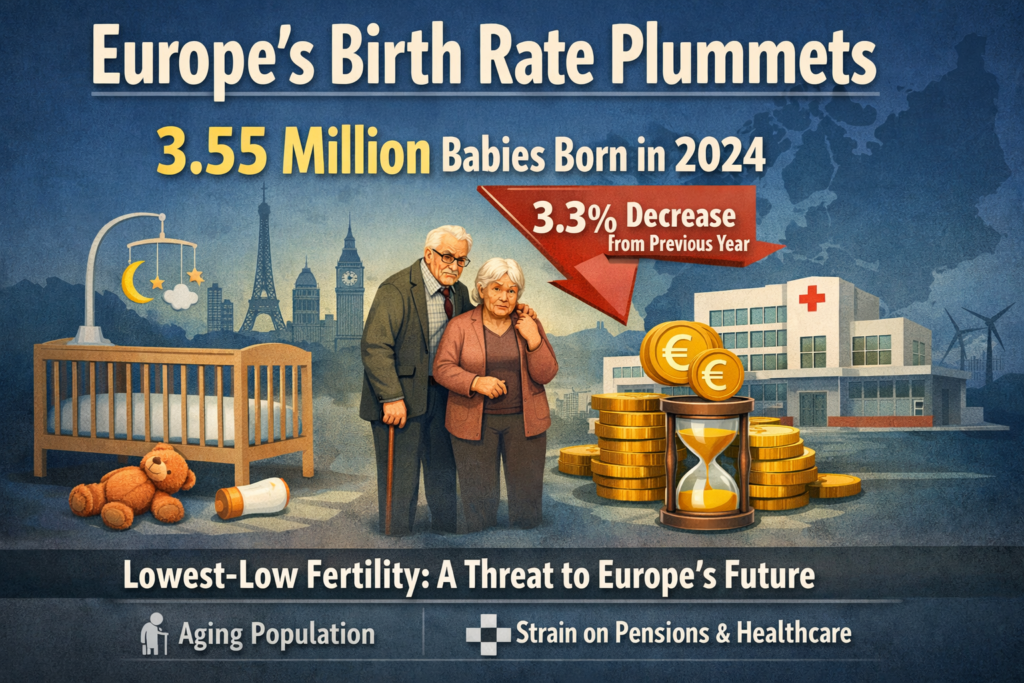
The figures paint a stark picture of a continent in transition, as 3.55 million babies were born in 2024, a 3.3% decrease from the previous year. Analysts warn that the trend toward “lowest-low fertility” is no longer a peripheral concern but a structural reality threatening the long-term sustainability of European pension and healthcare systems.
The Regional Divide: Highest vs. Lowest
While every member state remains below the replacement threshold, the gap between the continent’s most and least fertile nations has widened.
The Highest Rates:
-
Bulgaria (1.72): Surprisingly, Bulgaria recorded the highest fertility rate in the EU. Experts suggest a combination of government child allowances and a cultural emphasis on family has helped the nation rebound from its lows a decade ago.
-
France (1.61): Long considered Europe’s demographic engine, France maintained its position in the top three, though its current rate is its lowest since the end of the First World War.
-
Slovenia (1.52): Slovenia notably stood as the only EU country to record an increase in its fertility rate compared to the previous reporting year.
The Lowest Rates:
-
Malta (1.01): Registering what demographers call “bottom-of-the-barrel” fertility, Malta remains the least fertile nation in the bloc.
-
Spain (1.10) & Lithuania (1.11): Both nations continue to struggle with high youth unemployment and housing costs that delay family formation.
-
Italy (1.18): Italy recorded a new record low, with only six babies born for every 1,000 inhabitants, while death rates continue to climb.
The “Over 30” Shift
The Eurostat data highlighted a significant shift in when European women are choosing to have children. For the first year on record, the 30–35 age group has surpassed the under-30s as having the highest fertility rate.
The average age of a woman at the birth of her first child has risen to 29.9 years across the EU. Italy leads this trend with the oldest first-time mothers (average age 31.9), while Bulgaria has the youngest (average age 26.9).
Economic and Social Headwinds
The “Euronews” analysis accompanying the data points to a “perfect storm” of economic factors: the rising cost of living, a chronic shortage of affordable housing in major cities, and the increasing length of time young people spend in higher education.
“We are moving from a world of ‘just-in-time’ manufacturing to ‘just-in-case’ parenting,” noted one sociologist. “Young people feel they must be 100% financially secure before even considering a first child, a threshold that is becoming harder to reach.”
The Immigration Factor
The report also noted that 24% of newborns in the EU now have a “foreign mother”, born in either another EU or non-EU country. In Luxembourg, this figure reaches a staggering 68%. Demographers agree that without this influx, the EU’s overall population decline would be significantly more precipitous.
As the EU’s median age continues to rise, increasing by 2.1 years since 2015, the pressure on the “Silver Economy” is mounting. With the proportion of children under 15 falling to 14.6%, the European Commission is facing renewed calls to harmonize family-friendly policies, including universal childcare and shared parental leave, to prevent a total demographic collapse by mid-century.