
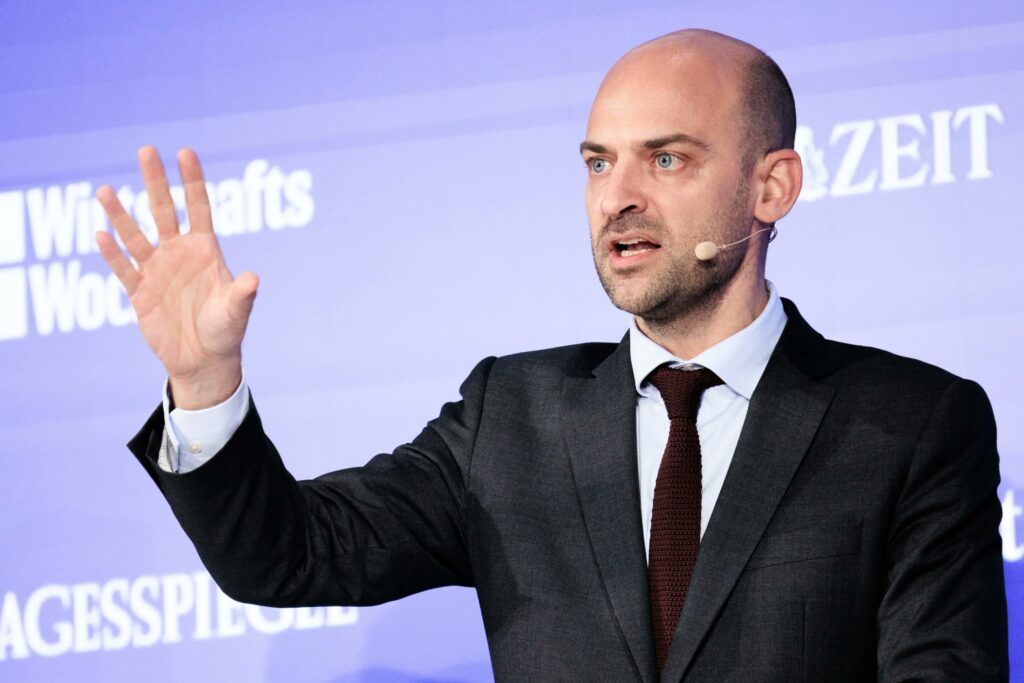
Image: from Souveraine Tech X @SouveraineTech
By Open Chronicle Staff with Agencies | March 19, 2026
BERLIN — In a move that blurred the lines between diplomatic trial balloon and lighthearted banter, French Foreign Minister Jean-Noël Barrot suggested on Tuesday that the European Union’s next expansion might cross the Atlantic.
Speaking at the Europe 2026 conference in Berlin alongside his German counterpart, Barrot characterized the EU as an increasingly attractive “third superpower” capable of balancing the global scales between the United States and China. Amidst rising geopolitical tensions and shifting alliances, Barrot noted that the bloc is drawing interest from partners far beyond its traditional borders.
“The European Union is attracting more candidate countries,” Barrot said, citing Iceland as a likely addition in the coming months. Then, with a smile that sparked both laughter from the moderator and applause from the audience, he added: “And maybe Canada at some point.”
The remarks come at a time of unprecedented flux in Transatlantic relations. While Canada remains a bedrock of NATO and the G7, the political climate in Washington has prompted some to look elsewhere for stability. Reports from earlier this year indicated that U.S. President Donald Trump has occasionally referred to Canada as a potential “51st state,” a rhetoric that has sent ripples of unease through Ottawa.
Despite the warm reception in Berlin, the prospect of a “European Canada” faces a steep uphill climb at home. Prime Minister Mark Carney has consistently thrown cold water on the idea. Last June, and again at a NATO summit earlier this year, Carney dismissed the notion of formal membership, stating that while he seeks “clearer and broader ties” with the continent, becoming a member state is “not the path we are taking.”
Current Canadian policy focuses instead on deep integration without the loss of sovereignty. In February 2026, Canada became the first non-European nation to join the EU’s Security Action for Europe (SAFE) defense procurement program, a $162-billion initiative.
Skeptics in Canada argue that adding a layer of Brussels-based regulation to the existing federal and provincial framework would be a “bureaucratic nightmare.” However, public sentiment appears to be shifting; a 2025 poll suggested that 44% of Canadians would support joining the bloc as a way to insulate the country from U.S. trade volatility.
While Barrot’s comments may have been semi-joking, they underscore a serious reality: in a world of “superpowers,” the EU is actively seeking to expand its orbit, and Canada is increasingly viewed as a natural, if distant, kin.