
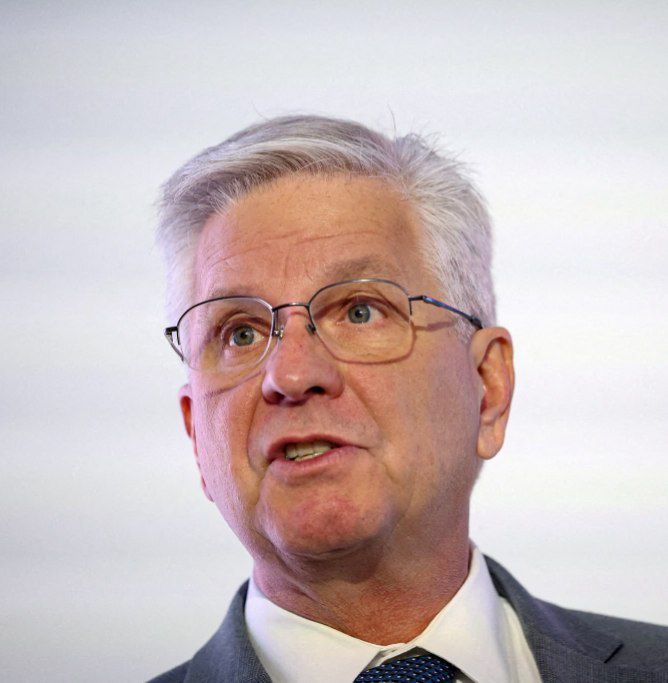
Image: from Litest X @Litest
By Open Chronicle with Agencies
WASHINGTON, D.C. – Federal Reserve Governor Christopher Waller expressed deep concern today regarding the economic fallout of the ongoing Middle East conflict, warning that a prolonged blockade of the Strait of Hormuz could reignite inflationary pressures across the United States.
Speaking in an interview with CNBC, Waller—traditionally viewed as a “dove” for his focus on supporting the labor market—signaled a significant shift in his monetary outlook. He revealed that the escalating geopolitical crisis has forced him to reconsider his recent advocacy for interest rate cuts.
The “Hormuz Factor”
The Strait of Hormuz, a vital artery for global energy through which approximately 20% of the world’s oil flows, has remained effectively closed to commercial traffic since the outbreak of hostilities on February 28. This disruption has sent Brent crude prices surging toward $100 per barrel, with domestic gasoline prices following suit.
“Two weeks ago… I was considering voting in favor of a cut in Federal Reserve interest rates,” Waller explained. “But the Strait of Hormuz has remained closed, it appears the conflict will be protracted, and oil prices are going to stay high for longer. This suggests that inflation is a bigger concern than I previously thought.”
A “Wait and See” Approach
Waller’s comments come just days after the Federal Open Market Committee (FOMC) opted to hold interest rates steady. While he had previously hinted at a dissent in favor of a quarter-point cut due to a softening labor market, marked by a loss of 92,000 jobs in February, the “oil shock” has anchored him to the current consensus.
-
Inflation vs. Jobs: Waller noted that while the labor market is weakening, the “bleed-through” effect of high energy costs into core inflation cannot be ignored.
-
The Policy Path: He indicated that the Fed must remain cautious, stating, “I just want to wait and see where this goes.”
-
No Rate Hikes: Despite his inflation concerns, Waller clarified that he is not currently advocating for further rate hikes, but rather a pause in the planned easing cycle.
Market Reaction
Waller’s shift from an immediate “dissenter” to a cautious observer has sent ripples through the financial markets. The 10-year Treasury yield rose following his remarks, as investors recalibrated expectations for when the Fed might finally begin its long-awaited pivot toward lower borrowing costs.
Analysts at Goldman Sachs noted that Waller’s pivot is a “bellwether” for the rest of the board. If a noted dove is sounding the alarm on inflation, the prospect of any rate relief before the second half of 2026 appears increasingly dim.
As the 2026 Iran War enters a more “protracted” phase, the Federal Reserve finds itself caught in a classic stagflationary trap: a cooling economy paired with rising costs, a scenario Waller admits is “more concerning” than anything the board anticipated at the start of the year.