
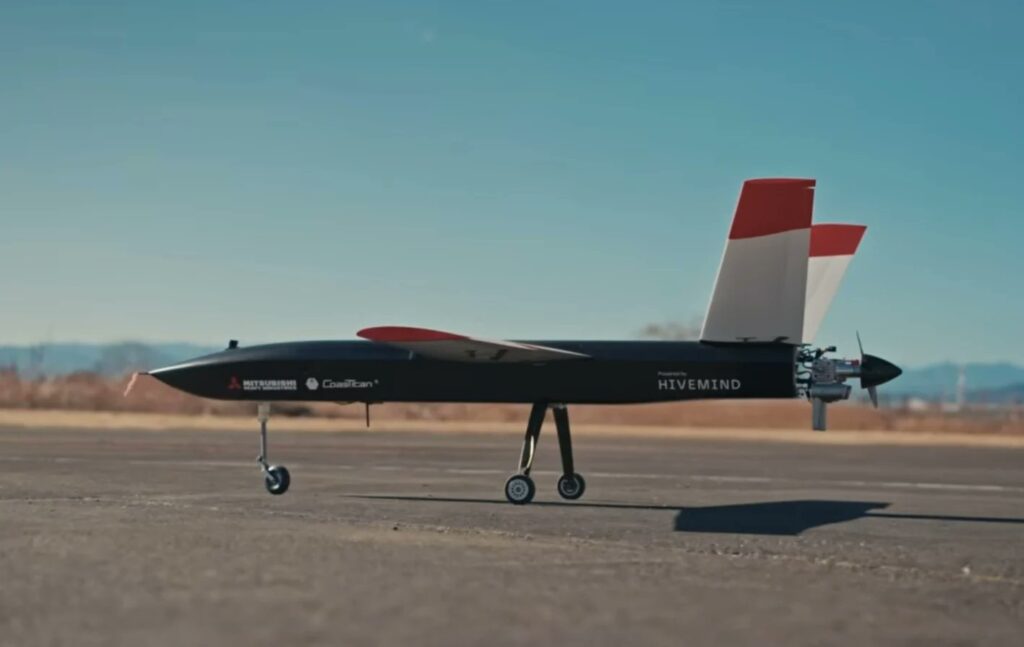
Image: from Valhalla X @ELMObrokenWings
By Open Chronicle with Agencies
NAGOYA, JAPAN – In a significant move to accelerate the integration of artificial intelligence into East Asian airspace, Mitsubishi Heavy Industries (MHI) and the U.S.-based defense tech firm Shield AI have officially partnered to test advanced autonomy for unmanned aerial vehicles (UAVs). The collaboration aims to bring “pilot-like” decision-making capabilities to Japan’s domestic drone programs, a key pillar of the nation’s rapid military modernization.
The “Hivemind” Integration
At the heart of the partnership is Shield AI’s proprietary “Hivemind” software, an AI pilot capable of flying drones in GPS-denied and communications-contested environments. Unlike traditional drones that rely on a constant data link to a human operator, Hivemind-equipped UAVs can maneuver, identify threats, and execute mission objectives autonomously.
MHI, Japan’s premier defense contractor, will leverage this technology to enhance the survivability and offensive potential of its future unmanned platforms, which are expected to serve as “loyal wingmen” to manned fighter jets.
Strengthening the US-Japan Tech Alliance
The agreement follows a broader trend of deepening technological cooperation between Washington and Tokyo. As regional security dynamics shift, Japan has moved to bolster its “Standoff Defense” capabilities, identifying autonomous systems as a force multiplier that can compensate for a shrinking demographic and an increasingly complex aerial landscape.
“Partnering with Shield AI allows us to leapfrog traditional development cycles,” an MHI engineering lead noted. “Autonomous flight is no longer a luxury; it is the baseline for the next generation of air superiority.”
Collaborative Combat Aircraft (CCA)
The testing phase is expected to focus on how multiple UAVs can operate as a coordinated swarm. By utilizing AI to manage flight patterns and sensor fusion, the systems can overwhelm adversary defenses without risking human pilots.
-
The Goal: Seamless coordination between MHI-built hardware and Shield AI software.
-
The Challenge: Ensuring AI reliability in “high-clutter” environments and maintaining ethical guardrails for autonomous systems.
-
The Timeline: Initial flight tests are slated to begin at MHI’s specialized testing facilities, with data being shared to refine the algorithms for Japan’s specific geographic needs.
A New Era of Deterrence
For Shield AI, the partnership marks a major expansion into the Indo-Pacific market. For Japan, it represents a departure from traditional, slow-moving procurement towards agile, software-first defense development.
As the flight tests commence, the results will likely influence the design of the Global Combat Air Programme (GCAP), the ambitious sixth-generation fighter project involving Japan, the UK, and Italy. By mastering autonomy now, MHI and Shield AI are setting the stage for a future where the cockpit may increasingly become optional.