
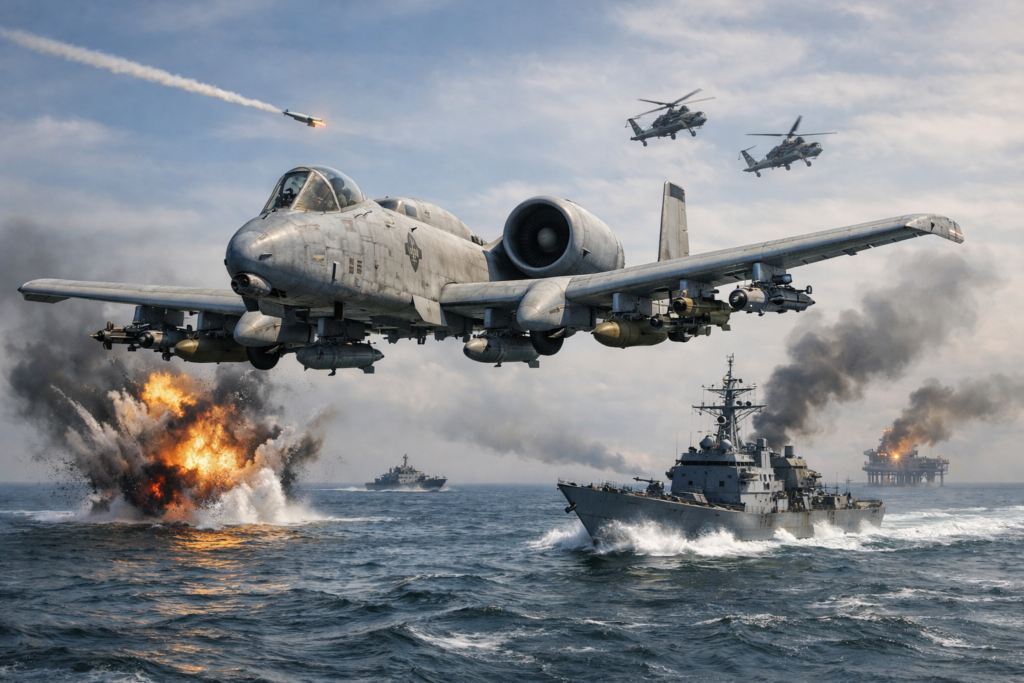
Image Credentials: Image Title: The “Warthog” in the Gulf: A Technical Analysis of A-10 Operations and Maritime Attrition Source: (sora.openai) Date: March 2026. Attribution: This image was created using AI-generated imagery
By the Open Chronicle Technical Analysis Desk
SUMMARY: The current conflict in the Middle East, designated “Operation Epic Fury,” has transformed the Persian Gulf into a laboratory for modern asymmetric warfare. This report analyzes the technical efficacy of legacy platforms, specifically the A-10 Thunderbolt II, against Iranian swarming tactics and the strategic implications of strikes on critical energy infrastructure like the South Pars field.
1. The “Warthog” Resurgence: From Tank Killer to Maritime Predator
The U.S. Air Force (USAF) had previously signaled the total retirement of the A-10 Thunderbolt II by 2026. However, the requirement for persistent littoral overwatch in the Strait of Hormuz has proven that the platform’s unique flight envelope is ideal for high-threat maritime environments.
Tactical Efficacy Against Fast Attack Craft (FAC)
The Iranian Revolutionary Guard Corps (IRGC) utilizes small, agile, and often unmanned fast boats for swarming and mine-laying. The A-10 has demonstrated superiority over 5th-generation stealth fighters (like the F-35) in this specific theater due to three technical factors:
-
Persistent Loiter Time: Equipped with 600-gallon external fuel tanks, the A-10 can remain on-station for hours, providing a continuous “umbrella” for commercial tankers that faster jets cannot match without constant refueling.
-
Low-Cost Precision Munitions: The integration of the APKWS II (Advanced Precision Kill Weapon System) allows the A-10 to turn standard 70mm rockets into laser-guided missiles. This enables the destruction of small boats at a fraction of the cost of a Hellfire or Maverick missile.
-
Anti-Drone Interdiction: Utilizing its 30mm GAU-8/A Avenger cannon and Sidewinder missiles, the A-10 has been effectively used to down Shahed-class loitering munitions before they reach naval targets.
2. Infrastructure Warfare: The South Pars-Ras Laffan Axis
The Israeli strike on South Pars—the world’s largest natural gas field, shared by Iran and Qatar—marks a shift from tactical military engagement to strategic infrastructure attrition.
Supply Chain Vulnerabilities
Iran’s retaliation against Qatar’s Ras Laffan industrial complex has highlighted the extreme fragility of the Global LNG (Liquefied Natural Gas) market.
-
Capacity Impact: Early estimates suggest that 17% of Qatar’s export capacity has been compromised by the strikes.
-
Hormuz Risk Premium: With 20% of global oil transit passing through the Strait, Iran’s ability to deploy “smart mines” or coastal missile batteries has created an economic “chokehold,” causing UK and European gas benchmarks to surge by over 11% in 24 hours.
3. Coalition Strains: Unilateralism vs. Integrated Strategy
While Prime Minister Netanyahu claims Israel “acted alone” regarding South Pars, the technical coordination required to bypass Iranian S-300 and S-400 air defense layers suggests deep integration with U.S. Electronic Warfare (EW) assets.
“We can create the conditions, but they [the Iranian people] have to exploit those conditions… If the regime survives, it will be shorn of industries it built over decades.” — Benjamin Netanyahu
However, this “Maximum Pressure” strategy faces a technical-political hurdle: the MAGA movement’s isolationist wing. Critics argue that the high cost of cruise missile expenditures and the resulting energy inflation at home undermine the “America First” doctrine.
Technical Conclusion
The war in the Gulf reaffirms that low-cost, high-persistence platforms must augment high-end stealth technology. The “Warthog” has demonstrated that legacy systems, when updated with modern precision kits such as APKWS, remain essential for littoral defense. Conversely, the shared nature of the South Pars field ensures that any military “victory” carries a high risk of self-inflicted global economic damage.