
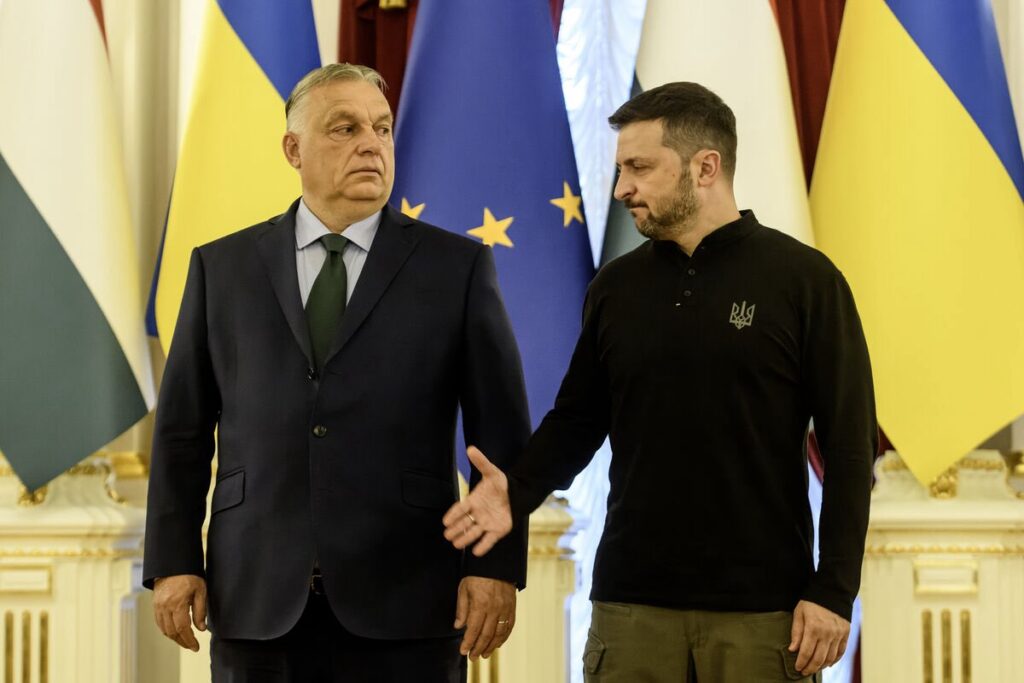
Image: from The Other Side Media X @TheOtherSideRu
By Open Chronicle with Agencies
BRUSSELS – The veneer of European solidarity faced a grueling test this week as Hungary once again deployed its veto power, stalling a critical multi-billion euro financial aid package destined for war-torn Ukraine. The move has sent shockwaves through Brussels, leaving Kyiv’s immediate economic future in a precarious state of uncertainty and reigniting a fierce internal debate over the European Union’s decision-making architecture.
A Lone Holdout
The proposed aid package, designed to provide a steady stream of grants and loans to stabilize Ukraine’s economy and support essential public services, required unanimous approval from all 27 member states. While 26 nations stood ready to ratify the agreement, Hungarian Prime Minister Viktor Orbán remained the sole holdout, citing concerns over the transparency of the funds and demanding that the aid be decoupled from the EU’s central budget.
“We cannot support a plan that ties our own economic stability to a long-term commitment we are not prepared to manage,” a Hungarian spokesperson stated following the deadlocked session.
High Stakes for Kyiv
The veto comes at a critical juncture. As the conflict in the East enters a grueling new phase of attrition, Kyiv has repeatedly warned that without predictable Western financial support, it faces a massive budget deficit that could undermine its defensive capabilities. The Ukrainian Ministry of Finance noted that the “limbo” created by the Brussels impasse risks devaluing the national currency and disrupting the payment of military salaries and humanitarian services.
Brussels Weighs “Plan B”
Across the continent, leaders expressed visible frustration. Several high-ranking diplomats suggested that Hungary’s repeated use of the veto is being leveraged as “blackmail” to unlock EU funds previously frozen due to concerns over the rule of law in Budapest.
-
The Stalemate: 26 countries support the aid; 1 opposes.
-
The Risk: Potential collapse of Ukrainian public services.
-
The Alternative: Bilateral agreements between the 26 supportive nations, bypassing the EU budget entirely.
“Unity is our strongest weapon, but it is also our greatest vulnerability when it is held hostage by a single member,” remarked one EU diplomat on condition of anonymity. “We are now exploring legal workarounds, but such a shift would be a logistical nightmare and a symbolic defeat for the Union.”
For now, the hallways of the Berlaymont building remain quiet as negotiators scramble to find a compromise before the next emergency summit. In Kyiv, the air is thick with anticipation; while the battlefield remains the primary front, the financial front in Brussels may prove just as decisive.