
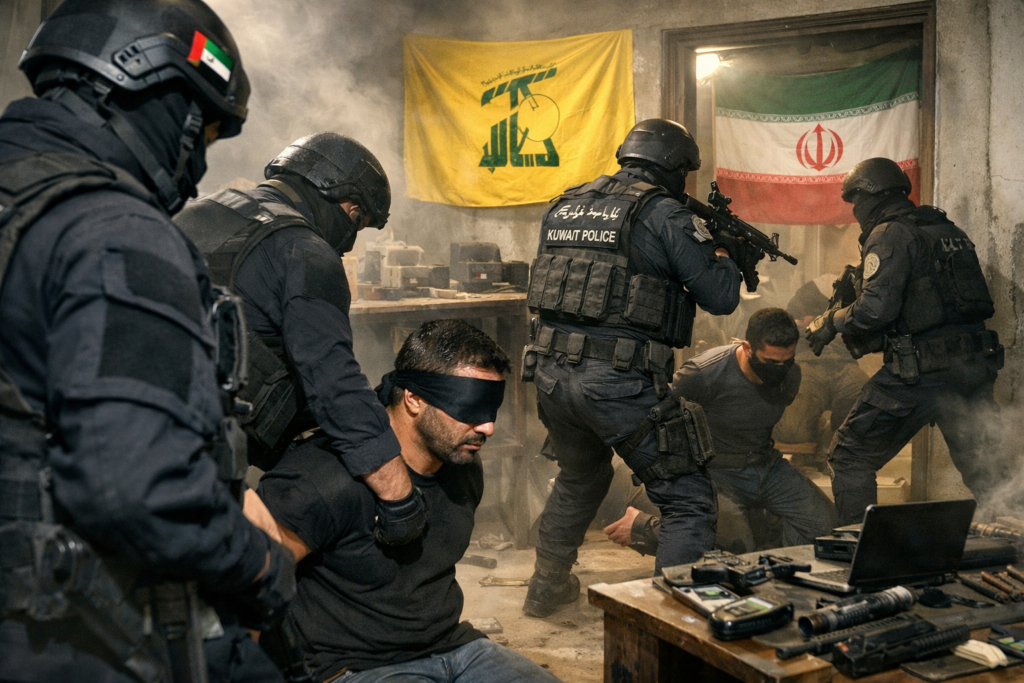
Image Credentials: Image Title: UAE and Kuwait Dismantle “Terrorist Cells” Linked to Hezbollah and Tehran Source: (sora.openai) Date: March 2026. Attribution: This image was created using AI-generated imagery
By Open Chronicle with Agencies
ABU DHABI / KUWAIT CITY – State security forces in the United Arab Emirates (UAE) and Kuwait have announced the successful dismantling of multiple “terrorist networks” operated by the Lebanese group Hezbollah and the Iranian regime. The coordinated security sweep comes as the Gulf region remains on high alert following the outbreak of the 2026 Iran War.
UAE: Infiltration of the National Economy
The UAE State Security Apparatus (SSA) confirmed today that it had broken up a network that was using fictitious commercial fronts to infiltrate the country’s economy. According to official statements, the group was tasked with money laundering and financing terrorism under direct coordination with external entities linked to Tehran and Hezbollah.
Five individuals were detained during the operation. Authorities warned that any attempt to exploit the nation’s civil institutions or financial stability for subversive ends will be met with “firmness and force.”
Kuwait: Thwarting Attacks on Vital Facilities
The announcement in Abu Dhabi follows a series of high-profile arrests in neighboring Kuwait. The Kuwaiti Ministry of Interior reported this week that it had foiled a “sabotage plan” targeting critical state infrastructure.
-
The First Cell: 16 members (14 Kuwaitis and 2 Lebanese) were arrested with a cache of weapons, encrypted communication devices, and drones.
-
The Second Cell: 10 additional members affiliated with Hezbollah were detained on Wednesday after investigations revealed they had received external training in weapons handling and drone operations.
U.S. Fast-Tracks $16.5 Billion Arms Sale
Against this backdrop of internal subversion and external threats, the United States Department of State has authorized an emergency $16.5 billion arms package for the UAE, Kuwait, and Jordan.
U.S. Secretary of State Marco Rubio utilized emergency waivers to bypass the standard congressional review, citing the “immediate need” to bolster regional air defenses. The sale includes:
-
Kuwait: $8 billion for Lower-Tier Air and Missile Defense Sensor (LTAMDS) radars.
-
UAE: Over $8.4 billion for long-range discrimination radars, counter-drone systems, and F-16 munitions.
-
Jordan: $70.5 million for aircraft maintenance and logistics.
Regional Context: The 2026 Iran War
The current instability stems from the conflict that erupted on February 28, 2026, when a joint U.S.-Israeli military campaign targeted the Iranian leadership. The strikes resulted in the death of Supreme Leader Ali Khamenei and much of the Islamic Republic’s military high command.
While Washington has signaled a transition in combat operations, Tehran continues to retaliate through its “Axis of Resistance,” utilizing sleeper cells and proxy strikes against U.S. allies in the Gulf. The recent arrests in Abu Dhabi and Kuwait City suggest that the “financial front” of this conflict is becoming just as contested as the battlefield.