
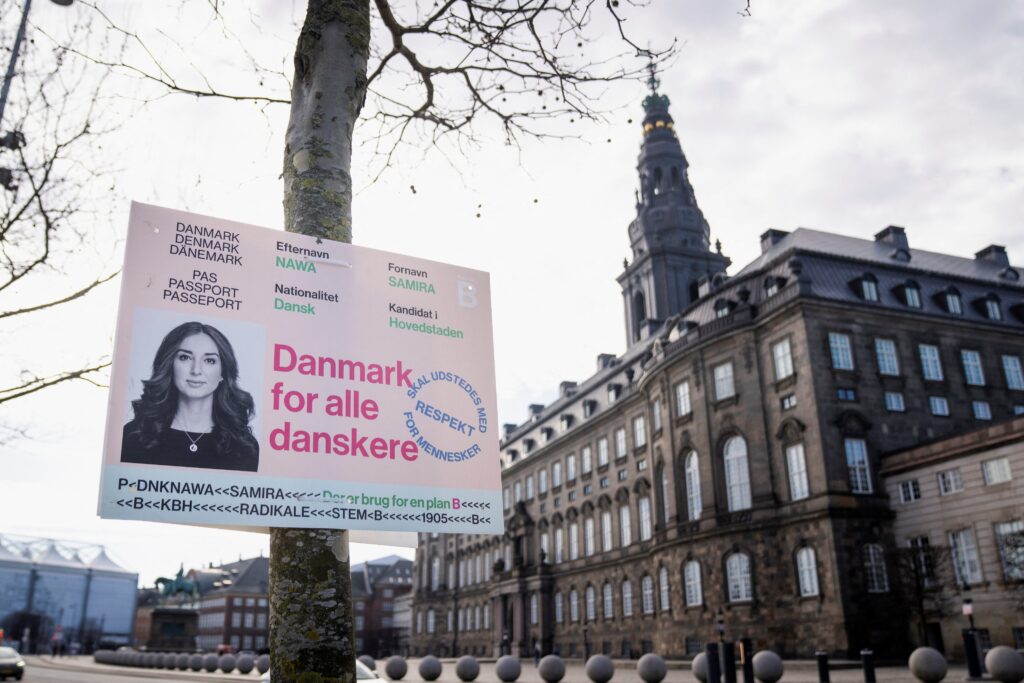
Image: from PiQ Newswire X @PiQNewswire
By Open Chronicle Staff with Agencies
COPENHAGEN — Citizens across Denmark began casting their ballots Tuesday in a general election that has evolved into a high-stakes referendum on national sovereignty and the future of the Arctic. Prime Minister Mette Frederiksen, leader of the center-left Social Democrats, is seeking a third term as the nation grapples with an increasingly aggressive diplomatic tug-of-war involving the United States and the autonomous territory of Greenland.
While the “Rigsfællesskabet” (the Danish Realm) has long enjoyed a stable status quo, the current political climate has been electrified by U.S. President Donald Trump’s renewed interest in Greenland, which the White House has repeatedly suggested could be a candidate for annexation.
The Greenland Factor
The 179-seat Folketing (Parliament) may find its balance of power determined not in Copenhagen, but in the North Atlantic. Frederiksen’s firm rejection of U.S. overtures has bolstered her image as a defender of Danish territorial integrity, yet it has also emboldened independence movements within Greenland itself.
“The aggression shown by the U.S. has sharpened the focus on our perspective in the Danish Parliament,” noted Greenland’s Business Minister Naaja Nathanielsen. In the capital of Nuuk, where over 20 candidates are vying for seats, the debate over whether to remain under the Danish Crown or seek total independence has reached a fever pitch. If the vote in mainland Denmark remains as close as polls suggest, the four seats reserved for Greenland and the Faroe Islands could act as kingmakers in forming a new government.
Domestic Fractures
Despite the international headlines, the campaign trail in Denmark has been dominated by the pressing realities of the cost-of-living crisis and a hardening stance on immigration. The Social Democrats have surprised some observers by pivoting toward stricter migration policies, a move aimed at neutralizing the influence of right-wing parties.
Current polling shows a razor-thin margin between the center-left bloc and the right-wing opposition. Political analysts suggest that Foreign Minister Lars Løkke Rasmussen and his centrist Moderates party may hold the decisive “middle ground” in the inevitable coalition negotiations.
The Regional Context
The election comes at a time of heightened global uncertainty, with the outcome set to define Denmark’s role in a changing NATO landscape and its management of Arctic resources. As polling stations across the country remain open until 8:00 p.m. local time, Europe watches closely to see if Frederiksen can navigate this “Arctic storm” or if a new leadership will take the helm in Copenhagen.
Final results are expected late Tuesday evening, signaling a new chapter for one of the world’s oldest monarchies.