
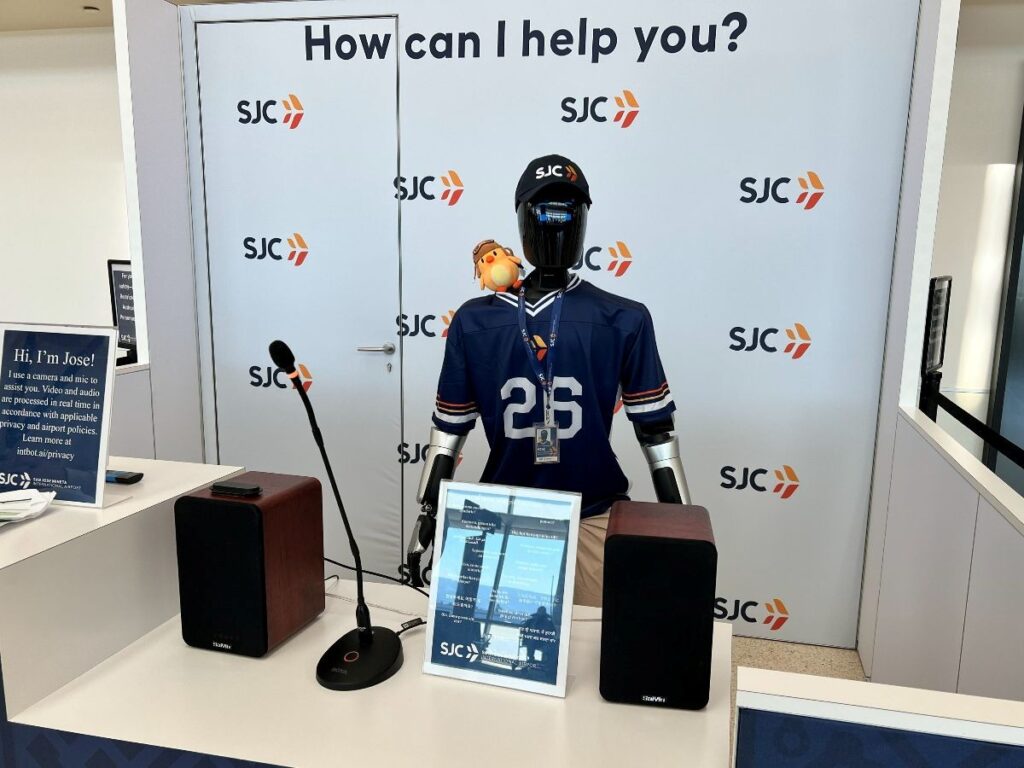
Image: José, a humanoid robot, at SJC Terminal B near Gate 24 (San José Mineta International Airport (SJC)
By Julian Thorne | Open Chronicle Technology Columnist
SAN JOSÉ, CA — Travelers at San José Mineta International Airport (SJC) may find themselves seeking directions from a surprising new staff member this week. In a major pilot program launched Tuesday, the airport debuted “José,” an AI-powered humanoid robot designed to serve as a high-tech concierge for the millions of passengers passing through the gateway to Silicon Valley.
Developed by local startup IntBot, the robot is part of a four-month pilot program aimed at easing the “travel snarls” that have plagued major U.S. hubs in early 2026 due to staffing shortages and increased spring break volumes.
A Polyglot in Terminal B
Stationed at Terminal B, Gate 24, “José” is far more than a stationary kiosk. Using a sophisticated “social intelligence engine,” the humanoid can autonomously navigate busy terminals, read social cues to determine if a passenger needs help, and engage in natural, unscripted conversations.
One of its most critical features is its linguistic range: the robot is capable of communicating in over 50 languages, making it an essential asset for international travelers. Whether providing real-time gate updates, locating the nearest “Zoom Zone,” or offering directions to baggage claim, the robot is designed to handle repetitive inquiries, allowing human staff to focus on more complex passenger crises.
“Social Intelligence” vs. Scripted Bots
The IntBot platform represents a new generation of “Physical AI.” While previous airport robots often relied on rigid scripts or remote human operators, José utilizes a multimodal intelligence system that fuses vision, audio, and language in real-time.
“At IntBot, we are defining social intelligence for physical AI,” said Lei Yang, CEO of IntBot. “It’s about understanding human intent and context. The robot needs to know when to engage, when to wait, and how to respond naturally in the chaos of a public hub.”
Preparing for the World Stage
The timing of the deployment is strategic. San José Mayor Matt Mahan noted that the airport is bracing for a massive influx of global visitors for the upcoming FIFA World Cup. “Thanks to IntBot, these visitors will receive clear directions and real-time information in their own languages,” Mahan said. “We are turning SJC into a live testing ground for technologies that reinforce our reputation as a global tech hub.”
The pilot program aligns with a broader trend in 2026, which has seen humanoid robots move from factory floors into public service roles. Just months ago, IntBot made history at CES 2026 by operating an entire exhibition booth using only its flagship robot, “Nylo.”
The Human Element
While the sight of a robot “singlehandedly running its own gate” has intrigued tech enthusiasts, it has also sparked discussions regarding the future of work in the service industry. Airport officials have been quick to frame the robot as a “force multiplier” rather than a replacement, emphasizing that the goal is to improve accessibility and operational efficiency during peak travel periods.
As José begins its four-month “shift,” the eyes of the aviation industry are on San José. If successful, the friendly humanoid may soon become a standard feature at airports worldwide, providing a robotic helping hand to weary travelers in a world that never stops moving.