
By Open Chronicle Staff with Agencies
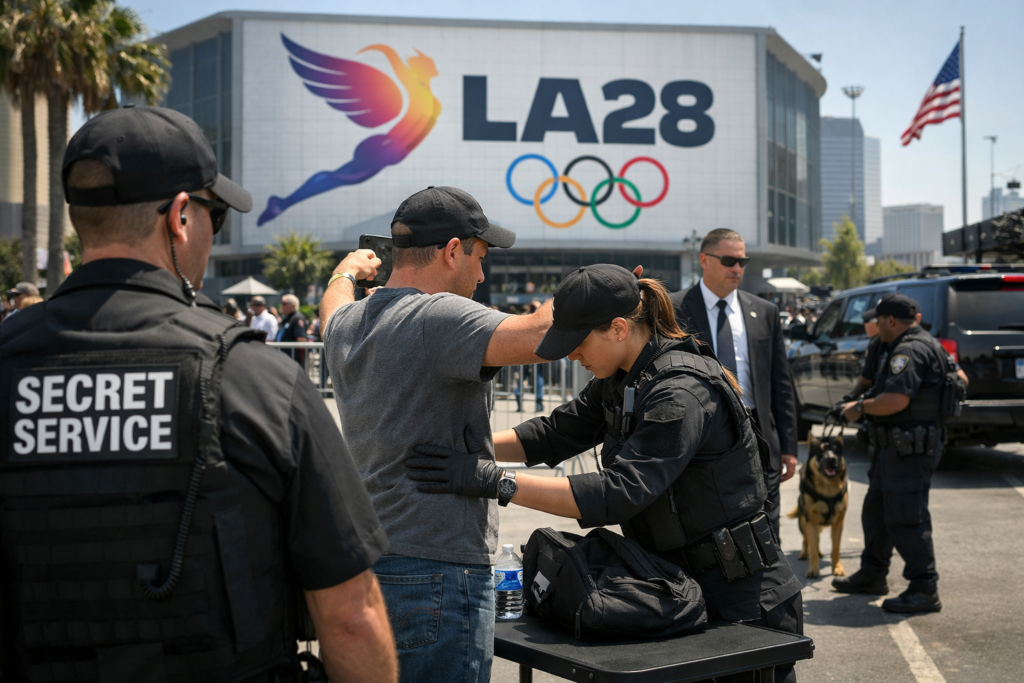
LOS ANGELES — The University of Southern California (USC) is preparing for an unprecedented security transformation as the U.S. Secret Service prepares to establish “stop and search” zones across the campus for the 2028 Olympic and Paralympic Games.
The announcement, made during Wednesday’s Academic Senate meeting, has sparked immediate concerns regarding the university’s ability to maintain its summer academic programs and the long-term impact on campus culture.
“Highest Level of Security in the World”: Mark Ewalt, USC’s executive director of operations and compliance, informed faculty that the heightened measures are a requirement for hosting what is designated as a National Special Security Event. USC is slated to be a primary hub for the Games, with the Los Angeles Memorial Coliseum hosting track and field events and the Opening Ceremony, while the Galen Center will house badminton and rhythmic gymnastics.
The University Park Campus will also serve as the global headquarters for press and media operations.
“All the details are not worked out, even though we’ve been working on this for the better part of three years,” Ewalt said, noting that anyone passing through designated campus zones during the summer and fall of 2028 will be subject to mandatory searches.
Academic Programs in Jeopardy: The intensity of the security footprint has left the university’s 2028 summer session in doubt. While USC recently announced a new scholarship model to make summer enrollment more affordable and accessible, administrators are now unsure if these programs can physically coexist with the Olympic lockdown.
The logistical challenges extend beyond checkpoints. Ewalt warned of a significant reduction in available parking and noted that while the university expects to be reimbursed for Olympic-related costs, quantifying the full financial and operational disruption remains a complex task.
A History of Hardened Borders: For many long-standing faculty members, the news evokes a sense of déjà vu. Before the 1984 Los Angeles Olympics, USC installed temporary barbed-wire fencing that eventually evolved into the permanent brick and wrought-iron perimeter that defines the campus today.
More recently, the university implemented mandatory ID scans and bag checks in response to pro-Palestinian encampments in early 2024. While those measures were largely rolled back in August 2025 under interim President Beong-Soo Kim, the 2028 plan represents a shift toward a much more rigid, federally-mandated security apparatus.
Concerns Over Campus Morale: The prospect of “stop and search” zones has met with pushback from faculty concerned about the psychological toll on the university community. Julie Cederbaum, a professor of social work, urged administrators to consider the human element of the security plan.
“I would just like culture and morale to be a part of the conversation,” Cederbaum said during the meeting, highlighting fears that the campus could feel more like a fortress than an educational institution for the duration of the Games.
As Los Angeles prepares to step onto the world stage, USC finds itself at the center of a tension between global prestige and the daily realities of campus life.