
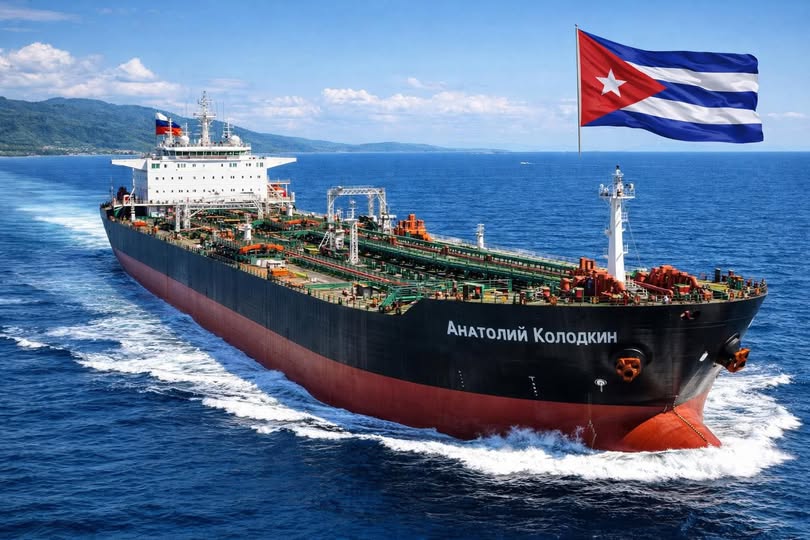
Image: from DeFiMole X @DeFiMole_
By Open Chronicle Staff with Agencies
HAVANA / WASHINGTON — The approach of the Russian tanker Anatoly Kolodkin toward Cuban waters has triggered a high-level security alert within the U.S. Navy and reignited a fierce debate over Moscow’s intelligence-gathering capabilities just 90 miles from the Florida coast.
The vessel, which is defying U.S. sanctions imposed on both Moscow and Havana, is ostensibly transporting fuel to the energy-strapped island. However, a report published Tuesday by The New York Times suggests the tanker may be pulling double duty as a mobile signals intelligence platform, gathering strategic data as it traverses the Caribbean.
The Shadow of Lourdes. The movement of Anatoly Kolodkin has brought renewed scrutiny to the “Lourdes” signals intelligence facility near Havana. A relic of the Cold War that officially closed 25 years ago, Lourdes was once the largest Soviet listening post outside of Russia. While President Vladimir Putin denied reports of its reactivation in 2014, U.S. intelligence officials remain skeptical.
Post 1/5
🇨🇺🇷🇺 UPDATE: Russia’s oil tankers are CLOSER than ever to Cuba 🔥
The Anatoly Kolodkin (Russian-flagged, 730,000 barrels of crude) is now just days from Matanzas. The Hong Kong-flagged Sea Horse (carrying ~200,000 barrels of diesel/gas oil) is expected as early as March… pic.twitter.com/AXMMVrq9Gs— New Direction AFRICA (@Its_ereko) March 21, 2026
Even in a degraded state, the facility’s proximity to the United States, less than 320 kilometers from Florida, allows it to monitor sensitive installations, including U.S. Central Command, satellite launch sites at Cape Canaveral, and President Trump’s Mar-a-Lago residence.
“Local antennas remain surprisingly relevant,” said Glenn S. Gerstell, former general counsel of the National Security Agency (NSA). He noted that such ground-based equipment can capture radio and walkie-talkie signals with a clarity that distant satellites cannot match.
A ‘National Emergency’. In January, President Trump cited the establishment of “sophisticated military and intelligence capabilities” in Cuba as a primary reason for slashing oil imports to the island. His recent executive order declaring a “national emergency” specifically highlights foreign bases on the island as a top-tier threat to national security.
The administration’s stance is echoed by Secretary of State Marco Rubio, who has long maintained that the presence of foreign adversaries in the Caribbean is “unacceptable.” During previous policy debates, Rubio insisted that any “good deal” with Cuba must include the expulsion of Russian assets from Lourdes and the dismantling of Chinese listening stations in Bejucal.
The Chinese Connection. While the Russian presence is a legacy concern, the modernization of Chinese facilities in Cuba has added a new layer of complexity. Since 2019, Beijing has reportedly upgraded its base at Bejucal, one of four alleged Chinese electronic eavesdropping posts on the island. These stations are positioned to monitor U.S. military training exercises and high-tech telemetry from Florida’s “Space Coast.”
Pretext or Proximity? Not all observers agree with the administration’s alarmist tone. William LeoGrande, a professor at American University, argued that the focus on espionage is a “perfect excuse” to justify a hardline policy against the Cuban regime. “The Lourdes base is already obsolete,” LeoGrande stated, suggesting the threat is being exaggerated for political leverage.
However, former intelligence officials warn that even if formal bases are shuttered, diplomatic facilities in Havana remain “packed with covert listening equipment.”
As the Anatoly Kolodkin nears its destination, the U.S. Navy continues to monitor its trajectory, treating the tanker not merely as a commercial vessel but as a potential piece on the global chessboard of 21st-century shadow warfare.