
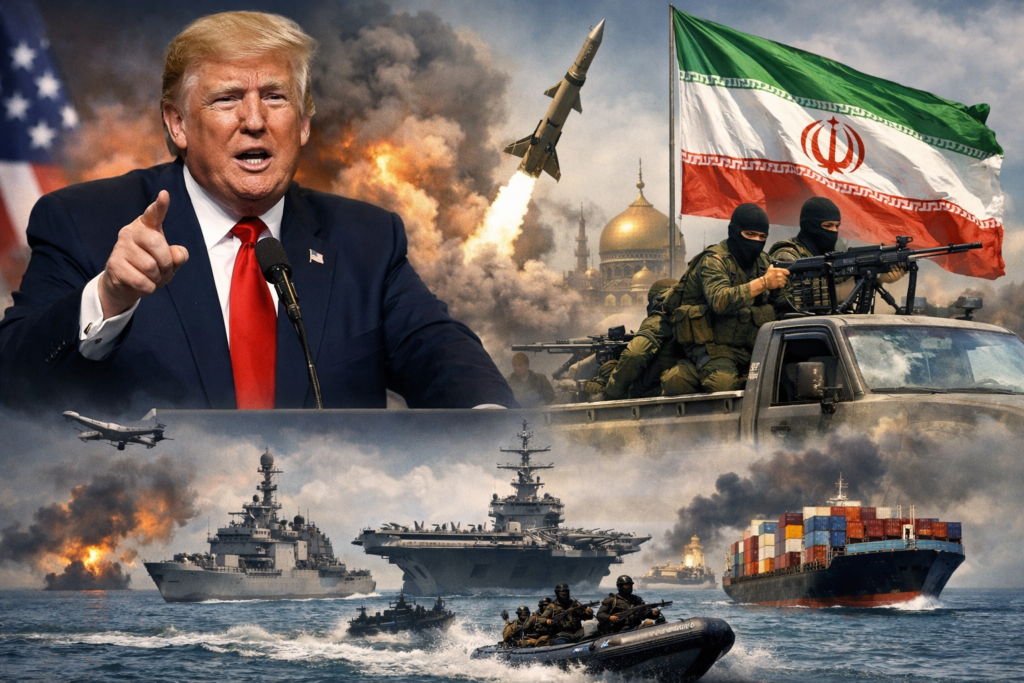
Image Credentials: Image Title: Mixed Signals as Trump Claims Progress in Iran War While Blockade Tightens Source: (sora.openai) Date: March 2026. Attribution: This image was created using AI-generated imagery (sora.openai) and does not depict a real-world scene.
By Open Chronicle Staff with Agencies
WASHINGTON – President Donald Trump announced a second extension of his deadline for Iran to reopen the Strait of Hormuz on Thursday, claiming that negotiations to end the month-long conflict are “going very well.” However, the optimism from the White House was immediately met with a harsh rebuttal from Tehran, where officials denied the existence of direct talks and intensified their maritime blockade.
In a post on Truth Social, Mr. Trump stated he would pause threatened strikes on Iranian energy infrastructure until April 6, 2026, at 8:00 P.M. ET. He characterized the delay as a response to an Iranian request for “more time,” asserting that Tehran had already allowed “eight big boats of oil” to transit the strait as a gesture of good faith.
The Islamic Revolutionary Guard Corps (IRGC) swiftly labeled the President’s comments as “false statements.” On Friday morning, the IRGC Navy reportedly forced three container ships to turn around in the waterway. Maritime tracking data confirmed that two Chinese-owned vessels operated by COSCO Shipping Lines Ltd reversed course after entering the strait, underscoring Tehran’s insistence that the shipping lane remains closed to any “allies and supporters of the Zionist-American enemies.”
“Ransom” in the Strait. The blockade has evolved into what critics describe as a state-sponsored shakedown. Reports from maritime intelligence firms and Gulf officials suggest Iran has established a “toll booth” system, charging select commercial vessels from neutral nations like China, India, and Pakistan up to $2 million per transit to “cover the country’s cost of war.”
Sultan Ahmed Al Jaber, head of the Abu Dhabi National Oil Company (ADNOC), condemned the practice as “economic terrorism” during a visit to Washington. “When Iran holds Hormuz hostage, every nation pays the ransom at the gas pump and the grocery store,” Al Jaber said. Iran’s parliament is reportedly drafting legislation to formalize these fees by early April.
UN Condemns School Strike. The humanitarian toll of the conflict took center stage at the United Nations Human Rights Council on Friday. Iranian Foreign Minister Abbas Araghchi addressed the council via video, branding a February 28 strike on an elementary school in Minab a “calculated assault.” Araghchi claimed more than 175 students and teachers were “slaughtered in cold blood,” labeling the incident a war crime.
U.N. rights chief Volker Turk described the bombing as a “visceral horror” and called for transparent accountability. While a preliminary U.S. assessment suggests American forces were “likely” responsible, officials maintain the school was not intentionally targeted and may have been hit due to outdated intelligence identifying it as a military site.
Regional Escalation and Market Turmoil. Despite the diplomatic posturing, military activity remains intense. Israel launched a “wide-scale wave of strikes” against Iranian infrastructure in Tehran early Friday, while Hezbollah strongholds in Beirut were also hit. In retaliation, the IRGC targeted U.S. and allied facilities in the Gulf, including a Patriot air defense maintenance site in Bahrain.
The lack of clarity regarding a de-escalation has sent global markets into a tailspin. Wall Street suffered its worst drop since the war began on Thursday, with the Nasdaq composite sliding into “correction” territory, 10% below its recent highs. Oil prices continued to climb Friday as traders weighed the reality of the IRGC blockade against Mr. Trump’s claims of progress.
Political Fractures. Domestically, the war is creating friction within the Republican Party. Rep. Nancy Mace (R-SC) expressed “grave concerns” about the lack of an exit strategy, warning against the conflict turning into another “endless war.” Meanwhile, in Israel, opposition leader Yair Lapid warned that the IDF is “stretched to the limit and beyond,” accusing the government of entering a multi-front war without the necessary strategy or manpower.
As the new April 6 deadline approaches, the international community remains on edge, caught between the White House’s rhetoric of diplomacy and the volatile reality on the ground and at sea.