
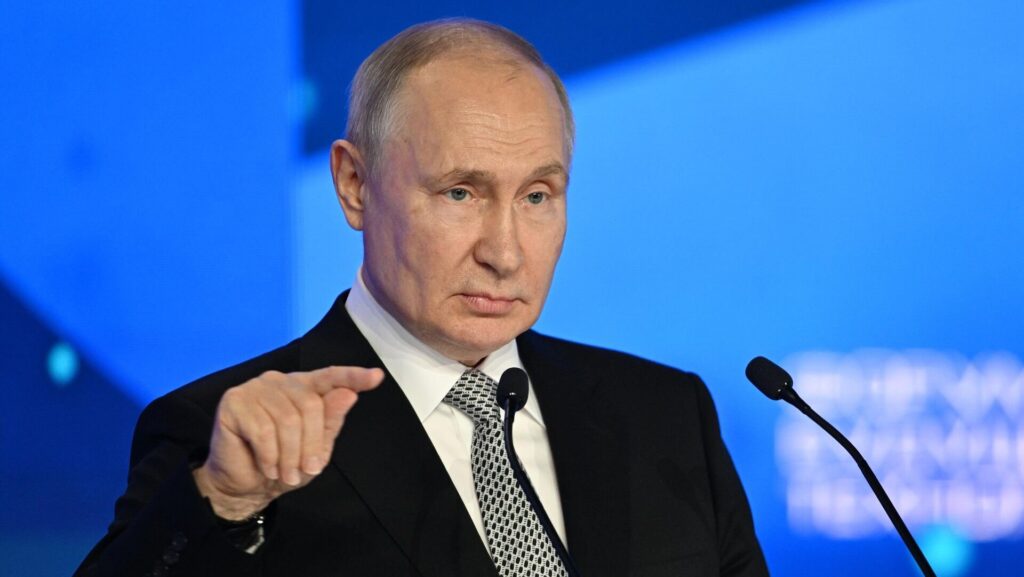
Image: from Tymofiy Mylovanov X @Mylovanov
By OPEN CHRONICLE STAFF with Agencies
MOSCOW — Russian President Vladimir Putin has called upon the nation’s top business leaders to provide “voluntary” contributions to the federal budget, a move industry analysts describe as a desperate attempt to plug a widening deficit caused by the protracted conflict in Ukraine and tightening international sanctions.
The request, framed as a patriotic gesture during a high-profile meeting with the Russian Union of Industrialists and Entrepreneurs (RSPP), signals a tightening of the Kremlin’s grip on private capital as the Russian economy shifts toward a permanent wartime footing.
The “Windfall” Demand: According to reports from The Bell, the Russian government is seeking a one-time “excess profit tax” or a direct donation from large corporations that saw significant earnings growth over the past two years. While the Kremlin has characterized the payments as voluntary, sources within Moscow’s financial circles suggest that major firms have little choice but to comply if they wish to maintain favorable relations with the state.
“The message from the top is clear: the state provided the environment for these profits, and now the state requires its share to ensure national security,” said a Moscow-based economic consultant who requested anonymity. “In the current climate, ‘voluntary’ is a polite euphemism for a mandatory levy.”
Budgetary Bleeding: The push for corporate funding comes as Russia’s Ministry of Finance grapples with a significant shortfall. Declining revenues from oil and gas exports—the traditional lifeblood of the Russian Treasury, combined with the astronomical costs of military mobilization and hardware production, have left the 2026 budget under immense strain.
By targeting the “oligarch class” and large industrial conglomerates, Putin aims to insulate the general public from immediate tax hikes or austerity measures that could spark domestic unrest. However, the move risks alienating the very business elite that has remained largely loyal to the administration since the invasion began.
Market Chills and Long-term Risks: Economists warn that forced contributions could have a chilling effect on what remains of Russia’s private investment sector. If companies are forced to divert capital reserves toward the war effort, essential investments in technology, infrastructure, and diversification will likely stall, further tethering Russia’s economic future to the military-industrial complex.
The RSPP initially attempted to counter the proposal by suggesting a marginal increase in the general corporate tax rate, arguing it would be more transparent and predictable. However, the Kremlin appears set on a rapid liquidity injection to fund immediate frontline requirements.
The Cost of Conflict: The demand for business-led funding underscores the mounting financial toll of the war. With Western capital markets closed and foreign reserves largely frozen, the Kremlin is increasingly looking inward to sustain its military operations.
As the “Leo Era” of global tension deepens and U.S. officials like Marco Rubio signal an intensification of Western pressure, Putin’s reliance on the domestic private sector suggests that Moscow is bracing for a long, expensive war of attrition.