
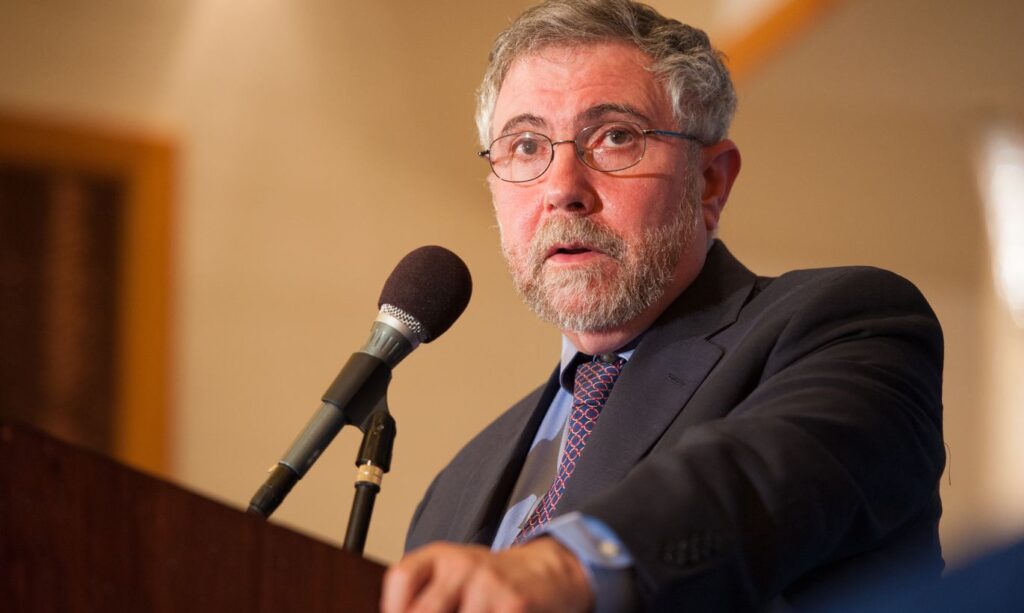
Image: from Denys Shtilierman X @DenShtilierman
By Open Chronicle Staff with Agencies
NEW YORK — Nobel laureate Paul Krugman has put forward a chilling hypothesis regarding recent fluctuations in U.S. foreign policy toward Iran, suggesting that highly classified national security information may be being leaked to allow individuals close to the administration to reap multi-million dollar profits in the financial markets.
Speaking with Mary Harris on the What Next podcast, the economist highlighted a series of “suspicious” market movements that coincided perfectly with President Donald Trump’s erratic shifts in military rhetoric. The key incident occurred last week after the President threatened to “obliterate” Iranian power plants, only to abruptly withdraw the ultimatum minutes before it was set to expire.
The “Nine-Minute” Windfall
According to Krugman, the most damning evidence is found in the oil markets. Just minutes before the official announcement of a de-escalation, trading volumes for crude oil saw a massive, coordinated spike. The timing suggests that specific traders knew the President’s televised “retreat” was coming before the public—or even some members of the military, did.
Krugman estimated that a 10% swing in oil prices on a transaction volume of $580 million could have generated approximately $58 million in instant profits for those who bet against a price surge right before the announcement.
“If a spy handed this type of information to our adversaries, we would call it treason,” Krugman argued during the interview. “Why aren’t we using the same language now?”
Market Signals as National Security Risks
The economist outlined three primary reasons why these financial maneuvers represent a grave threat to the United States:
-
Sensitivity of Information: These leaks do not involve corporate balance sheets; they involve decisions of war and peace that affect thousands of lives.
-
Operational Signaling: Adversarial governments in Russia, China, and Saudi Arabia closely monitor market activity. A massive, “peace-leaning” bet placed minutes before a presidential speech serves as a clear signal to foreign intelligence that the U.S. is planning to de-escalate, stripping the administration of its strategic element of surprise.
-
Moral Equivalence: Krugman maintains that selling national secrets through financial transactions is morally indistinguishable from selling them directly to a foreign power.
A Pattern of “Buying the Dip”
This is not the first time the Trump administration has faced allegations of market manipulation. Krugman drew parallels to the “Liberation Day” tariffs imposed a year ago, which were characterized by similar “suspicious” trading patterns. He suggested that allies of the White House might be treating the presidency as a tool to create financial “rollercoasters,” allowing them to “buy the dip” with 100% certainty.
While the economist noted that these transactions are traceable via subpoenas to brokerage firms, he expressed skepticism that an investigation would yield results in the current political climate.
“It is possible they believe we are now a one-party nation,” Krugman concluded. “Or that by the time an investigation gains steam, there will be enough people in power to protect them.”
The White House has not yet responded to Krugman’s allegations, which add a new layer of domestic controversy to the ongoing “Operation Epic Fury” in the Middle East.