
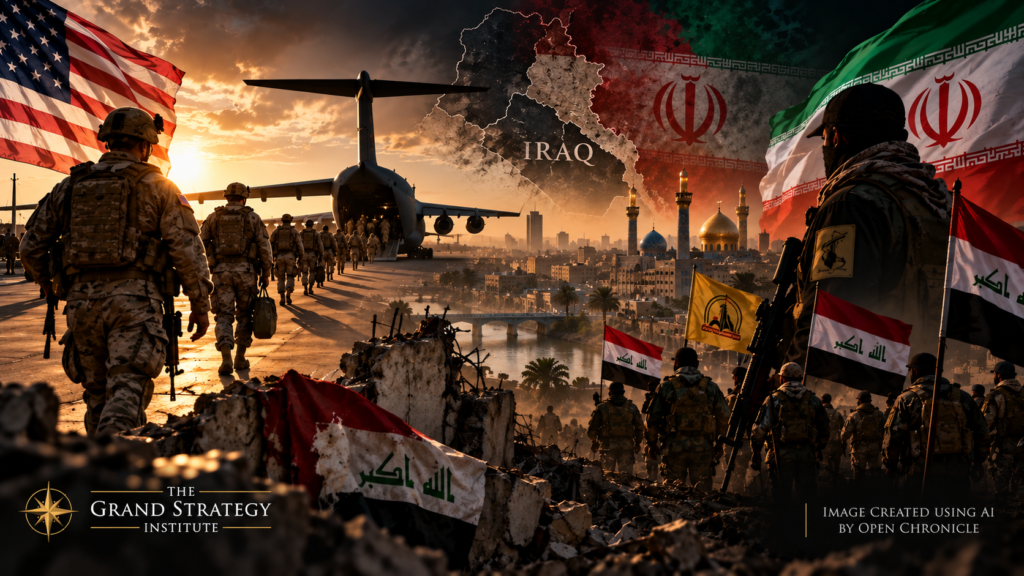
The departure of the last American military forces from Iraq closes a mission that began with the fight against Islamic State in 2014 and, more broadly, another chapter of the intervention launched in 2003. But the withdrawal does not remove the forces that made Iraq strategically important. Iran remains deeply connected to armed groups, political networks and economic interests inside the country. ISIS has been territorially defeated but not eliminated. The Iraqi state still faces the unresolved question of who ultimately controls armed force. Washington may therefore be leaving the battlefield without ending the competition that made the battlefield matter.
By The Grand Strategy Institute Research Division
Grand Strategy Analysis | 2 October 2026
The final American troops have left Iraq.
Iran has not.
That difference may eventually matter more than the withdrawal itself.
On 30 September 2026, the United States completed the departure of its remaining military forces from Iraq, ending the American-led coalition mission that returned to the country in 2014 to fight Islamic State.
For Washington, the moment represented the conclusion of another long military commitment.
For Baghdad, it represented sovereignty.
For Tehran and several Iran-aligned Iraqi armed groups, it was presented as something else.
Victory.
The competing interpretations reveal the strategic problem at the centre of the withdrawal.
America’s military presence was visible, politically controversial and ultimately temporary.
Iran’s influence is geographically natural, institutionally embedded and designed for endurance.
That does not mean Iraq has become an Iranian satellite.
Iraq has its own nationalism, institutions, political factions and interests, and many Iraqis reject domination by either Washington or Tehran.
Nor does the American withdrawal automatically produce an Iranian strategic victory.
But it does create an asymmetry.
The United States has removed one of its principal instruments of direct influence while Iran retains several of its own.
And this is occurring while Washington and Tehran are engaged in a wider regional confrontation.
That makes the withdrawal more than the conclusion of a counterterrorism mission.
It makes it a test of whether the United States can compete for influence in Iraq without maintaining forces on Iraqi territory.
The Withdrawal Was Not a Sudden Trump Decision
Understanding how America reached this point is essential.
The withdrawal originated in negotiations between Washington and Baghdad during the Biden administration.
In September 2024, the two governments announced a transition plan for the coalition mission against Islamic State.
The original arrangement envisaged ending the coalition’s military mission in Iraq while maintaining a second phase allowing operations against ISIS in Syria to be supported from Iraqi territory until September 2026.
American officials emphasised at the time that this was intended to be a transition rather than the abandonment of the US-Iraq security relationship.
The objective was to replace the coalition framework with a longer-term bilateral partnership.
The Trump administration inherited that process.
It ultimately completed it.
The distinction matters because the withdrawal should not be reduced to the preferences of one administration.
It reflects a much broader American problem.
After more than two decades of intervention, Washington has struggled to determine what military presence in Iraq is actually supposed to accomplish.
America Has Already Left Iraq Once
There is an unavoidable historical echo.
American combat forces left Iraq in 2011.
Three years later, they returned.
The reason was Islamic State.
ISIS exploited political dysfunction, sectarian grievances, the collapse of security structures in neighbouring Syria and weaknesses within Iraqi forces.
In 2014, the organisation captured Mosul and swept across enormous areas of northern and western Iraq.
Iraqi security forces collapsed in several locations.
The United States returned at Baghdad’s request.
A broad international coalition followed.
Iran also intervened.
Iraqi Shiite militias mobilised.
Kurdish forces fought across the north.
The territorial caliphate was eventually destroyed.
Iraq declared territorial victory over ISIS in 2017.
The final territorial enclave controlled by the organisation in Syria fell in 2019.
But ISIS did not disappear.
It became an insurgent network.
That history creates the first strategic question surrounding the 2026 withdrawal.
Is Iraq now sufficiently resilient to prevent another security vacuum from becoming another strategic surprise?
The answer cannot yet be known.
ISIS Is Down. It Is Not Gone.
The United States has strong grounds for arguing that the original mission has largely succeeded.
The Islamic State no longer controls major Iraqi cities.
It does not administer a territorial caliphate stretching across Iraq and Syria.
Iraqi security institutions are substantially more capable than they were when Mosul collapsed in 2014.
Those achievements matter.
A permanent foreign deployment cannot be justified simply because some residual terrorist threat will always exist.
But the opposite conclusion would also be dangerous.
Territorial defeat is not organisational extinction.
ISIS cells continue to operate.
Insurgent organisations do not necessarily need cities.
They need ungoverned spaces.
Weapons.
Money.
Recruitment networks.
Local grievances.
Political paralysis.
And time.
The danger is therefore not necessarily another dramatic ISIS offensive immediately after the American departure.
It is the gradual erosion of the intelligence and counterterrorism ecosystem that helped prevent the organisation from rebuilding.
The decisive question becomes whether Iraqi institutions can preserve that pressure without a permanent American military presence.
The Bigger Problem Is Iran
ISIS is only one dimension of the withdrawal.
The more consequential geopolitical issue may be Iran.
Iran and Iraq share a border of roughly 1,600 kilometres.
They share deep religious, commercial, political and social connections.
Iran cannot geographically withdraw from Iraq.
America can.
This gives Tehran an enduring structural advantage.
For decades, Iran has developed relationships with Iraqi political movements and armed organisations.
Some date back to Saddam Hussein’s rule.
Others expanded after the American invasion in 2003.
Still others gained prominence during the fight against ISIS.
These networks do not all behave as simple Iranian proxies.
The Popular Mobilization Forces contain diverse organisations with different degrees of loyalty to Baghdad, ideological affinity with Tehran and operational independence.
That distinction matters.
But several of the most powerful factions maintain close relationships with Iran and the Islamic Revolutionary Guard Corps.
Some possess their own armed forces.
Some possess drones and missiles.
Some participate in politics.
Some control businesses and economic networks.
Some combine all of these characteristics.
This creates something more complex than a conventional foreign military presence.
Iran does not need divisions permanently stationed in Iraq if friendly Iraqi organisations can generate influence from inside the Iraqi system itself.
This Is Tehran’s Strategic Advantage
American and Iranian power operate differently in Iraq.
American influence has historically depended heavily on visible institutions.
Embassies.
Military advisers.
Bases.
Training missions.
Intelligence relationships.
Economic assistance.
Weapons sales.
Diplomatic pressure.
Iranian influence frequently operates through relationships that are harder to separate from Iraqi domestic politics.
Religious networks.
Political parties.
Militias.
Commercial relationships.
Intelligence connections.
Personal relationships among elites.
Cross-border trade.
Ideological affinity.
This means Washington and Tehran are not playing the same game.
America’s presence can be withdrawn by agreement.
Iran’s networks cannot be removed by simply closing a military base.
That is why the departure of American forces potentially changes the competitive balance even if relatively few troops were still present.
The Militias Did Not Leave With the Americans
This is the central contradiction.
The Iraqi government wanted the coalition mission to end.
It also sought to bring armed groups under state control.
Those processes were supposed to reinforce one another.
Foreign troops would leave.
Armed authority would consolidate under Baghdad.
Iraqi sovereignty would increase.
The first part happened.
The second remains unfinished.
Reuters reported in September that powerful Iran-aligned groups were resisting the government’s effort to disarm them. Some factions belonging to the wider Islamic Resistance in Iraq collectively possess tens of thousands of fighters, increasingly sophisticated weapons and significant economic interests.
The deadline for disarmament has subsequently slipped into 2027.
That creates an uncomfortable asymmetry.
The foreign military force operating with the Iraqi government’s consent has left before the Iraqi state has established an uncontested monopoly over armed force.
This may prove to be the most important fact about the withdrawal.
Sovereignty Means More Than Removing Foreign Soldiers
This exposes a deeper problem with the language of sovereignty.
Sovereignty can be understood territorially.
Foreign forces leave.
The national flag remains.
The government controls the bases.
But strategic sovereignty requires something more demanding.
The state must possess final authority over organised violence within its territory.
If an armed organisation can independently decide to launch missiles or drones against another state, then Baghdad may formally possess sovereignty while lacking complete control over the consequences of actions originating from Iraqi territory.
This matters enormously during the current confrontation with Iran.
An Iraqi militia attacks an American target.
Washington retaliates.
Iran supports the militia.
Baghdad condemns both sides.
Iraq becomes a battlefield without the Iraqi government having chosen the war.
That is precisely the scenario Iraqi sovereignty is supposed to prevent.
The withdrawal therefore creates a paradox.
Removing American troops strengthens one dimension of Iraqi sovereignty. Disarming autonomous armed organisations is necessary to strengthen another.
Achieving the first without achieving the second could leave sovereignty incomplete.
Iran Has Already Won One Important Objective
Iran has pursued the removal of American forces from Iraq for years.
From Tehran’s perspective, American bases immediately west of Iran represented more than a political irritant.
They represented strategic vulnerability.
American intelligence platforms operated nearby.
American aircraft could use regional infrastructure.
Special operations forces were positioned within reach of Iranian interests.
US forces supported partners capable of monitoring militia activity.
And the military presence symbolised Washington’s continued ability to shape Iraqi security.
Removing those forces therefore eliminates a strategic problem for Iran.
This does not mean Tehran now controls Iraq.
It means one of the instruments capable of constraining Iranian influence has been reduced.
That distinction is important.
But Iran Is Not Entering Iraq From a Position of Unlimited Strength
There is another side to the equation.
Iran in 2026 is not the Iran of a decade earlier.
The current conflict with the United States and Israel has imposed severe military and economic costs.
Iranian infrastructure has been attacked.
Its military establishment has suffered losses.
Its economy faces intense pressure.
Sanctions have expanded.
Regional military networks have been disrupted.
The United States is currently applying military and economic pressure against Tehran on a scale dramatically greater than existed when the Iraq withdrawal arrangement was negotiated in 2024.
This means Washington is withdrawing from Iraq at an extraordinary moment.
Iran may be weakened regionally while simultaneously gaining relative freedom of manoeuvre inside one of the countries most important to its security.
That apparent contradiction is central to the story.
The Tactical Argument for Withdrawal
Calling the withdrawal simply a tactical mistake would overlook important advantages.
American forces stationed inside Iraq were vulnerable.
Iran-aligned militias had repeatedly demonstrated the ability to attack American facilities with rockets, missiles and drones.
A relatively small US deployment could therefore become a hostage to regional escalation.
Protecting several thousand troops can require disproportionate resources.
Air defence.
Intelligence.
Force protection.
Aircraft.
Logistics.
Reinforcements.
Medical evacuation.
Regional response forces.
Removing the troops eliminates targets.
It reduces the number of Americans directly exposed to militia attacks.
It also removes one of the principal justifications used by some militias for maintaining an armed resistance posture.
From this perspective, withdrawal can be understood as force protection through strategic repositioning.
America does not need soldiers permanently inside Iraq to strike threats elsewhere in the Middle East.
Its regional military architecture remains extensive.
Jordan.
Kuwait.
Qatar.
Bahrain.
Saudi Arabia.
Naval forces.
Long-range aviation.
Intelligence platforms.
Satellites.
Drones.
Special operations capabilities.
The United States can project enormous power into Iraq without occupying Iraqi bases.
That is the strongest case for the withdrawal.
But Tactical Safety Can Produce Strategic Distance
The counterargument is equally important.
Military presence does more than provide firepower.
It produces information.
Relationships.
Access.
Influence.
Habitual cooperation.
Human intelligence.
Institutional familiarity.
Political reassurance.
Rapid response capability.
A small contingent can therefore have strategic value disproportionate to its combat power.
Once those personnel disappear, Washington may retain the ability to strike Iraq but lose some of its ability to understand Iraq.
That distinction matters.
Over-the-horizon power is excellent at reaching targets. It is less effective at maintaining relationships.
This is one of the lessons of America’s wider experience with military retrenchment.
Technology can replace some physical presence.
It cannot replace all of it.
Intelligence May Be the Capability That Matters Most
The most important American contribution in Iraq may never have been the number of infantry soldiers.
It was the architecture surrounding them.
Surveillance.
Signals intelligence.
Targeting.
ISR aircraft.
Analytical support.
Joint command structures.
Training.
Air support.
Intelligence fusion.
The United States developed an enormous capability to combine information from different sources and transform it into operational decisions.
Iraqi forces benefited from that ecosystem.
The key question after withdrawal is therefore not whether Iraqi soldiers can fight.
They can.
It is whether Iraq can reproduce enough of the intelligence system necessary to find small insurgent networks before those networks become larger ones.
Washington says training and intelligence cooperation will continue.
That may mitigate the problem substantially.
But cooperation conducted from outside the country will not necessarily reproduce every capability previously available on the ground.
Kurdistan May Be the First Place Where the Difference Is Felt
The Kurdish region has particular reasons for concern.
Kurdish forces were among America’s most important partners in the fight against ISIS.
The region has also been exposed to missile and drone attacks.
Kurdistan Regional Government Prime Minister Masrour Barzani publicly criticised the withdrawal and argued that the region would become more vulnerable, particularly because of weaknesses in air defence.
The Kurdish question reveals another dimension of American presence.
US forces were not simply counterterrorism assets.
They were also a form of reassurance.
Their presence complicated calculations by actors considering attacks against US partners.
Once the troops leave, those partners must ask whether American security guarantees remain equally credible from hundreds of kilometres away.
That psychological dimension cannot easily be measured.
But alliances and partnerships depend partly on perception.
Iran Does Not Need to Conquer Iraq
The phrase “Iran will take over Iraq” would be analytically misleading.
Tehran does not need to annex Iraq.
It does not need Iranian soldiers patrolling Baghdad.
It does not necessarily need a completely subordinate Iraqi government.
A more useful Iranian objective is strategic denial.
Iraq should never again become a hostile platform from which a major adversary can threaten Iran.
That means Tehran benefits from an Iraq that is sufficiently friendly, sufficiently penetrated or sufficiently divided that it cannot become an American strategic base against Iran.
From this perspective, influence matters more than occupation.
Political vetoes matter more than flags.
Militia networks matter more than divisions.
Economic dependency matters more than territorial conquest.
This is cheaper, less visible and potentially more durable.
Geography Is Working for Iran
There is another reality Washington cannot change.
Iran is next door.
The United States is not.
Geography produces persistence.
Governments change.
American administrations change.
Military deployments change.
Congressional priorities change.
Public opinion changes.
Iran remains across the border.
Every Iraqi government must therefore maintain some relationship with Tehran regardless of its preferences.
Iran understands this.
The United States sometimes behaves as if influence is something that can be periodically deployed.
For Iran, influence in Iraq is a permanent national security requirement.
That produces different time horizons.
Washington can decide that Iraq is no longer worth the cost. Tehran cannot decide that Iraq is no longer geographically important.
The 2011 Analogy Is Powerful but Imperfect
Critics of the withdrawal will inevitably invoke 2011.
America left.
Iraq destabilised.
ISIS emerged.
America returned.
There is a lesson there.
But history should not become a template.
Iraq in 2026 is not Iraq in 2011.
Its security forces are different.
ISIS is weaker.
Regional politics are different.
The Popular Mobilization Forces are institutionalised.
Iran’s position is different.
The Kurdish region is different.
American regional strike capabilities are different.
The analogy is therefore useful as a warning, not a prediction.
The real lesson of 2011 is narrower:
withdrawal does not eliminate the strategic consequences of what happens after withdrawal.
America may leave a battlefield.
It cannot guarantee that the battlefield will stop affecting American interests.
Washington Is Not Actually Leaving the Middle East
This point is essential.
The Iraq withdrawal should not be confused with an American military departure from the region.
The United States retains a vast regional military architecture.
The Fifth Fleet remains headquartered in Bahrain.
Al Udeid in Qatar remains central to American air operations.
Kuwait remains an important logistics hub.
Jordan hosts American forces.
Regional air and missile defence networks remain critical.
American warships operate across surrounding seas.
Long-range bombers can deploy from outside the region.
And the conflict with Iran has demonstrated Washington’s ability to move large amounts of military power into the theatre rapidly.
Recent operations have also exposed the costs of doing so. Reuters reports that the 2026 fighting has strained American munitions, aircraft and other military resources, while CSIS has estimated the Iran campaign’s costs in the tens of billions of dollars.
The emerging strategy is therefore not withdrawal from the Middle East.
It is redistribution within the Middle East.
Iraq Is Being Removed From the American Base Network
That distinction may ultimately define the decision.
America is not giving up the ability to project military power.
It is changing where that power resides.
Instead of maintaining forces inside Iraq, Washington can rely more heavily on regional hubs and mobile forces.
This has clear advantages.
Fewer politically sensitive deployments.
Fewer exposed troops.
Greater flexibility.
Reduced militia justification for attacks.
But it also produces disadvantages.
Longer response distances.
Reduced local intelligence.
Less political influence.
Less reassurance for partners.
Greater dependence on neighbouring states granting access.
The strategic calculation is therefore not presence versus absence.
It is forward presence versus distributed access.
The Iranian Model Is Almost the Reverse
This produces a fascinating contrast.
America is moving toward distributed external power.
Iran relies heavily on embedded local power.
The American model:
Air bases.
Aircraft carriers.
Long-range bombers.
Satellites.
Regional headquarters.
Missile defence.
Intelligence networks.
Precision strike.
The Iranian model:
Local militias.
Political relationships.
Religious networks.
Drones.
Missiles.
Economic connections.
Intelligence relationships.
Ideological organisations.
Both can project influence.
But they operate on different timescales and through different mechanisms.
Iraq may now become one of the clearest tests of which model is more durable.
The Real Contest Is Over the Iraqi State
Ultimately, neither American nor Iranian strategy should be the centre of the analysis.
Iraq should.
The decisive question is whether Iraq can become sufficiently sovereign that it does not need either power to manage its internal security.
That requires something far more difficult than the departure of American troops.
It requires a state capable of controlling its territory.
Controlling its borders.
Controlling its airspace.
Controlling its armed forces.
Integrating or demobilising militias.
Preventing ISIS regeneration.
Balancing relations with Iran.
Maintaining partnerships with Washington.
Managing Kurdish relations.
And preventing Iraqi territory from becoming a battlefield in someone else’s war.
If Baghdad achieves that, the American withdrawal may eventually look strategically justified.
If it does not, the withdrawal may be remembered very differently.
The Most Important Deadline Was Not 30 September
This may be the central insight.
There were effectively two clocks running in Iraq.
One measured the departure of American forces.
The other measured the consolidation of Iraqi sovereignty over armed groups.
The first clock reached zero.
The second did not.
That creates the strategic risk.
The withdrawal would be much less consequential if Baghdad already possessed an uncontested monopoly on force.
But powerful armed organisations remain.
Some maintain ties to Iran.
Some possess sophisticated weapons.
Some participate in the political system.
Some resist disarmament.
The American departure therefore occurred before the Iraqi state had fully resolved the question that will define the next phase:
Who ultimately decides when armed force is used from Iraqi territory?
Was the Withdrawal a Massive Strategic Mistake?
The evidence does not yet justify treating that conclusion as established fact.
There is a credible strategic argument for leaving.
The original anti-ISIS mission had largely accomplished its territorial objective.
Iraq requested the transition.
American forces had become targets.
The United States possesses alternative regional bases.
Iraqi forces are substantially more capable than in 2014.
A permanent American military presence could itself undermine Iraqi sovereignty and feed militia mobilisation.
Those are substantial arguments.
But there is also a strong case that the timing carries exceptional risk.
The militias remain armed.
ISIS remains active at a reduced level.
Kurdistan remains vulnerable.
The Iraqi state has not completed security-sector consolidation.
Iran retains deep networks.
And the withdrawal occurs during an active US-Iran confrontation.
That combination makes the decision strategically consequential in a way that a withdrawal under more stable regional conditions might not have been.
Tactical Success, Strategic Failure?
This distinction deserves attention.
The withdrawal itself can be executed perfectly.
Every soldier leaves.
Every vehicle is removed.
Every base is transferred.
No casualties occur.
No equipment is abandoned.
From a military logistics perspective, that would be success.
But strategy asks a different question.
What political condition exists after the operation is complete?
This is where American military history becomes uncomfortable.
The United States has repeatedly demonstrated extraordinary tactical competence.
It can invade.
Strike.
Deploy.
Withdraw.
Destroy targets.
Move armies across continents.
But tactical accomplishment does not automatically produce favourable strategic outcomes.
Iraq itself is perhaps the most important example.
America removed Saddam Hussein in weeks.
The strategic consequences lasted decades.
The same principle applies to withdrawal.
Leaving successfully is not necessarily the same thing as succeeding by leaving.
The Grand Strategic Question
The United States faces a wider problem that extends far beyond Iraq.
It wants to reduce permanent military commitments.
It wants allies and partners to carry more responsibility.
It wants resources available for the Indo-Pacific.
It wants to avoid another generation of Middle Eastern ground wars.
But Washington also wants to contain Iran.
Prevent ISIS resurgence.
Protect Israel.
Protect Gulf partners.
Secure energy routes.
Defend maritime trade.
Maintain regional access.
Deter attacks on Americans.
And prevent rival powers from filling strategic vacuums.
These objectives are individually understandable.
Collectively, they may be difficult to reconcile with continual reductions in forward presence.
This is the contradiction at the centre of contemporary American Middle East strategy.
Washington wants fewer commitments without necessarily wanting fewer responsibilities.
Iraq will test whether that is possible.
Strategic Assessment
The Grand Strategy Institute assesses that the American withdrawal from Iraq should not yet be characterised definitively as either a strategic success or a catastrophic mistake.
Its consequences will depend primarily on what happens next.
The tactical logic is defensible.
American troops were increasingly exposed to militia attack.
The territorial ISIS caliphate has been destroyed.
Iraqi forces have improved substantially.
Washington retains formidable military capabilities elsewhere in the region.
Continued intelligence, training and bilateral security cooperation can preserve elements of the relationship without a permanent deployment.
But the strategic risks are equally substantial.
Iran retains geographically and politically embedded influence.
Several powerful armed organisations have not surrendered their weapons.
ISIS retains insurgent capacity.
Kurdistan fears increasing vulnerability.
And the Iraqi state’s monopoly over organised violence remains incomplete.
The withdrawal therefore creates a strategic experiment.
Can the United States preserve influence without presence?
Can Iraq preserve security without the coalition?
Can Baghdad disarm or integrate powerful armed factions without triggering internal conflict?
Can Iran resist exploiting the space created by America’s departure?
Can Washington respond effectively from outside Iraq if the security environment deteriorates?
And can Iraq prevent itself from becoming a secondary battlefield in the wider confrontation between Washington and Tehran?
Those questions will determine whether 30 September 2026 eventually looks like the end of an unnecessary American deployment or the beginning of another strategic reversal.
America Leaves. Iran Waits.
There is a final asymmetry that Washington cannot eliminate.
The United States thinks about Iraq as a strategic choice.
Iran thinks about Iraq as geography.
American presidents can withdraw troops.
Congress can reduce funding.
Pentagon planners can move forces to Jordan or the Gulf.
American voters can decide that the cost is no longer justified.
Iran cannot relocate itself.
Its western border will still meet Iraq tomorrow.
And the day after that.
And decades from now.
That does not guarantee Iranian dominance.
Iraqi nationalism remains powerful.
Tehran can overreach.
Militias can lose legitimacy.
Baghdad can strengthen its institutions.
Regional balances can change.
American influence can continue without American bases.
But it does mean that time operates differently for the two competitors.
America can leave.
Iran can wait.
And for Iraq, that may be the defining strategic problem of the post-American military era.
The greatest risk is therefore not simply that America has left Iraq.
It is that Washington may discover that removing its troops was much easier than removing Iraq from the strategic competition with Iran.
Research Basis
The assessment is grounded in official US documentation and international reporting on the transition of the coalition mission in Iraq, the final American military withdrawal, the continuing presence of Iran-aligned armed groups and the strategic uncertainties emerging after the departure of US forces.
The central factual foundation is unusually strong. The 2024 US-Iraq agreement explicitly envisaged ending the coalition mission while moving toward bilateral security cooperation. The Pentagon at the time stressed that ISIS remained a threat even after its territorial defeat. The final withdrawal was completed on 30 September 2026, with counter-ISIS activity shifting outside Iraq and continued training and intelligence cooperation envisaged.
The 2024 US-Iraq Transition Agreement
Official US documentation established a timetable for ending the military mission of the Global Coalition to Defeat ISIS in Iraq while moving toward bilateral security relationships and continued cooperation with Baghdad.
The End of the US Military Presence
Reporting on the final stage of the withdrawal documents the departure of remaining American forces by 30 September 2026 and the transition toward counter-ISIS activity conducted from outside Iraq alongside continued training and intelligence cooperation.
The Unresolved Disarmament Problem
Reuters reporting documents the continuing military and political importance of Iran-aligned armed groups and the significant resistance encountered by Baghdad as it attempts to consolidate state authority and address militia disarmament.
The Post-Withdrawal Balance
International reporting documents concerns surrounding Iranian influence, residual ISIS activity, the future balance of power inside Iraq and the vulnerabilities that may emerge as Washington replaces physical military presence with external and bilateral forms of security cooperation.
Iran-aligned militias remain an important military and political force, Baghdad’s effort to consolidate armed authority remains incomplete, ISIS retains residual insurgent capacity and questions remain over Iranian influence and the vulnerability of US partners following the withdrawal.
The assessment distinguishes between the tactical completion of the American withdrawal and its longer-term strategic consequences. Military presence, intelligence access, counterterrorism capability, Iraqi state authority, militia autonomy, Iranian influence and the security of US partners are therefore evaluated as separate but interconnected indicators. The withdrawal itself is an established event. Whether it ultimately strengthens Iraqi sovereignty or creates additional strategic space for Iran remains an analytical question whose answer will depend on subsequent developments.
The Grand Strategy Institute
Continue Exploring Strategic Analysis
Return to The Grand Strategy Institute for strategic assessments, long-form analysis and research examining geopolitics, military affairs, international security, emerging technologies and the changing international order.
← Back to The Grand Strategy Institute