
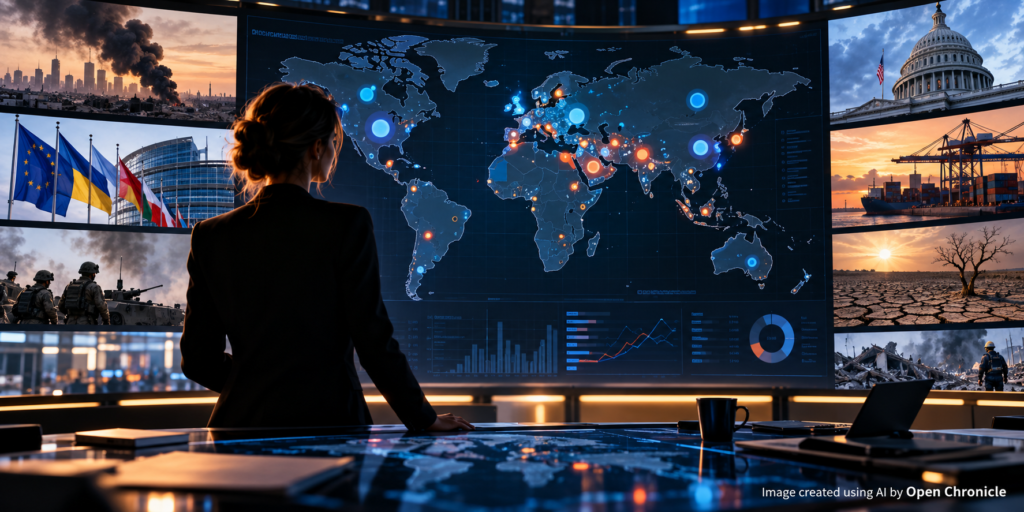
A new analytical platform transforms Open Chronicle’s international news coverage into a living picture of the countries, regions and themes commanding editorial attention, helping readers see patterns that are difficult to detect when stories are viewed individually.
By Open Chronicle
News usually arrives one story at a time.
A political crisis develops in one country. A conflict intensifies somewhere else. Energy markets react to geopolitical pressure. Elections reshape governments. New technologies emerge. Humanitarian emergencies compete for international attention.
Each story matters on its own. But when dozens of stories are published across days and weeks, another question becomes possible:
What does the news cycle look like when we step back and examine it as a whole?
Open Chronicle has launched the Global News Monitor to explore that question.
The new analytical platform examines recent Open Chronicle Global News Brief coverage and transforms it into a structured view of the countries, regions and subjects receiving editorial attention.
Rather than replacing conventional news reporting, the Monitor adds another layer to it.
It allows readers to move from individual headlines to patterns.
From a Stream of Stories to a Picture of the News Cycle
Traditional news pages are chronological by design. The newest development appears first, followed by what came before it.
That remains essential for following events.
But chronology does not always reveal concentration.
A reader moving through dozens of stories may sense that certain countries or subjects are appearing repeatedly without immediately seeing how dominant they have become across the wider coverage.
The Global News Monitor analyses that broader picture.
It examines published Global News Briefs over defined periods and identifies recurring geographic and thematic signals. Those signals are then organised into a series of visual analytical modules.
The result is a dashboard that asks a different question from a conventional news homepage.
Not simply:
What happened?
But also:
Where is our global coverage concentrating, what subjects are driving it, and how is that concentration changing?
World Pulse: The News Cycle at a Glance
At the beginning of the Monitor is World Pulse, a compact overview of the dataset currently being analysed.
It shows the number of stories examined, the countries identified as relevant across those stories, the active themes detected by the system and the number of major world regions represented.
These figures provide context for everything that follows.
Instead of presenting isolated percentages without explanation, World Pulse tells readers the scale of the editorial material behind the analysis.
As new Global News Briefs are published and older stories move outside the analytical period, the picture can change.
The Monitor is therefore designed not as a static report, but as a continuously evolving view of Open Chronicle’s international coverage.
World Focus: Seeing the Geography of Coverage
One of the most distinctive elements of the platform is World Focus.
The interactive analytical map translates geographic relevance into a global visualisation, allowing readers to see where editorial attention is concentrating.
Countries receiving stronger signals become more prominent on the map, while a regional analysis provides another way of understanding how coverage is distributed across Europe, the Middle East, Asia Pacific, the Americas and Africa.
The purpose is not to suggest that countries receiving less coverage are less important.
Instead, World Focus answers a much narrower and more transparent question:
Where is Open Chronicle’s recent global reporting concentrated?
That distinction is fundamental to understanding the Monitor.
Countries in Focus: Coverage and Intensity
The Countries in Focus section examines geographic concentration in greater detail.
Two measurements help explain the results.
Coverage measures how widely a country appears across the Global News Briefs being analysed after meeting the Monitor’s editorial relevance threshold.
Intensity measures that country’s share of the total geographic relevance detected across the dataset.
The distinction matters.
A country may appear across a large proportion of stories without dominating the overall geographic signal. Another may appear in fewer stories but receive particularly strong relevance within them.
Showing both measurements provides a more nuanced picture than simply counting mentions.
What Is Shaping the World?
Geography is only one part of a news cycle.
The Global News Monitor also analyses the subjects running through Open Chronicle’s international reporting.
Its thematic framework currently examines seven broad areas:
Wars & Security, Geopolitics, Politics & Elections, Economy & Energy, Technology & AI, Climate & Disasters, and Humanitarian & Society.
The What Is Shaping the World module shows how strongly those themes are represented across recent coverage.
As with the country analysis, the objective is not to declare one issue objectively more important than another.
The system measures editorial concentration within the material being analysed.
That allows readers to see, for example, whether security and geopolitical stories are dominating a particular period, whether economic coverage is gaining prominence, or whether technology, climate or humanitarian issues are occupying a larger share of the news cycle.
Trend Monitor: Watching Attention Move
News cycles are not static.
A subject that dominated international coverage several weeks ago may begin to recede. Another country or issue may suddenly become much more prominent.
That movement is the focus of Trend Monitor.
The module compares recent editorial concentration over seven days with a broader 30 day reference period.
Countries and themes can consequently appear as Rising, Stable or Easing, depending on how their share of editorial attention has changed.
This does not predict what will happen next.
It shows what has already changed inside the coverage.
That makes Trend Monitor particularly useful for identifying shifts that may be difficult to notice when reading stories individually.
Analysis Without Pretending to Predict the World
The limits of the Global News Monitor are as important as its capabilities.
It is not a geopolitical risk index.
It does not calculate the probability of war.
It does not measure whether one crisis is objectively more serious than another.
It does not attempt to forecast elections, conflicts, markets or political developments.
And its rankings should not be interpreted as a hierarchy of global importance.
The Monitor analyses Open Chronicle editorial coverage.
Its measurements describe patterns within that coverage and should be understood within that context.
Making this distinction explicit is central to the project.
Data can make journalism more understandable, but numbers can also create a false impression of certainty when their meaning is not clearly defined.
The Global News Monitor is designed to show its analytical framework rather than conceal it.
An Analytical Layer Built on Journalism
Behind the visual interface is an editorial analysis engine developed for the project.
The system examines recently published Global News Briefs, evaluates geographic and thematic relevance across headlines, summaries and article text, and converts those signals into structured measurements.
Countries must pass relevance thresholds before entering the analysis. Themes are evaluated through their presence and strength across the material. Geographic signals are aggregated into regional concentration, while different analytical periods allow short term movements to be compared with a broader reference.
The visualisations are therefore connected directly to the journalism being published.
When the underlying coverage changes, the analytical picture changes with it.
This relationship between reporting and analysis is at the heart of the project.
A Different Way to Explore Open Chronicle
The Global News Monitor represents another step in the development of Open Chronicle as more than a collection of individual articles.
News remains the foundation.
But a modern publication can also help readers navigate relationships between stories, identify recurring subjects, explore historical context and understand how apparently separate developments form part of larger patterns.
The Monitor is one attempt to build that additional layer.
Readers can still open the latest Global News Brief and follow events story by story.
Or they can step back, open the Global News Monitor and look at the news cycle from above.
Sometimes the individual headline tells the story.
Sometimes the pattern does.
Explore the Global News Monitor
The Open Chronicle Global News Monitor is now available to readers, with World Pulse, World Focus, Countries in Focus, thematic analysis and Trend Monitor providing different perspectives on recent international coverage.
Explore the Open Chronicle Global News Monitor
Editorial Note: The Open Chronicle Global News Monitor measures patterns and concentration within Open Chronicle’s own Global News Brief coverage. Its indicators do not constitute forecasts, geopolitical risk assessments or measurements of the objective importance or severity of world events.