
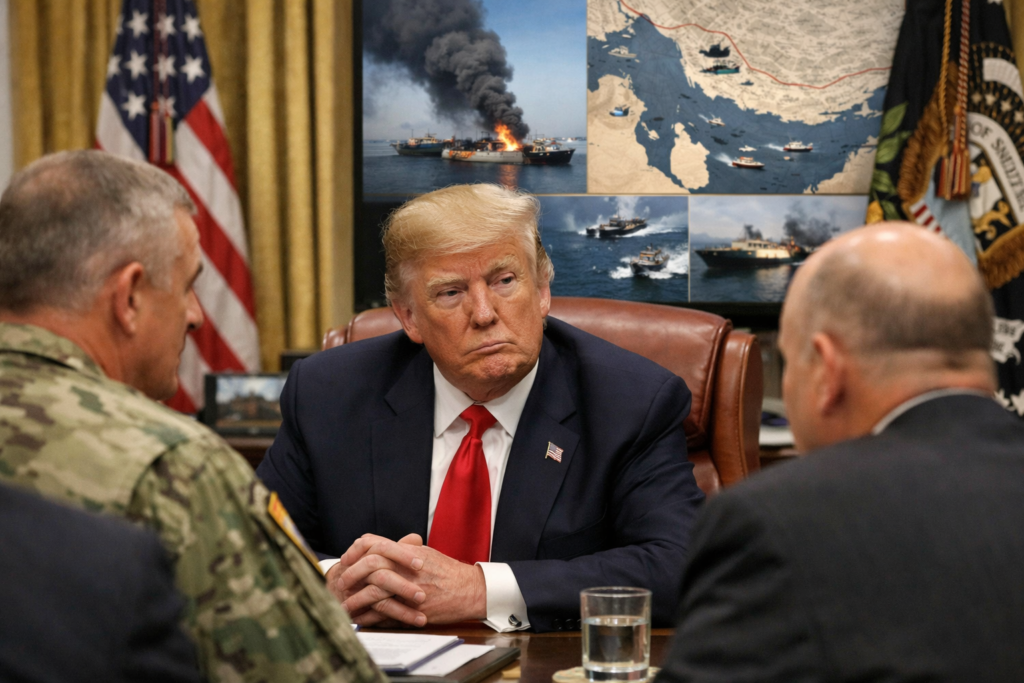
Image Credentials: Image Title: Trump Signals Readiness to End Iran Campaign Even if Strait of Hormuz Remains Closed Source: (sora.openai) Date: March 2025. Attribution: This image was created using AI-generated imagery (sora.openai) and does not depict a real-world scene.
By Open Chronicle Staff with Agencies
WASHINGTON — President Donald Trump has informed top aides that he is prepared to conclude the U.S. military campaign against Iran, even if the strategically vital Strait of Hormuz remains largely obstructed, according to a report by The Wall Street Journal.
The shift in strategy suggests the administration is prioritizing a swift exit from “Operation Epic Fury” over a prolonged maritime struggle. Citing senior administration officials, the report indicates that the President and his advisors have concluded that a full-scale operation to forcibly reopen the waterway, responsible for the transit of a fifth of the world’s oil, would extend the conflict far beyond the original four-to-six-week timeline.
Redefining Victory
Under the newly refined strategy, the United States aims to achieve its primary military objectives, paralyzing the Iranian navy and dismantling its missile stockpiles, before declaring an end to active combat operations. Once these kinetic goals are met, the administration plans to pivot back to a “maximum pressure” diplomatic and economic campaign to compel Tehran to restore free commercial traffic.
“The President is focused on a surgical and decisive conclusion,” one administration source noted. “If diplomatic pressure fails to reopen the Strait, Washington will look to allies in Europe and the Gulf to take the lead in maritime security efforts.”
Escalation Amidst Exit Talks
Despite the talk of an endgame, the U.S. military footprint in the Middle East continues to expand. This week, the amphibious assault ship USS Tripoli and the 31st Marine Expeditionary Unit entered regional waters.
Furthermore, President Trump has ordered elements of the 82nd Airborne Division to deploy and is currently weighing the dispatch of an additional 10,000 ground troops to bolster the hundreds of special operations forces already on the front lines. White House Press Secretary Karoline Leavitt reaffirmed on Tuesday that the administration is “adhering to the previously established timeline” for the operation, despite the intensifying regional volatility.
The “Ally First” Maritime Strategy
The reported decision to potentially leave the Strait of Hormuz partially closed marks a significant departure from decades of U.S. naval doctrine, which views the freedom of navigation in the Persian Gulf as a core national interest.
By shifting the burden of reopening the Strait to regional partners and European allies, Trump appears to be doubling down on his “America First” approach to collective security. Administration officials added that while further military options for the waterway remain on the table, they are not currently a “priority” compared to the immediate goal of neutralizing Iran’s offensive capabilities.
The news comes as global energy markets remain on edge, with oil prices fluctuating wildly in response to the uncertain status of Gulf shipping lanes and the potential for a prolonged “shadow war” even after U.S. conventional forces withdraw.