
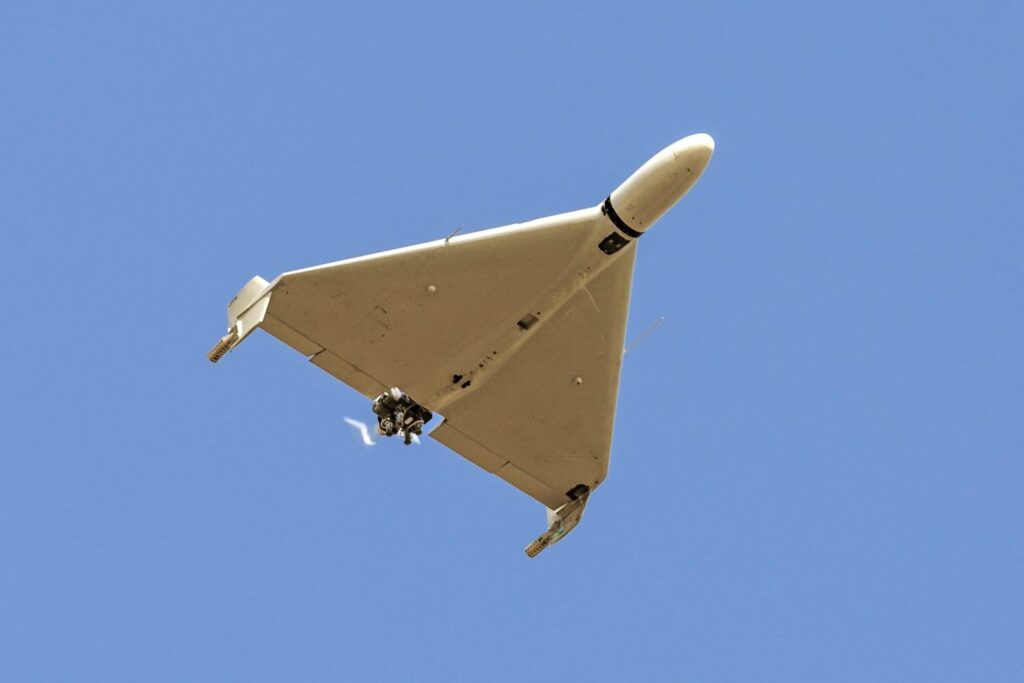
Image: from Mario Nawfal X @MarioNawfal
By Open Chronicle Staff with Agencies
DUBAI — New maritime and defense data indicate that Iran’s missile and drone operational capacity remains largely intact, contradicting recent assertions from the White House that the regime’s strike systems have been almost entirely disabled.
Despite President Trump’s March 26 claim that 90% of Iran’s missile and launch systems were “destroyed,” an analysis of data from regional defense ministries and the Tel Aviv-based Institute for National Security Studies (INSS) reveals that Tehran has launched 6,770 missiles and unmanned aerial vehicles (UAVs) since February 28.
But Iran retains the ability to surge attacks:
• 10 ballistic missiles launched at Israel—largest barrage since early in the war
• Multiple salvos launched at Israel within a two-hour window
• Drone attacks increased across Bahrain, Kuwait, and the UAE pic.twitter.com/DW7mUNc13L— JINSA (@jinsadc) April 1, 2026
The “Steady Pace” Reality
The data suggests that rather than a decline, the frequency of attacks has followed a stable, and in some cases increasing, pattern. Analysts note that if Iran’s capabilities were truly degraded to the extent claimed by Washington, the ratio of weekly strikes would have dropped significantly below 25%. Instead, recent figures show:
-
Israel: Iran launched 200 missiles and 215 drones at Israel in the last week alone, accounting for over 30% of its total monthly output.
-
The UAE: Remains the most targeted nation in the Gulf, absorbing 2,429 strikes since the conflict began.
-
Kuwait: Ranks second among Gulf states with 950 strikes, including a recent hit on the U.S. Embassy compound.
Strategic Shifts and High-Value Losses
While the volume of fire remains high, the nature of the targets is shifting. On March 27, Iran successfully destroyed a U.S. E-3 Sentry (AWACS) aircraft at Prince Sultan Air Base in Saudi Arabia, a loss valued at approximately $300 million.
The geography of the conflict also expanded following a March 28 defense agreement between Qatar and Ukraine. Iran resumed strikes on Qatari territory shortly after the deal—which focused on sharing expertise in missile and UAV warfare, was signed, ending a brief lull in attacks on Doha.
Discrepancy in Battle Damage Assessment
The gap between U.S. official statements and the reality on the ground is widening. The White House maintains that it has struck over 11,000 targets within Iran and destroyed 92% of its largest naval vessels. Simultaneously, the Israeli Defense Forces (IDF) report conducting 800 waves of airstrikes using 16,000 munitions.
However, the “retaliation strategy” employed by Tehran appears to rely on a decentralized production network and a “shadow fleet” infrastructure that has proven resilient to traditional kinetic strikes. This resilience is further evidenced by the regime’s continued ability to maintain a maritime “toll booth” at Larak Island, effectively controlling passage through the Strait of Hormuz despite the massive coalition presence.
Regional Outlook
While strikes on Saudi Arabia and Jordan have shown a slight downward trend in the last 72 hours, the persistent barrages against the UAE and Israel suggest that Iran’s “arsenal of exhaustion” is far from depleted. With U.S. embassies in Riyadh and Kuwait City now closed and nonessential personnel evacuated, the diplomatic and military pressure on the region continues to reach unprecedented levels.