
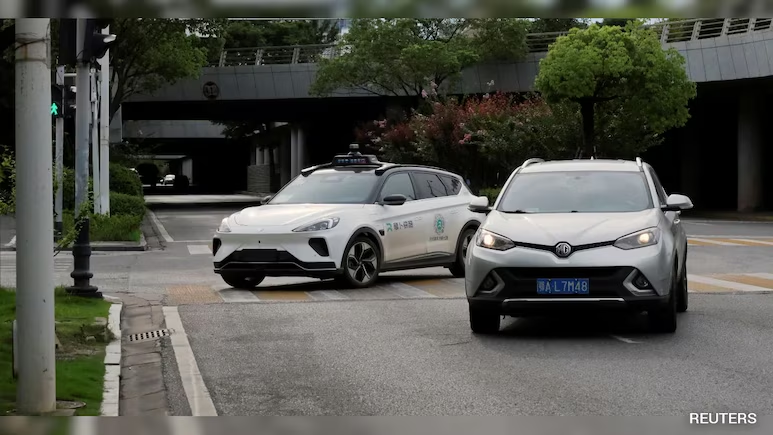
Image: from NDTV X @ndtv
By Open Chronicle Staff with Agencies
WUHAN – A major technological failure paralyzed parts of Wuhan on Tuesday evening, as more than 100 autonomous robotaxis operated by Baidu’s “Apollo Go” service simultaneously stalled in the middle of busy roads and elevated highways. The mass malfunction, which began around 9:00 PM local time on March 31, created widespread traffic congestion and left passengers trapped inside their vehicles for up to two hours.
Around 100 Baidu robotaxis stall across roads in Wuhan after system failure, causing traffic chaos.
Passengers exit safely as police respond.pic.twitter.com/S3sbSoV6Zg— Global Affairs 24 (@GlobalAffair24) April 1, 2026
“System Failure” and Fleet Paralysis
Wuhan traffic police confirmed that the disruption was caused by a “system malfunction.” While Baidu has not issued an official statement, customer service representatives reportedly attributed the incident to an “abnormal driving system” and network issues. Industry experts suggest the event may have been triggered by a widespread safety self-check mechanism that, when activated by unexpected conditions, caused the vehicles to immobilize automatically.
The incident highlights a significant vulnerability in large-scale autonomous deployments: correlated failure. Unlike human-driven fleets, where accidents are typically isolated events, centrally managed autonomous networks can experience synchronized errors. When the backend system experiences a critical fault, the entire fleet can be affected simultaneously.
Passenger Ordeals
Passengers trapped in the vehicles described distressing scenarios, particularly those stranded on elevated expressways where exiting the car into high-speed, rush-hour traffic was deemed too dangerous.
-
Communication Failures: Reports indicate that many in-car SOS buttons and backseat communication screens were unresponsive or disconnected, forcing passengers to contact emergency services via their personal mobile phones.
-
Emergency Response: Local traffic police and Apollo Go staff were dispatched to facilitate the safe extraction of stranded riders. Authorities confirmed that there were no injuries, though the stalled vehicles were involved in several minor rear-end collisions.
Renewed Safety Debates
This event has reignited public debate in China regarding the readiness of fully autonomous transport for mass commercial use. Wuhan serves as the primary operational hub for Apollo Go, hosting a fleet of more than 1,000 vehicles.
Critics point to this incident as evidence that current regulatory frameworks, often built around individual vehicle defects, are ill-equipped to handle the systemic risks posed by massive, interconnected autonomous networks. While statistics often show that autonomous vehicles are safer than human drivers on average, the Wuhan incident demonstrates that fleet-wide failures can introduce entirely new types of risks in dense urban environments.
Operations have since resumed, and Baidu is under pressure to provide a transparent account of the failure as the company continues its aggressive global expansion.