
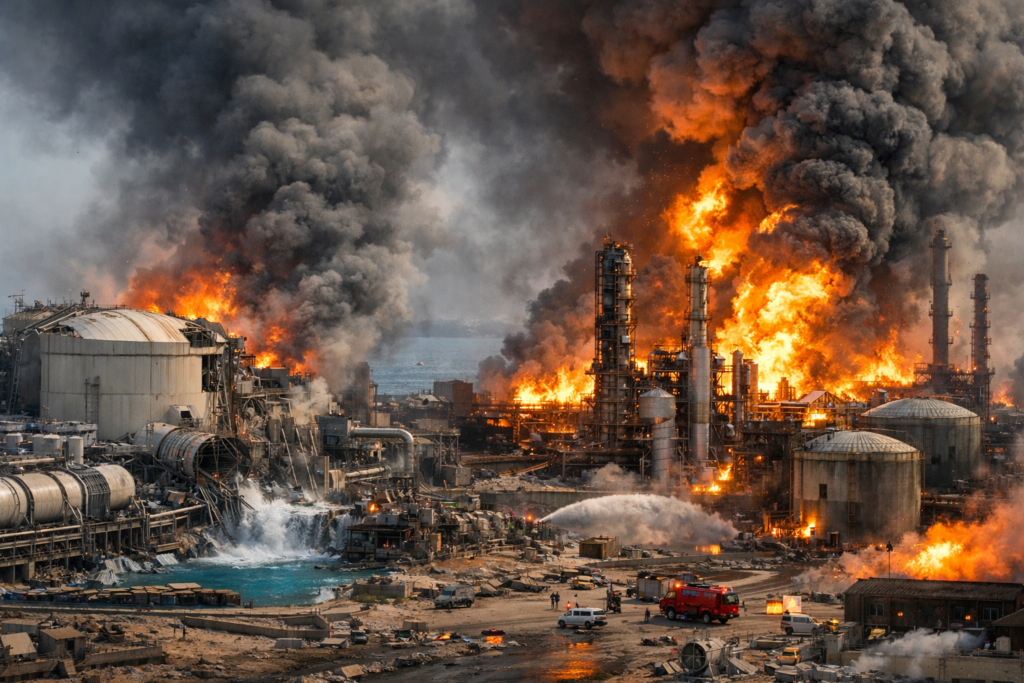
Image Credentials: Image Title: Regional War Enters Fifth Week: Iran Strikes Gulf Desalination Plants as “Pragmatic” Peace Proposal Emerges Source: (sora.openai) Date: April 2026. Attribution: This image was created using AI-generated imagery (sora.openai) and does not depict a real-world scene.
By Open Chronicle Staff with Agencies
DUBAI, UAE – As the conflict between the U.S.-Israeli coalition and Iran nears the end of its fifth week, Tehran launched a series of high-impact strikes on Friday targeting critical civilian infrastructure across the Persian Gulf. The attacks, which damaged a major desalination plant and set a Kuwaiti oil refinery ablaze, come despite repeated claims from President Trump that Iran’s military capabilities have been “eviscerated.”
While the kinetic war intensifies, a potential diplomatic crack appeared on Friday. Former Iranian Foreign Minister Mohammad Javad Zarif published a surprise proposal in Foreign Affairs magazine, suggesting a middle ground to end a stalemate he described as a “loss of precious lives.”
Critical Infrastructure Under Fire
The Iranian “retaliation strategy” shifted focus Friday toward the lifeblood of the Gulf states: water and energy.
-
Kuwait: The state-run Kuwait Petroleum Corp. reported multiple fires at the Mina al-Ahmadi refinery. Simultaneously, a desalination plant—essential for drinking water in the arid region—sustained “material damage.”
-
UAE: Authorities were forced to shut down a gas field after intercepted missile debris sparked a fire.
-
Regional Alerts: Sirens sounded in Bahrain and Israel, while Saudi Arabia reported destroying a fresh wave of Iranian drones.
The Zarif Proposal: A “Pragmatic” Gamble?
Mohammad Javad Zarif, the architect of the 2015 nuclear deal, called for an immediate end to the “suffering.” His proposal suggests Iran place strict limits on its nuclear program and reopen the Strait of Hormuz in exchange for a total lift of all sanctions.
The proposal attempts to bridge the gap between Washington’s 15-point plan (which demands the dismantling of all nuclear sites) and Tehran’s 5-point counterproposal (which demands the removal of all U.S. bases from the Middle East). However, Zarif’s influence remains uncertain; many of Iran’s top leaders have been killed in “Operation Epic Fury,” and Zarif hinted at domestic pushback immediately after the article’s release.
The Human and Economic Toll
The cost of the five-week war continues to climb across multiple fronts:
-
Casualties: Over 1,900 people have been killed in Iran. In Lebanon, where Israel has launched a ground invasion against Hezbollah, more than 1,300 have died, and 1 million are displaced.
-
U.S. Losses: The Pentagon confirms 13 U.S. service members have been killed to date.
-
Oil Crisis: Brent crude hit $109 per barrel on Friday, a 50% increase since the war began on February 28.
UN Security Council Deadlock
The UN Security Council is expected to vote Saturday on a proposal from Bahrain to authorize “defensive action” to secure the Strait of Hormuz. While the U.S. supports the measure, veto-holding members Russia, China, and France have signaled opposition to any language that authorizes the “use of all necessary means” (force), fearing it would lead to a broader global conflagration.
As thousands of U.S. Marines and paratroopers arrive in the region, speculation of a looming ground offensive grows, even as the “pragmatic wing” in Tehran reaches for a diplomatic exit.