
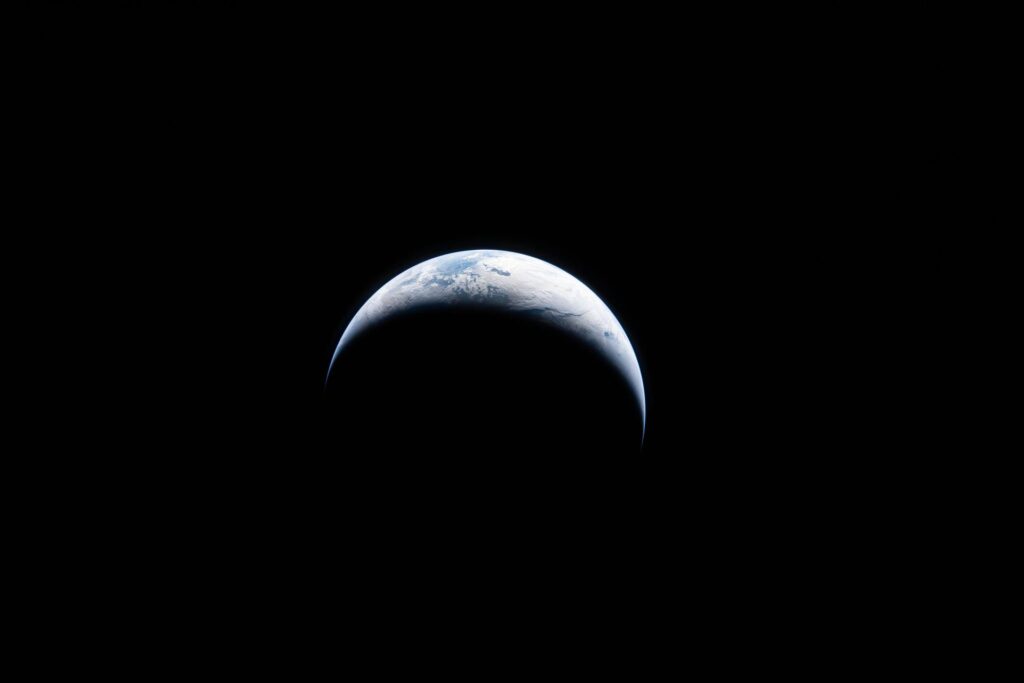
Image: from R A W S A L E R T S X @rawsalerts
By Open Chronicle Staff with Agencies
HOUSTON — The four-person crew of NASA’s Artemis II mission began their fifth day of deep-space travel on Sunday, marking a historic return to the lunar vicinity for the first time in over five decades. As the Orion spacecraft streaks toward the Moon, the crew has already become the first humans to witness the massive Orientale basin, often called the Moon’s “Grand Canyon,” with their own eyes.
🚨#BREAKING: New Stunning, breathtaking images of our home, Mother Earth, captured by the Artemis II crew as they make history set to fly around the Moon tomorrow in a mission that marks a new era of exploration. pic.twitter.com/Du0BY2SJu9
— R A W S A L E R T S (@rawsalerts) April 6, 2026
A Call from the Past
The crew’s morning began with a poignant reminder of the Apollo legacy. Charlie Duke, the 90-year-old Apollo 16 moonwalker, provided the ceremonial wake-up call from Mission Control in Houston.
“Below you on the Moon is a photo of my family,” Duke told the crew, referring to the family portrait he famously left on the lunar surface in 1972. “I pray it reminds you that we in America and all of the world are cheering you on.”
WATCH: The Artemis II crewed mission was set to shatter the Apollo 13 record for the farthest distance humans have traveled from Earth, reaching 252,760 miles, in a lunar flyby that would also give astronauts a rare view of the Moon's far side pic.twitter.com/DcizK3Zcwu
— Reuters Science News (@ReutersScience) April 6, 2026
Technical Milestones and Vital Statistics
According to NASA’s mission dashboard, Orion was approximately 346,000 kilometers from Earth and just over 100,000 kilometers from the Moon as of Sunday morning. The mission is currently approaching the “lunar sphere of influence,” the point where the Moon’s gravitational pull surpasses that of the Earth.
| Mission Metric | Current Status (Approx.) |
| Distance from Earth | 346,000 km |
| Distance to Moon | 104,600 km |
| Mission Duration | Day 5 of 10 |
| Key Objective | Testing life support and “survival” suits |
The “Grand Canyon” of the Moon
Astronaut Christina Koch, participating in a live Q&A with the Canadian Space Agency, expressed the crew’s awe at seeing the Orientale basin. While the bullseye-shaped crater has been mapped by satellites for decades, the Artemis II crew—Koch, Reid Wiseman, Victor Glover, and Canadian Jeremy Hansen—are the first humans to view the entire basin directly.
“It’s very distinctive and no human eyes have previously seen this crater until today,” Koch said. “We were privileged enough to see it.”
Testing the “Life Support Ecosystem”
NASA Chief Jared Isaacman emphasized that while the sights are spectacular, the primary goal of Artemis II is data collection on the Orion spacecraft’s performance with a human crew.
Sunday’s schedule is dominated by rigorous testing of the crew’s bright orange “survival” suits. These pressurized suits are critical for launch, re-entry, and emergency scenarios like cabin depressurization. The crew will simulate emergency seat entry and assess their ability to eat and drink while fully suited.
Breaking Records
As Orion prepares to whip around the far side of the Moon, the crew is expected to set a new record for the farthest distance from Earth ever traveled by humans. This “free-return trajectory” will use the Moon’s gravity to slingshot the spacecraft back toward Earth for a splashdown later this week.
“The information will be paramount to set up for subsequent missions like Artemis III in 2027 and the lunar landing on Artemis IV in 2028,” Isaacman noted.