
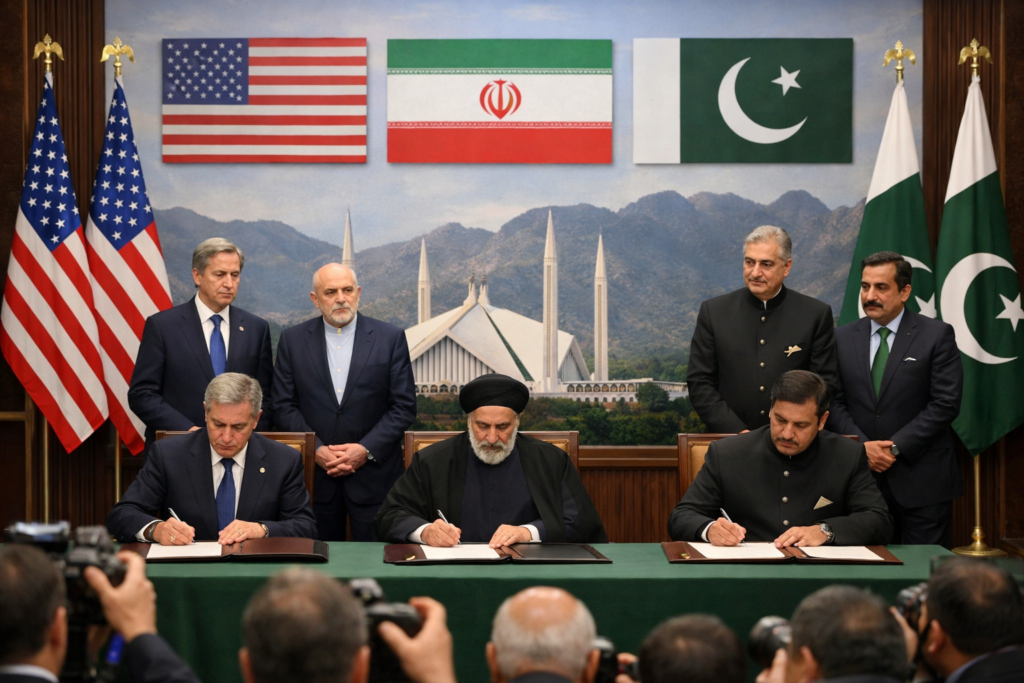
Image Credentials: Image Title: Diplomatic Breakthrough Pakistan Proposes ‘Islamabad Accord’ to End U.S.-Iran Hostilities Source: (sora.openai) Date: April 2026. Attribution: This image was created using AI-generated imagery (sora.openai) and does not depict a real-world scene.
By Open Chronicle Staff with Agencies
ISLAMABAD/WASHINGTON — A high-stakes diplomatic framework aimed at halting the month-long conflict between the United States and Iran has been delivered to both Washington and Tehran, sources confirmed Monday. The proposal, brokered by Pakistan, outlines an immediate ceasefire and the reopening of the strategic Strait of Hormuz.
The “Islamabad Accord,” as the tentative deal is being called, comes just hours before President Donald Trump’s Tuesday “deadline” for the destruction of Iranian infrastructure.
🚨🇺🇸🇮🇷 BREAKING: Reuters alleges Iranian war may end on Monday.
A framework to end hostilities has been put together by Pakistan and exchanged with Iran and the U.S. overnight, according to Reuters source.
The plan is to immediately end hostilities and begin working on a… pic.twitter.com/5Esq8mqdyj
— RTSG News (@RTSG_News) April 6, 2026
The Two-Tiered Framework
According to reports from Reuters and APA, the plan was finalized overnight following marathon communications led by Pakistan’s Army Chief, Field Marshal Asim Munir. Munir reportedly remained in constant contact with U.S. Vice President JD Vance, special envoy Steve Witkoff, and Iranian Foreign Minister Abbas Araqchi.
The proposed deal is structured in two distinct phases:
-
Immediate Ceasefire: An electronic Memorandum of Understanding (MoU) to stop all hostilities today and immediately reopen the Strait of Hormuz to global oil traffic.
-
Comprehensive Settlement: A 15–20 day window to negotiate a permanent regional framework, culminating in face-to-face talks in Islamabad.
Key Concessions and Obstacles
The final agreement is expected to address the core grievances of both nations. The U.S. is seeking a firm Iranian commitment to abandon its nuclear weapons program, while Tehran is demanding a permanent ceasefire and guarantees against future attacks from the U.S. and Israel, alongside the release of frozen assets and sanctions relief.
| Proposed Term | U.S. / Ally Objective | Iranian Objective |
| Nuclear Status | Permanent cessation of enrichment | Civilian energy rights / Security guarantees |
| Economic | Stabilization of global oil markets | Lifting of sanctions / Asset release |
| Security | Reopening of the Strait of Hormuz | Non-aggression pact from U.S. and Israel |
A Tense Wait for Tehran
While the United States and regional mediators, including China, have signaled support for the 45-day temporary ceasefire first reported by Axios, Iran has yet to formally commit.
“Iran has not responded yet,” a Pakistani source told Reuters, noting that despite “intensified civilian and military outreach,” the leadership in Tehran remains cautious. Iranian officials have previously insisted on ironclad guarantees that they will not face a renewed offensive once the ceasefire expires.
Global Markets on Edge
The urgency of the diplomatic push cannot be overstated. With 20% of the world’s oil supply currently bottlenecked by the closure of the Strait, energy markets have seen unprecedented volatility.
President Trump has maintained a high-pressure campaign, recently using social media to warn that “Tuesday at 8:00 P.M.” marks the end of his patience. Should the Islamabad Accord fail to gain traction today, the risk of a massive escalation targeting Iranian power plants and bridges remains the stated policy of the White House.
As of Monday morning, neither the White House nor the Iranian Foreign Ministry has issued an official response to the Pakistani proposal.