
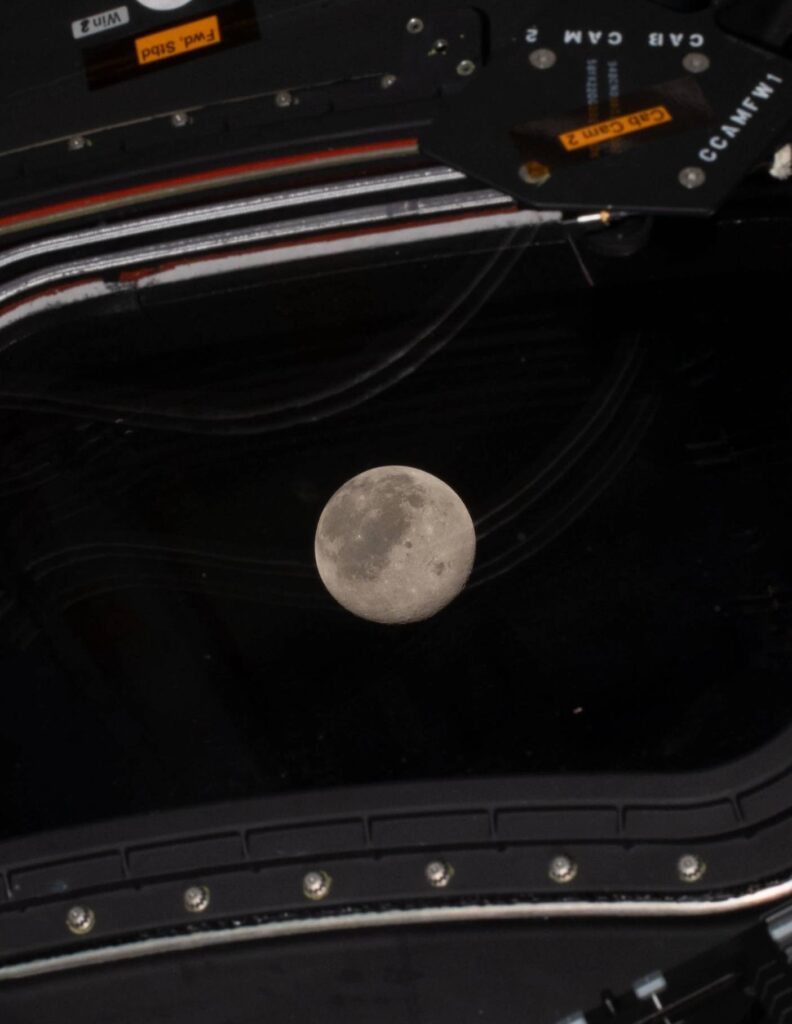
Image: from Black Hole X @konstructivizm
By Open Chronicle Staff with Agencies
HOUSTON — For the first time in 56 years, the record for the farthest human journey into the cosmos has been shattered. On Monday, the four astronauts of the Artemis II mission officially surpassed the legendary distance set by the crew of Apollo 13, venturing deeper into the void than any humans in history.
The milestone occurred as the Orion spacecraft swung around the far side of the Moon, placing the crew approximately 252,760 miles (406,778 kilometers) away from Earth. This exceeds the 1970 record by roughly 4,105 miles (6,606 kilometers).
pic.twitter.com/Zj5Ed004IO
🚀 TEARS IN SPACE: Artemis II makes history! 🌌😭
The Orion crew has officially passed the 248,655-mile mark—traveling farther from Earth than Apollo 13 ever did. A new record, a new era, and history rewritten among the stars. 🌕🛰️#ArtemisII #NASA…— Defense_Vortex 🇺🇸 (@Defense_Vortex) April 6, 2026
A Voice from the Past
The historic day began at 10:50 AM ET with a poignant wake-up call for NASA astronauts Reid Wiseman, Victor Glover, and Christina Koch, and CSA astronaut Jeremy Hansen. The crew was greeted by a pre-recorded message from the late Jim Lovell, the Apollo 8 and 13 commander who passed away last year at age 97.
“Welcome to my old neighborhood,” Lovell’s voice crackled through the Orion cabin. “It’s a historic day… don’t forget to enjoy the view. Good luck and godspeed.”
The Artemis II crew has broken the record for furthest distance from Earth ever travelled by humans.
pic.twitter.com/pJvJSAU9wf— John Luke (@yesknow) April 6, 2026
Into the Lunar Shadow
At 2:34 PM ET, the mission entered its most critical phase: the lunar flyby. As Orion passed behind the Moon, the spacecraft plunged into darkness, resulting in brief communication blackouts as the lunar mass blocked signals to NASA’s Deep Space Network on Earth.
During this six-hour window, the astronauts transitioned from pilots to observers and photographers. From a vantage point 4,000 miles above the lunar surface, the crew described a “basketball-sized Earth” setting and rising over the rugged, cratered horizon of the Moon’s far side, a “celestial remix” of the moonrise seen from Earth.
Science at the Edge of the Void
While the astronauts captured high-resolution imagery for public record, a team of dozens of researchers in the Science Evaluation Room at the Johnson Space Center in Houston monitored their real-time descriptions.
The crew, having undergone extensive geological and lunar phenomena training, provided live commentary on:
-
Unique Lighting Conditions: Observing how sunlight filters around the jagged edges of the lunar limb.
-
Geological Features: Identifying craters and basins on the far side that are never visible from Earth.
-
System Integrity: Testing how the Orion’s life-support systems hold up at maximum distance and during solar transitions.
The Path to Mars
This record-breaking flyby is more than a feat of distance; it is a stress test for NASA’s broader lunar ambitions. The Artemis program aims to land humans back on the lunar surface by 2028, with the ultimate goal of establishing a permanent base.
“This is our proving ground,” NASA officials stated. “By mastering these distances now, we are laying the literal and metaphorical groundwork for the first crewed missions to Mars in the coming decades.”
The Orion capsule is now utilizing the Moon’s gravity to “slingshot” back toward home, with a scheduled splashdown in the Pacific Ocean on April 10.