
OPEN CHRONICLE | GLOBAL NEWS DESK | MIDDLE EAST & GLOBAL ENERGY SECURITY
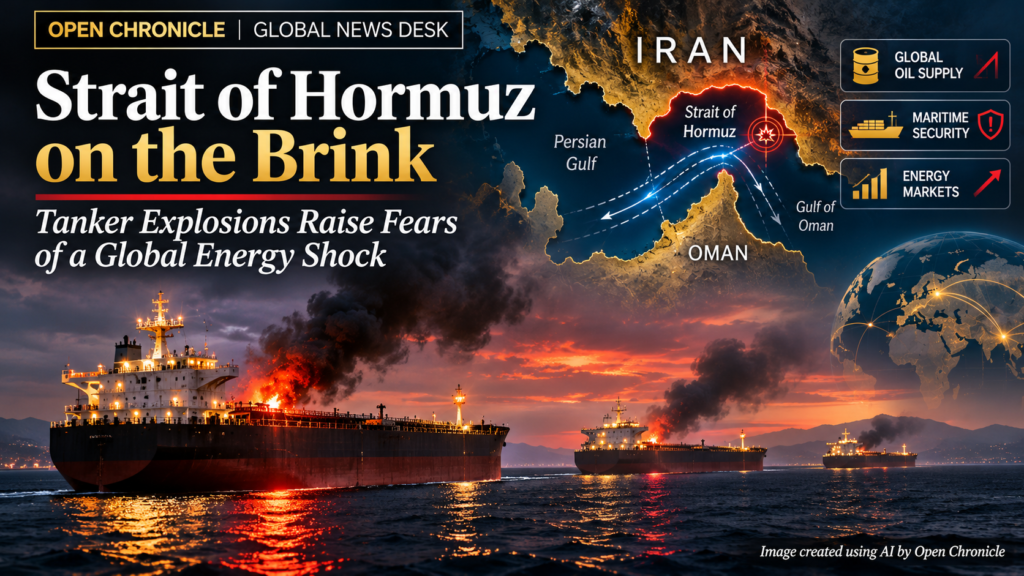
Iran says three oil tankers caught fire after striking naval mines in the Strait of Hormuz, intensifying concerns over the safety of one of the world’s most important maritime trade routes. With Washington and Tehran locked in confrontation, the latest incidents expose the fragile balance between military pressure, global energy supplies and the security of international shipping.
By Open Chronicle News Desk
November 14, 2026 | Special Report | Middle East, Maritime Security & Energy
Editorial Verification
November 14, 2026
Reuters and AFP report that Iranian naval authorities announced three tanker incidents involving alleged naval mines. The vessels were not identified, and the cause of the reported explosions has not been independently established. Maritime security authorities have separately documented attacks on commercial shipping in the region.
1. Three Tankers, One of the World’s Most Dangerous Waterways
The Strait of Hormuz has become the center of another dangerous escalation in the confrontation between Iran and the United States.
On November 14, Iranian naval authorities reported that three oil tankers had caught fire after allegedly striking naval mines while attempting to navigate the strategic waterway.
According to statements carried by Iranian state media, two vessels were traveling through a route that Tehran considers unauthorized when explosions occurred.
Iran’s Islamic Revolutionary Guard Corps Navy claimed that the ships had disabled their radar and positioning systems before attempting to cross the strait.
One was described as a supertanker.
Iran’s conventional navy separately reported a third incident east of the strait, where another tanker allegedly struck a mine and was forced to stop.
The Iranian statements did not identify the vessels, their flags, operators or cargoes.
Independent confirmation of the reported mine strikes was not immediately available.
That distinction is crucial.
While the announcements add to mounting evidence of a deteriorating maritime security environment, they do not independently establish what caused each explosion or whether the incidents occurred exactly as described by Iranian authorities.
Nevertheless, the implications are serious.
The Strait of Hormuz is a vital passage for oil and liquefied natural gas shipments from the Persian Gulf to international markets.
A prolonged deterioration in maritime security could affect energy prices, shipping insurance, supply chains and the economic stability of countries far beyond the Middle East.
2. Why the Strait of Hormuz Matters to the World
The Strait of Hormuz connects the Persian Gulf with the Gulf of Oman and the wider Indian Ocean.
It lies between Iran to the north and Oman to the south.
At its narrowest point, the waterway is approximately 33 kilometers wide, although established shipping lanes occupy a much smaller portion of that space.
Its importance is difficult to overstate.
Before the latest conflict, roughly one-fifth of global petroleum liquids consumption passed through the strait, according to widely used international energy estimates.
Significant volumes of liquefied natural gas also depended on the route, particularly exports from Qatar.
Saudi Arabia, Iraq, Kuwait, the United Arab Emirates and other regional producers rely on Gulf maritime infrastructure to reach international customers.
Some oil can be redirected through pipelines that bypass the strait, but the available alternatives cannot simply replace all maritime flows.
For major Asian economies, including China, India, Japan and South Korea, disruptions can create immediate concerns about energy security.
Europe is also exposed through international energy prices, LNG markets and shipping costs.
The danger is therefore not limited to the physical loss of oil or gas shipments.
Even the perception that commercial vessels face unacceptable risks can change market behavior.
Shipowners may delay voyages.
Insurers may increase premiums.
Energy traders may price in additional geopolitical uncertainty.
And governments may begin competing to secure alternative supplies.
3. Iran’s Claims and the Problem of Independent Verification
Iranian authorities have increasingly described incidents involving commercial vessels as the consequence of ships entering restricted areas or ignoring instructions from Tehran.
In the latest announcements, the Revolutionary Guards claimed that two tankers attempted to cross without authorization.
The conventional navy presented a similar explanation for the third reported incident.
However, those accounts remain claims by a party directly involved in the conflict.
They must be distinguished from independently verified maritime incidents.
International monitoring organizations have documented attacks involving projectiles, fires and damage to commercial vessels.
In some cases, the precise weapon or mechanism responsible has remained unclear.
The distinction between a naval mine, a missile, a drone and another explosive device is significant.
Each implies different operational risks and may lead to different conclusions about responsibility.
A mine strike could indicate that hazardous devices remain in navigable waters.
A missile or drone attack could indicate deliberate targeting of an individual vessel.
An explosion without independently established cause cannot automatically be attributed to either.
For maritime authorities and insurers, accurate identification matters because it determines which routes can be considered safe and what protective measures are appropriate.
For journalists, it also establishes the limits of what can responsibly be reported as fact.
4. The United States and Iran Are Fighting for Control of Maritime Access
The latest tanker incidents cannot be separated from the wider confrontation between Washington and Tehran.
Since the conflict escalated earlier in 2026, Iran has attempted to impose restrictions on shipping through the strait.
Tehran has insisted that vessels obtain authorization before using routes it considers subject to its control.
The United States has responded with naval pressure against Iranian ports and military support for vessels navigating the waterway.
Washington maintains that international maritime traffic must not be subjected to unilateral restrictions imposed through military threats.
The competing positions have transformed commercial shipping into an instrument of strategic pressure.
For Iran, restricting access to the strait creates economic leverage over the United States and countries dependent on Gulf energy exports.
For Washington, preserving navigation is essential to maintaining the credibility of its regional security commitments and preventing a broader economic shock.
The confrontation has created a dangerous operating environment.
Commercial crews are exposed to risks arising from military activity over which they have little control.
Even ships that attempt to avoid confrontation can become vulnerable if navigational guidance, military warnings and commercial traffic management are inconsistent.
The result is a maritime corridor in which political decisions and military incidents can rapidly produce consequences for international trade.
5. A Growing Pattern of Attacks on Commercial Shipping
The latest Iranian announcements follow a series of incidents reported across the Gulf.
On November 12, Reuters reported that Iranian authorities had claimed four tankers were involved in explosions after entering areas Tehran considered restricted.
Those reports also lacked immediate independent confirmation.
Other incidents have been documented by maritime monitoring organizations.
The United Kingdom Maritime Trade Operations agency has recorded attacks on vessels near the strait, including cases involving unidentified projectiles and fires.
A November 12 advisory from the Joint Maritime Information Center classified the regional maritime threat level as severe.
Meanwhile, shipping industry organization INTERTANKO reported that attacks had continued across the Gulf during November, with casualties among seafarers.
The organization’s assessment also warned against automatically interpreting damage attributed to unidentified floating objects as proof that naval mines were responsible.
This distinction highlights the complexity of the situation.
There is substantial evidence that commercial shipping faces serious danger.
There is not necessarily equivalent evidence supporting every claim about the exact mechanism of each attack.
The cumulative effect, however, is increasingly difficult to ignore.
The Gulf is experiencing sustained maritime insecurity at a time when international markets remain heavily dependent on its energy exports.
6. Could the Tanker Incidents Trigger Another Oil Price Shock?
The possibility of another energy shock is one of the most important consequences of the escalating maritime crisis.
Oil markets respond not only to actual disruptions but also to expectations about future supply.
If traders believe that tankers may be unable to pass safely through the Strait of Hormuz, they may anticipate shortages or higher transportation costs.
This can influence prices even before a measurable reduction in deliveries occurs.
The effects would depend on several variables.
How many vessels are prevented from transiting?
How much export capacity can be redirected?
Are alternative suppliers able to increase production?
Do governments release strategic petroleum reserves?
And how long does the disruption last?
A short interruption affecting a limited number of ships would have different consequences from a sustained closure of major shipping routes.
Energy markets have already demonstrated some resilience during the conflict.
Shipping traffic has recovered at various points, and higher freight rates have encouraged some operators to continue sailing despite the risks.
But this recovery should not be confused with the restoration of normal maritime security.
A waterway can remain commercially active while still presenting serious risks to crews, cargoes and the environment.
The central concern is whether repeated incidents eventually push insurers, shipping companies or governments to conclude that the risks are no longer acceptable.
7. The Hidden Human Cost of the Maritime Crisis
Much of the international attention surrounding the Strait of Hormuz focuses on oil prices, naval deployments and geopolitical competition.
The people working aboard commercial vessels receive considerably less attention.
Seafarers operating in the region may face missile attacks, drone strikes, explosions, fires and the possibility of being stranded aboard damaged ships.
Their safety depends on emergency communications, access to rescue services and the ability to navigate rapidly changing security conditions.
In an incident involving a loaded oil tanker, a fire can threaten lives and create a major environmental hazard.
A damaged vessel may also become difficult to move safely, especially in a congested shipping corridor.
Crew evacuation can require coordination between commercial operators, coastal authorities and military forces.
These operations become more complicated when the surrounding waters are contested.
The consequences of maritime insecurity therefore extend beyond international energy markets.
They affect workers whose livelihoods depend on transporting goods through increasingly dangerous waters.
8. Environmental Risks: Oil Spills and Water Security
The environmental consequences of tanker attacks could be severe.
A major oil spill in the Persian Gulf would threaten marine ecosystems, fisheries, coastal communities and desalination infrastructure.
This last concern is particularly important.
Several Gulf countries depend heavily on desalinated seawater for domestic and industrial water supplies.
Oil contamination near desalination facilities can complicate water treatment and potentially interrupt operations.
A large spill could therefore create a crisis involving both energy and drinking water.
The region’s environmental vulnerability is amplified by its geography.
The Persian Gulf is relatively shallow and semi-enclosed, with limited water exchange compared with open oceans.
Pollution can consequently create persistent problems for coastal environments.
The risks are not hypothetical in a general sense.
Recent reporting has documented pollution associated with damaged vessels in the Gulf.
However, there is no independently verified basis at present for attributing a specific major oil spill to the three tanker incidents announced on November 14.
Environmental consequences should be assessed vessel by vessel, using confirmed information about cargo, damage and location.
9. Can International Naval Forces Keep the Strait Open?
Maintaining safe passage through the Strait of Hormuz presents several military and operational challenges.
Naval forces may escort commercial vessels, monitor suspected threats and conduct mine countermeasure operations.
However, ensuring the safety of every ship is difficult.
The strait is geographically constrained, heavily trafficked and located close to Iranian territory.
Threats can emerge from different directions and involve different weapons.
Even after naval forces announce that particular routes have been cleared of mines, newly reported incidents can create uncertainty about whether those routes remain safe.
The United States has said that major shipping corridors have been cleared.
Iranian authorities continue to claim that vessels are encountering mines in areas they describe as restricted.
These competing statements cannot be resolved through political declarations alone.
Independent maritime assessments, updated navigational warnings and reliable information about specific incidents are essential.
The objective must be to distinguish routes where navigation is demonstrably safer from areas where serious hazards remain.
Without that distinction, commercial operators may face contradictory instructions from military authorities.
10. The Diplomatic Dilemma: Escalation or Negotiation?
The maritime crisis is unfolding alongside attempts to reduce tensions between Washington and Tehran.
Regional governments have strong incentives to prevent further escalation.
Gulf states depend on stable maritime access for trade, energy exports and economic development.
A prolonged confrontation could undermine investment, raise transportation costs and threaten critical infrastructure.
Diplomatic efforts involving regional intermediaries therefore remain important.
Yet negotiations face difficult questions.
Would Iran agree to stop restricting commercial shipping?
Would Washington ease military or economic pressure in return?
How would compliance be verified?
Could maritime security arrangements be separated from wider disputes over Iran’s nuclear program and regional military activities?
And who would guarantee that commercial vessels could transit safely?
These questions illustrate why reopening a waterway is not necessarily the same as establishing durable maritime security.
A sustainable arrangement would require clear rules, credible monitoring and a reduction in the threat of renewed attacks.
11. What Happens If the Crisis Spreads?
The Strait of Hormuz is connected to a wider network of strategically important maritime routes.
Disruption in the Persian Gulf can affect shipping decisions across the Indian Ocean, the Red Sea and the Suez Canal.
If vessels avoid one dangerous corridor, alternative routes may become more congested or expensive.
Higher shipping costs can eventually influence the prices of manufactured goods, food and energy.
The effects can be particularly difficult for economies that depend on imported fuel.
Countries already facing inflation, currency pressure or fiscal constraints may have limited capacity to absorb sudden increases in energy costs.
A prolonged crisis could also accelerate efforts to diversify energy supplies.
Governments may invest in additional storage, alternative pipelines, renewable energy and domestic production.
However, these investments generally take years.
They cannot eliminate the immediate consequences of a serious maritime disruption.
The Strait of Hormuz therefore remains a critical vulnerability in the global economy, even as countries attempt to reduce their exposure.
12. The Questions That Will Determine What Happens Next
Several developments will be decisive in the coming days.
First, whether the three tankers reported by Iranian authorities can be independently identified.
Second, whether maritime investigators establish that naval mines caused the explosions.
Third, whether commercial traffic through the strait continues to recover or begins declining again.
Fourth, whether the United States and Iran escalate their military responses.
Fifth, whether diplomatic contacts produce practical measures to protect civilian shipping.
Finally, whether the latest incidents result in measurable changes to oil prices, freight rates or insurance costs.
These indicators will help distinguish a serious but contained security incident from a broader international energy crisis.
The difference matters enormously.
A period of elevated risk does not automatically mean that the strait has been closed.
But repeated attacks can progressively undermine confidence until shipping becomes commercially or operationally unsustainable.
Conclusion | A Narrow Waterway With Global Consequences
The latest tanker incidents demonstrate how vulnerable the global economy remains to instability in the Strait of Hormuz.
Iran’s claims about naval mines have not been independently established, but the broader pattern of attacks against commercial shipping is well documented.
The danger is no longer confined to the possibility of a temporary interruption in oil deliveries.
It involves the security of civilian crews, the protection of critical maritime infrastructure, the environmental vulnerability of Gulf waters and the risk of further military escalation between Washington and Tehran.
For energy markets, the immediate question is whether shipping can continue despite the danger.
For governments, the larger challenge is whether maritime security can be restored without expanding the conflict.
The Strait of Hormuz is only a narrow passage between two coastlines. Yet the consequences of losing confidence in its safety can extend across the entire world economy.
Sources and Further Reading
International reporting, official maritime security advisories and shipping industry assessments concerning the November 2026 Strait of Hormuz crisis.
Iran’s Navy Says Oil Tanker on Fire After Hitting Mine in Hormuz
Reporting on the Iranian naval announcement and the absence of immediate independent verification.
Iran Reports Three Incidents of Oil Tankers Hit by Mines in Hormuz
Coverage of statements by Iran’s Revolutionary Guards and conventional navy concerning three reported tanker incidents.
Four Tankers Struck by Explosions in Strait of Hormuz, Iran Says
Earlier reports concerning vessel explosions, Iranian claims and independently reported maritime security incidents.
Hormuz Traffic Is Up. So Are the Attacks
Analysis of recovering shipping activity, rising vessel attacks, risks to seafarers and the environmental consequences of maritime insecurity.
Regional Tension: Impact on Maritime Security
Official maritime security advisory detailing the regional threat assessment and documented incidents affecting commercial shipping.
Advice for Members Regarding the Situation in the Gulf Region
Shipping industry assessment of attacks, crew safety and uncertainty over the weapons involved in recent incidents.
This report was prepared using information available on November 14, 2026. Iranian claims that three oil tankers struck naval mines have not been independently established. The reported vessels have not been publicly identified in the cited accounts. Confirmed maritime security incidents are distinguished from statements by parties involved in the conflict. Economic and geopolitical consequences discussed in the article are analytical assessments rather than forecasts of certain outcomes.