
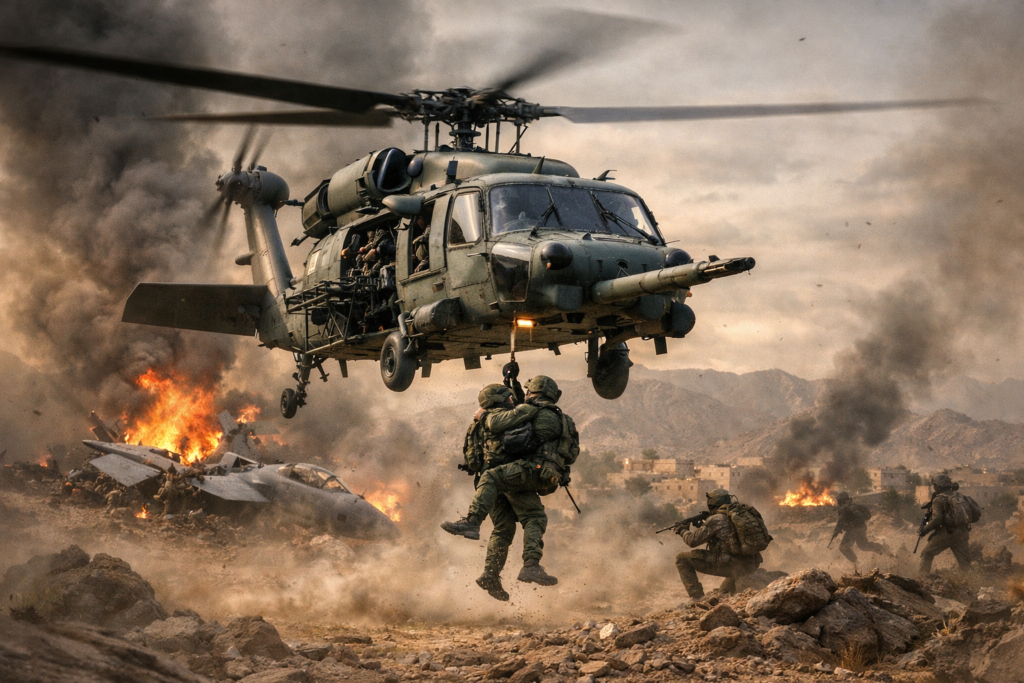
Image Credentials: Image Title: FROM COMBAT HERO TO BUDGET CUT THE FATE OF THE JOLLY GREEN II Source: (sora.openai) Date: April 2026. Attribution: This image was created using AI-generated imagery (sora.openai) and does not depict a real-world scene.
By Open Chronicle Staff with Agencies
WASHINGTON — In the high-stakes theater of modern warfare, the HH-60W “Jolly Green II” has just proven its worth in the most harrowing of circumstances. On Friday, the U.S. Air Force’s newest combat rescue helicopter completed its first-ever rescue behind enemy lines, retrieving a downed F-15 pilot during the ongoing conflict in Iran.
President Donald Trump lauded the rotorcraft as a “fabulous machine” during a Monday press briefing, describing the operation as “amazing.” Yet, despite this high-profile victory, the helicopter is facing a different kind of battle at home: a fight for its financial life.
A Tale of Two Rescues
The HH-60W, built by Lockheed Martin subsidiary Sikorsky, was specifically designed to replace the aging HH-60G Pave Hawk. Its success in rescuing the F-15 pilot—the first combat retrieval of an operator in its history—served as a powerful advertisement for its capabilities.
However, a second rescue conducted two days later revealed the Air Force’s shifting strategy. The F-15’s weapon systems officer (WSO) was retrieved using “other assets,” a move military leaders say proves that the Air Force does not need to rely solely on the Jolly Green II for personnel recovery.
The Fiscal 2027 Budget Battle
Just days after the rescue, the Trump administration released the Fiscal 2027 budget request, which notably includes zero funding for additional HH-60Ws. The Air Force has sought to cap the fleet at 75 aircraft—down from an original goal of 113—arguing that the slow-moving, non-stealthy helicopters are “useful in the Middle East” but would be “sitting ducks” in a high-tech conflict with a near-peer adversary like China.
Congress, however, has repeatedly pushed back, raising the program of record to at least 89 aircraft and providing a $100 million “plus-up” for additional helicopters in 2026.
“Senator Blumenthal will continue to champion additional procurement of the HH-60W,” a spokesperson for the Connecticut Senator (D-CT) stated. “We cannot allow gaps in the mission that saves our airmen’s lives.”
Future Rivals: MV-75 and the X-76
The Pentagon is already looking toward the next generation of vertical lift to fill the gap:
-
The MV-75: The Army’s tiltrotor aircraft (formerly the V-280 Valor) is aiming for initial deliveries in 2028. It offers twice the speed and range of traditional helicopters, designed specifically for the vast distances of the Pacific.
-
The X-76 (SPRPA SPRINT): Developed by Bell Textron and DARPA, this “runway-independent” jet-speed aircraft entered its build phase on March 9. With flight testing slated for early 2028, it represents a leap toward high-speed combat search and rescue.
Immediate Upgrades
While the future of procurement remains in limbo, the Air Force is not abandoning the current fleet’s safety. On Tuesday, the service released a Request for Information (RFI) seeking vendors to equip the existing HH-60Ws with advanced infrared countermeasures.
The move aims to protect crews from heat-seeking missiles, a threat that the Air Force admits “significantly increases the risk” to mission success in the current Iranian theater. As the debate over fleet size continues in Washington, the mission “That Others May Live” remains as perilous as ever.