
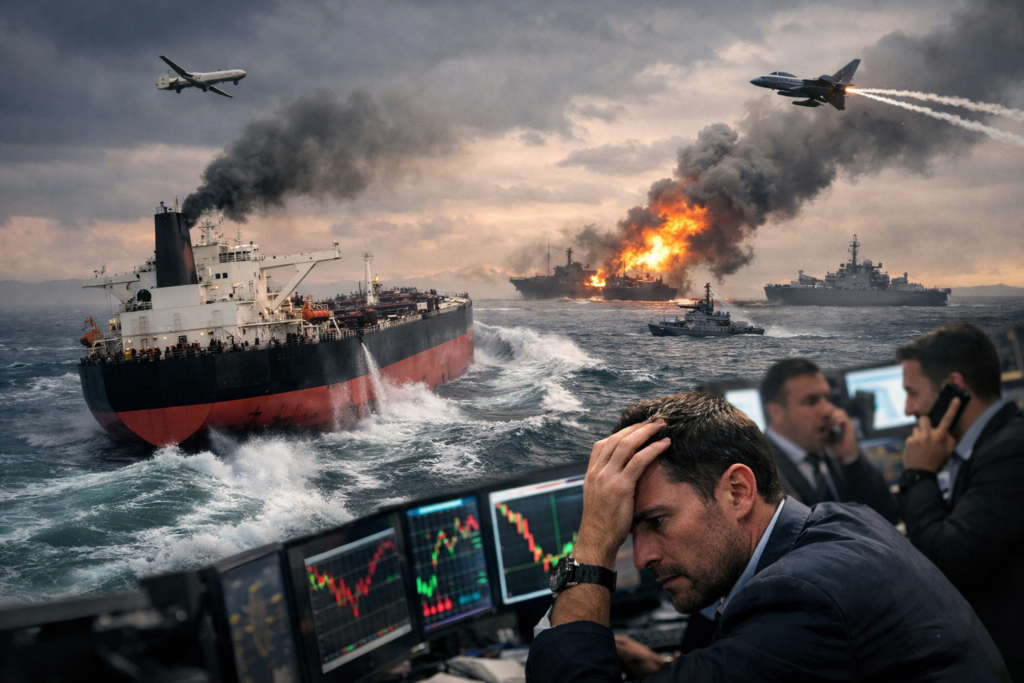
Image Credentials: Image Title: Market Panic; Supertankers Abort Transit as U.S.-Iran Peace Talks Collapse Source: (sora.openai) Date: April 2026. Attribution: This image was created using AI-generated imagery (sora.openai) and does not depict a real-world scene.
By Open Chronicle Staff with Agencies
SINGAPORE / DUBAI — The collapse of diplomatic efforts in Islamabad has triggered immediate repercussions in the world’s most sensitive shipping lane. According to ship-tracking data reported by Bloomberg, two empty supertankers performed abrupt U-turns in the Strait of Hormuz early Sunday, abandoning their attempts to enter the Persian Gulf as news broke that negotiations between the United States and Iran had ended without an agreement.
Mid-Water Retreat
Late Saturday, three Very Large Crude Carriers (VLCCs) were observed approaching the narrow chokepoint from the Gulf of Oman. The vessels reached the vicinity of Larak Island, a strategic Iranian military outpost, just as Vice President JD Vance announced that Iran had “chosen not to accept” American terms for a permanent ceasefire.
🇮🇷🇺🇸🇰🇼⛴ Two supertankers make U-turn in Strait of Hormuz the minute Islamabad peace talks failure declared
Three supertankers reached Iranian Larak Island on Sunday.
Two of them — the Agios Fanourios I (heading to Iraq) and the Shalamar (heading to the UAE) under the flag of… pic.twitter.com/oKDGqEJc0g
— Patriots of the world 👍🇺🇸 🇷🇺 (@AMoczas93932) April 12, 2026
Vessels involved in the maneuver:
-
Agios Fanourios I: A supertanker bound for Iraq, which reversed course and headed back toward the Arabian Sea.
-
Shalamar: A Pakistani-flagged tanker headed to Das Island in the UAE, which similarly aborted its mission.
The maneuvers underscore the extreme volatility of the maritime environment. While three tankers had successfully exited the Gulf earlier on Saturday, the collapse of talks appears to have slammed the “window of opportunity” shut for incoming traffic.
The Strait as a Weapon
The U-turns coincide with defiant rhetoric from Tehran. Ali Akbar Velayati, a senior adviser to Iran’s Supreme Leader, declared today that the Strait of Hormuz remains “firmly in our hands.”
Industry experts suggest the tankers’ retreat was likely triggered by a combination of spiked insurance premiums and fears of renewed Iranian seizures or U.S. mine-clearing operations, which President Trump signaled would proceed despite the diplomatic deadlock.
“The shipping industry isn’t waiting for the ceasefire to officially expire on April 22,” said a maritime risk analyst. “The moment the talks failed, the Strait became a ‘no-go zone’ once again.”
Economic Fallout
The inability of tankers to safely transit the Strait has effectively re-established the blockade that has crippled 20% of the world’s oil supply since the war began on February 28.
Current Shipping Impacts:
-
Insurance Rates: War-risk premiums for Gulf transits have reportedly tripled since Saturday evening.
-
Oil Volatility: Crude futures saw a sharp uptick in electronic trading following the report of the aborted transits.
-
Operational Gridlock: Dozens of tankers remain anchored outside the Gulf of Oman, awaiting clarity on whether the U.S. Navy will begin forced escort missions.
As the 14-day ceasefire enters its final ten days with no further talks scheduled, the visual of supertankers fleeing the Strait serves as a grim omen for the global energy market.