
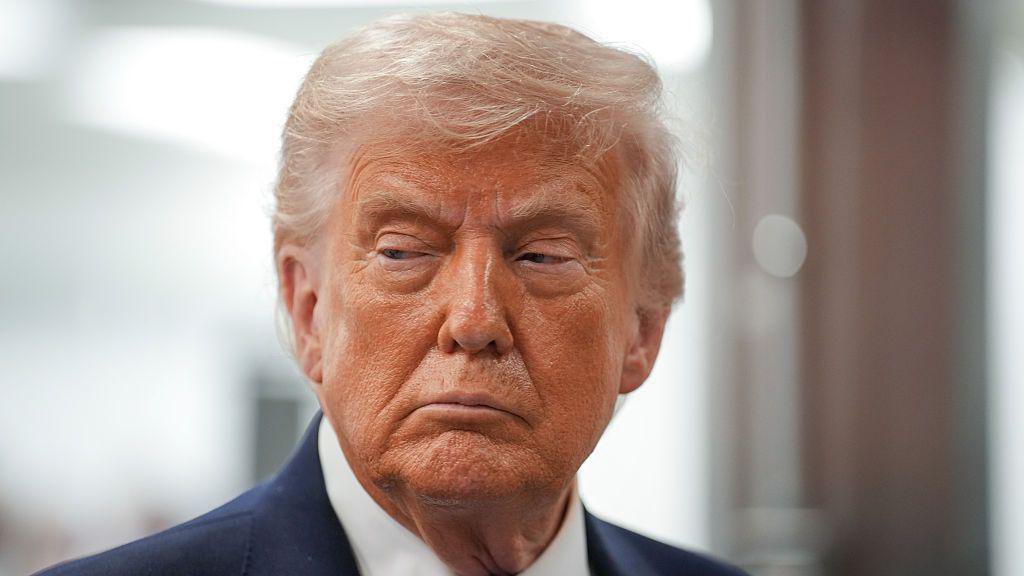
Images: from NEXT X @NEXT_HD24
By Open Chronicle Staff with Agencies
WASHINGTON / ISLAMABAD — President Donald Trump escalated the global energy crisis to a breaking point on Sunday, ordering the United States Navy to “immediately” begin a total blockade of the Strait of Hormuz. The move follows the dramatic collapse of peace negotiations in Islamabad, where U.S. and Iranian officials failed to reach an agreement to end the six-week-old war.
In a series of inflammatory social media posts, the President signaled that the U.S. is moving from a posture of containment to one of total economic and military strangulation.
President Trump announces a Naval Blockade of the Strait of Hormuz. pic.twitter.com/YQMLAwmKXN
— The ₿itcoin Therapist (@TheBTCTherapist) April 12, 2026
A Total Maritime Siege
The President’s directive targets the 20% of global oil supplies that flow through the narrow waterway, seeking to strip Tehran of its primary strategic and financial leverage.
-
The Blockade: The U.S. Navy will now “interdict any ships” attempting to enter or exit the Persian Gulf.
-
Toll Retaliation: In a significant escalation of international maritime law, Trump instructed the Navy to “seek and interdict” any vessel in international waters that has paid transit tolls to Iran. “No one who pays an illegal toll will have safe passage on the high seas,” the President warned.
-
Military Readiness: Trump declared the U.S. military is “LOCKED AND LOADED” to “finish up the little that is left of Iran” should the deadlock continue.
The Collapse in Islamabad
The diplomatic breakdown occurred after 21 hours of intense face-to-face negotiations mediated by Pakistan. Vice President JD Vance, who led the U.S. delegation, indicated that the “take-it-or-leave-it” proposal collapsed over Iran’s refusal to permanently abandon its nuclear program.
“We need to see an affirmative commitment that they will not seek a nuclear weapon,” Vance stated.
Iran’s lead negotiator, Parliament Speaker Mohammad Bagher Qalibaf, countered that the U.S. had failed to “gain our trust,” blaming the impasse on “U.S. overreach.” While Pakistan’s Foreign Minister Ishaq Dar urged both sides to maintain the fragile ceasefire, the President’s blockade order suggests the truce is effectively dead in the water.
The Lebanon Front: “Atrocious Effects of War”
While the ceasefire was intended to pause hostilities, Israel has continued its campaign in Lebanon, claiming the agreement did not apply to its fight against Hezbollah.
-
Latest Strikes: Six people were reported killed Sunday morning in the Lebanese village of Maaroub.
-
Beirut Bloodshed: The human toll has been catastrophic; over 300 people were killed in Beirut on the day the Iran ceasefire was initially announced, the deadliest day since the war began on February 28.
-
Papal Appeal: Pope Leo issued an emotional plea during his noon prayers, stating he is “closer than ever” to the Lebanese people and reminding combatants of the “moral obligation” to protect civilians from the “atrocious effects of war.”
Casualties and Crisis
As of April 12, 2026, the war has claimed at least 3,000 lives in Iran and 2,020 in Lebanon. Global energy prices have soared to historic levels as the Persian Gulf remains largely cut off from the global economy.
Negotiations between Israel and Lebanon are still tentatively scheduled to begin this Tuesday in Washington, despite widespread protests in Beirut. However, with the U.S. Navy now moving to physically seal the Strait of Hormuz, the prospect of a wider regional conflagration appears more likely than a diplomatic solution.