
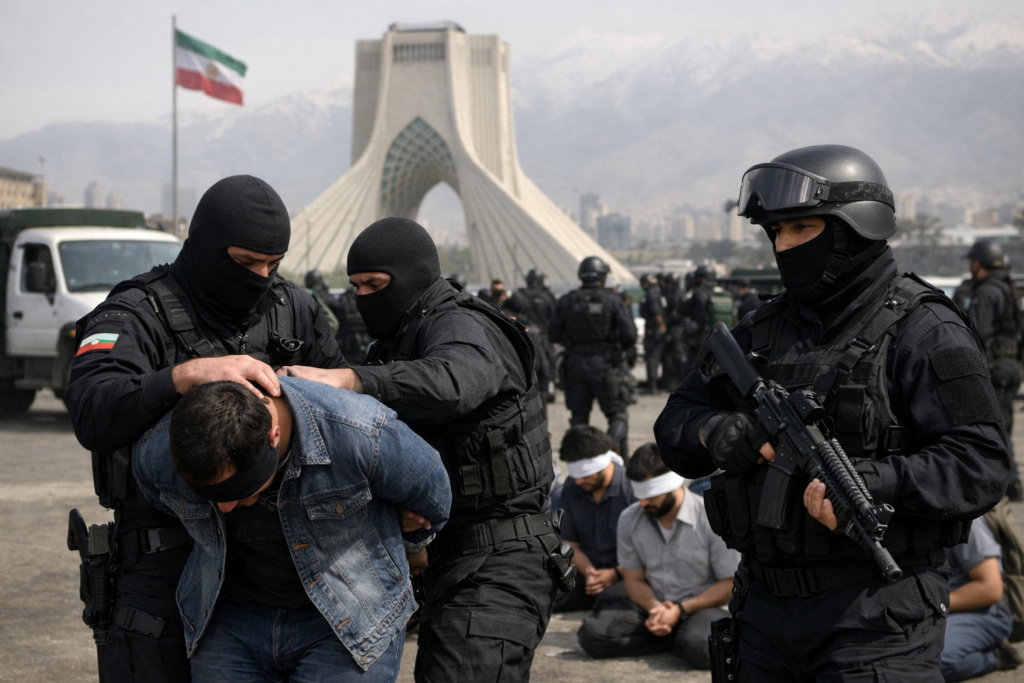
Image Credentials: Image Title: Tehran Launches Massive Purge, 50 Arrested in Multi-Province “Espionage” Sweep Source: (sora.openai) Date: April 2026. Attribution: This image was created using AI-generated imagery (sora.openai) and does not depict a real-world scene.
By Open Chronicle Staff with Agencies
TEHRAN, IRAN — The Iranian Police Command (FARJA) announced on Sunday that it has dismantled a sophisticated intelligence network, arresting 50 individuals across 16 provinces. The suspects are accused of acting as “mercenaries” for the United States and Israel, allegedly providing precise coordinates to guide missile strikes against strategic military and civilian infrastructure.
Mapping the Targets
According to an official statement released by FARJA and carried by state-run media (SNN), the detainees were caught monitoring and mapping sensitive locations across the country. The intelligence gathered reportedly included:
-
Public Infrastructure: Mapping facilities responsible for essential public services.
-
Mobile Coordinates: Tracking troop deployment sites and security checkpoints.
-
Covert Bases: Identifying hidden “safe houses,” including the Special Forces hideouts located within Azadi Stadium and Basij units stationed in civilian residential buildings.
The accuracy of recent strikes on hundreds of police stations, barracks, and Basij bases suggests that intelligence gathering has been remarkably precise. Security authorities claim the arrests have disrupted the flow of “fixed and moving coordinates” intended for future precision-guided missile operations.
High-Tech Sabotage
During the coordinated raids, security forces reportedly seized advanced electronic hardware, including satellite communication equipment and sophisticated surveillance devices. Weapons were also confiscated from several members of the group, whom the government has labeled as an organized sabotage wing working on behalf of foreign entities.
“The detainees sought to facilitate combat operations by providing the enemy with the blueprints of our security architecture,” the FARJA statement read.
New Harsher Penalties Loom
The arrests mark the first major application of Iran’s recently “strengthened and harsher” espionage laws. Passed to address the unique security challenges of the current conflict, the legislation significantly escalates the consequences for collaboration with foreign powers.
The suspects now face:
-
The Death Penalty: Applicable to those whose activities are deemed to have caused significant harm to national security.
-
Total Asset Confiscation: The state may seize all movable and immovable assets belonging to convicted spies.
-
Accelerated Trials: Under current wartime protocols, these cases are expected to move swiftly through the revolutionary court system.
A Climate of Internal Pressure
The sweep comes at a critical moment for the Iranian leadership. Following the collapse of peace talks in Islamabad and the continued closure of the Strait of Hormuz, the government is facing increased pressure to secure the “home front.”
With hidden bases, such as the Imam Ali security units, being targeted with surgical precision, the Iranian administration is signaling a zero-tolerance policy toward any form of internal dissent or intelligence leakage that could give the U.S.-Israeli coalition a further tactical advantage.