
Image: from EM-electomania.es X @electo_mania
Open Chronicle | Europe
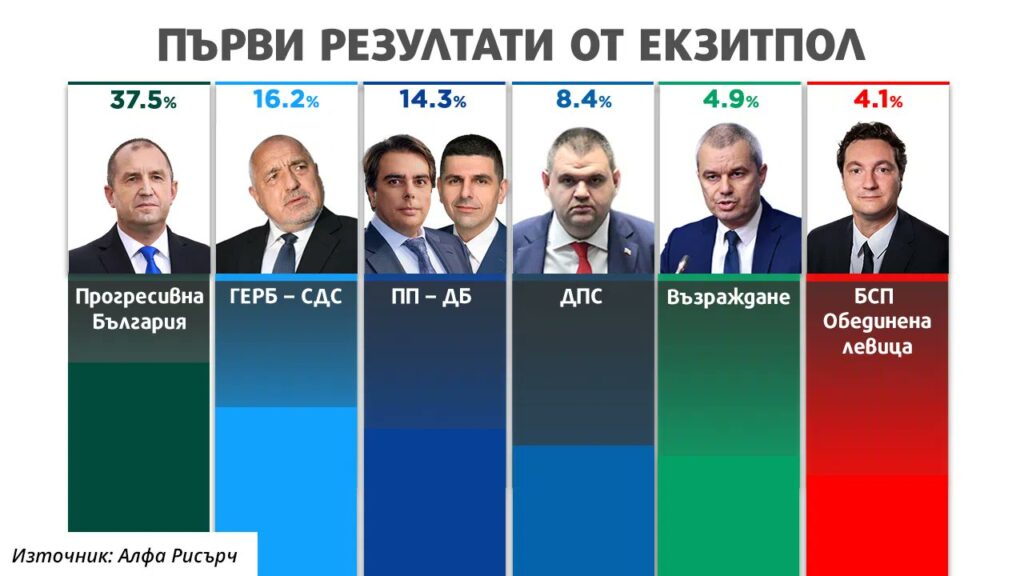
Sofia — Early exit polls from Bulgaria’s parliamentary elections indicate a decisive lead for Progressive Bulgaria, which is projected to secure 39.2 percent of the vote, according to data released by the Trend research center and reported by the Bulgarian Telegraph Agency.
The results suggest a significant gap between the leading bloc and its closest competitors, though the path to forming a government remains uncertain in a country marked by prolonged political instability.
Parliamentary elections in Bulgaria.
According to an exit poll by public broadcaster https://t.co/T3WTEtZfmV, the party of pro-Russian ex-president Rumen Radev, Progressive Bulgaria, is winning with over 38% of the vote. pic.twitter.com/afupWh3PNX
— PPN – PulsePoint News (@wogoa1) April 19, 2026
Opposition Trails Behind
The centre-right coalition Citizens for European Development of Bulgaria-Union of Democratic Forces is projected to come second with 15.1 percent, followed by We Continue the Change-Democratic Bulgaria at 13.3 percent.
Other parties appear to be trailing further behind. The Movement for Rights and Freedoms is expected to secure 8.1 percent, while the nationalist Revival hovers around the 5 percent threshold required to enter parliament.
The Bulgarian Socialist Party-United Left is projected at 4.2 percent, placing it at risk of falling below the parliamentary cutoff.
Low Turnout Reflects Voter Fatigue
Voter turnout stood at 34.63 percent as of late afternoon, according to the Central Election Commission (Bulgaria), highlighting continued public disengagement after years of political turbulence.
Since 2021, Bulgaria has experienced repeated elections, fragile coalitions, and caretaker governments, reflecting deep divisions within its political landscape.
Government Formation Still Uncertain
Despite its strong showing, Progressive Bulgaria faces a familiar challenge. Under Bulgaria’s electoral system, a party or coalition must secure at least 121 seats in the 240-member parliament to form a government.
Given the fragmented nature of the vote and the number of parties likely to enter parliament, coalition negotiations are expected to be complex.
A Pattern of Instability
The Balkan nation of 6.5 million has struggled to establish stable governance in recent years. Successive elections have failed to produce lasting coalitions, often resulting in short-lived administrations and interim governments appointed by the presidency.
The latest vote appears to reinforce that pattern, even as one political force emerges clearly ahead.
What Comes Next
As official results are confirmed, attention will shift to coalition talks and the willingness of rival factions to cooperate.
For Bulgaria, the outcome is not only about electoral victory, but about whether the country can break a cycle of political deadlock that has defined its recent history.