
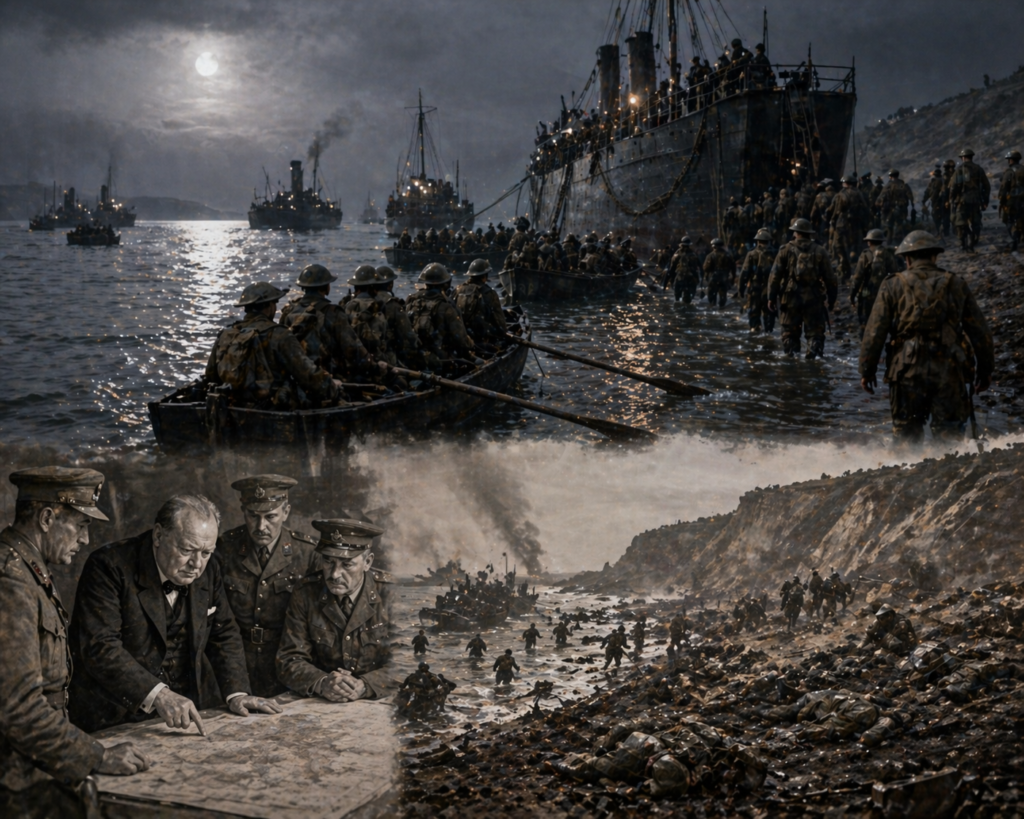
Image Credentials: Image Title: WW1 What Went Wrong at Gallipoli? Source: (chatgpt.com) Date: April 2026. Attribution: This image was created using AI-generated imagery (chatgpt.com) and does not depict a real-world scene.
By José Carlos Palma*
On 9 January 1916, the last Allied troops withdrew from the Gallipoli peninsula. The operation was carried out with remarkable precision. There was no chaos, no collapse, and very few casualties. In the context of the campaign, it stood out as a rare success.
That success only highlighted how deeply the campaign had failed.
The origins of Gallipoli lay in ambition. Allied leaders, locked in a stalemate on the Western Front, searched for an alternative way to break the deadlock. Attention turned to the Ottoman Empire, seen as a weaker link among the Central Powers. Among the most prominent advocates of this plan was Winston Churchill, who believed that forcing the Dardanelles could reshape the war.
The objective was clear, force the straits, capture Constantinople, and reopen a vital supply route to Russia. If successful, it might have forced the Ottoman Empire out of the war.
It was a bold strategy, but one built on fragile assumptions.
The initial naval offensive, part of the Dardanelles Campaign naval operations, quickly exposed those weaknesses. Ottoman defenses were stronger and better prepared than expected. Mines and coastal artillery inflicted serious damage on Allied ships, sinking and disabling several battleships. The advance stalled, and with it the hope of a quick victory.
Rather than reassessing the situation, the Allies escalated their efforts.
In April 1915, amphibious landings were launched along the Gallipoli coastline. British and French troops came ashore at Cape Helles, while Australian and New Zealand forces landed at Anzac Cove. The plan depended on speed and coordination, a rapid advance inland that would overwhelm Ottoman defenses before they could fully respond.
Instead, confusion set in from the beginning.
Troops landed off course. Maps were unreliable. Communication between units broke down. Soldiers advanced without clear objectives into terrain that was as hostile as the enemy itself. Waiting for them were determined Ottoman forces, led in part by Mustafa Kemal Atatürk.
Kemal’s response was decisive. He moved quickly to secure the high ground, recognizing its strategic value. From there, Ottoman forces were able to dominate the battlefield, turning every Allied advance into a costly uphill struggle.
Within days, the campaign had lost its momentum.
Gallipoli’s geography played a decisive role in this outcome. The peninsula’s steep ridges, narrow beaches, and difficult terrain favored the defenders. For Allied troops, every movement inland meant exposure to fire from above. What had been intended as a mobile offensive soon hardened into trench warfare, echoing the very stalemate the Allies had hoped to escape.
Leadership failures compounded the situation. Command structures lacked clarity, and decision-making was often slow at critical moments. Opportunities that might have shifted the balance were missed. This was especially evident during the August offensives at Suvla Bay, where Allied forces landed with little resistance but failed to advance quickly. The delay allowed Ottoman units to regroup and fortify, closing the window for a potential breakthrough.
As the fighting dragged on, the environment itself became an enemy.
The summer months brought intense heat, swarms of flies, and the spread of disease. Water was scarce, sanitation was poor, and dysentery became widespread. When winter arrived, conditions turned cold and wet, flooding trenches and adding new hardships. Soldiers endured not only combat but a relentless struggle against their surroundings.
By late 1915, it was clear the campaign was not achieving its objectives. The Allies had failed to secure the peninsula, failed to break Ottoman resistance, and failed to alter the broader course of the war in the region. The cost in lives and resources continued to rise, with no decisive result.
The decision to withdraw became unavoidable.
In a striking contrast to earlier operations, the evacuation was carefully planned and executed. Deception played a key role. Self-firing rifles and controlled silence masked the withdrawal. Under the cover of darkness, tens of thousands of troops were evacuated with minimal losses. The final phase of the Gallipoli Campaign demonstrated a level of discipline and coordination that had been largely absent before.
Gallipoli did not fail because of a single mistake. It failed because of a chain of interconnected errors. Overconfidence in the plan led to underestimating the enemy. Poor intelligence and inadequate planning undermined operations from the start. Weak coordination and hesitant leadership prevented recovery when things went wrong. The terrain and conditions amplified every failure.
Together, these factors created a campaign that was unlikely to succeed from the moment it began.
The legacy of Gallipoli extended far beyond the battlefield. For the Allies, it became a cautionary tale about the dangers of ambition without preparation. For the Ottoman Empire, it was a significant victory that strengthened morale and demonstrated resilience. For Mustafa Kemal, it marked the rise of a leader who would later shape the future of Turkey.
The evacuation in January 1916 brought the campaign to a quiet end. There was no triumph to celebrate, only lessons to be learned. Gallipoli remains a powerful reminder that even the most confident strategies can collapse when they fail to align with reality.
Bibliography
Bean, Charles Bean. The Story of Anzac: From the Outbreak of War to the End of the First Phase of the Gallipoli Campaign, May 4, 1915. Sydney: Angus & Robertson, 1921.
Erickson, Edward J Erickson. Gallipoli: The Ottoman Campaign. Barnsley: Pen & Sword Military, 2010.
Hamilton, Ian Hamilton. Gallipoli Diary. London: Edward Arnold, 1920.
Hart, Peter Hart. Gallipoli. Oxford: Oxford University Press, 2011.
Moorehead, Alan Moorehead. Gallipoli. London: Hamish Hamilton, 1956.
Prior, Robin Prior. Gallipoli: The End of the Myth. New Haven: Yale University Press, 2009.
Strachan, Hew Strachan. The First World War. London: Penguin Books, 2003.
Imperial War Museums. “Gallipoli Campaign.”
Australian War Memorial. “Gallipoli Campaign, 1915–1916.”
National Archives UK. “Records of the Dardanelles and Gallipoli Campaign.”