
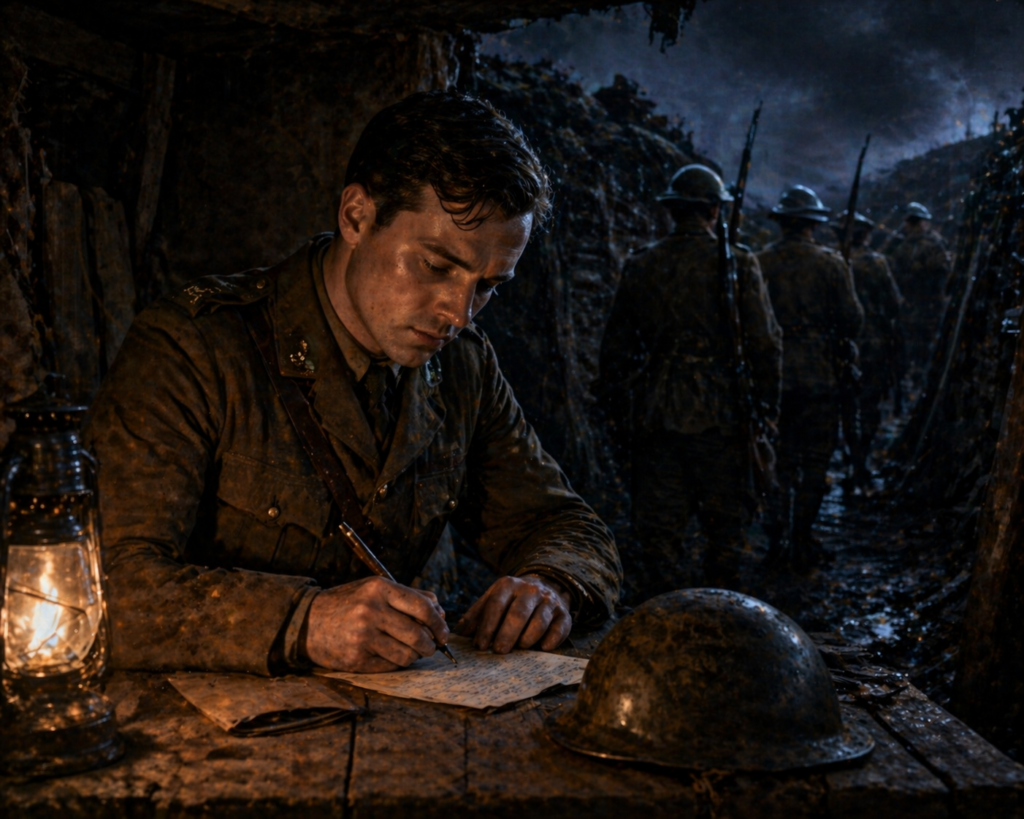
Image Credentials: Image Title: “My Dear Mother”: The Final Letter of Captain Wilfred Barlow Source: (chatgpt.com) Date: April 2026. Attribution: This image was created using AI-generated imagery (chatgpt.com) and does not depict a real-world scene.
By José Carlos Palma*
On the night of June 30, 1916, as thousands of British soldiers prepared to go “over the top” for the first time at the Battle of the Somme, one officer sat down to write what he knew might be his final words.
Captain Wilfred Barlow, a 28-year-old officer in the British Army, began his letter calmly, with a clarity that only comes when uncertainty turns into quiet acceptance.
“My dear Mother,
I am writing this in case I am killed tomorrow…”
There was no drama in the line, no attempt to soften its meaning. Only honesty.
The Night Before the Attack
Across the trenches of the Western Front, the atmosphere was tense but controlled. Officers briefed their men, equipment was checked, and the distant rumble of artillery continued without pause.
The plan was simple in theory. After a prolonged bombardment, British troops would advance across no man’s land and break through German defenses.
But many, including Barlow, understood the risks.
His letter continued:
“…I have no fear, and I am as happy as I can be.”
It is a striking sentence. Not because it suggests confidence in survival, but because it reflects a state of mind shaped by weeks, even months, of preparation for this exact moment.
Morning, July 1, 1916
At dawn, the guns fell silent.
Then came the whistles.
Men climbed out of their trenches and advanced into open ground. Within moments, machine gun fire tore through the advancing lines. The German defenses, largely intact, met the assault with devastating efficiency.
The first day of the Battle of the Somme would leave nearly 60,000 British soldiers killed, wounded, or missing.
Among them was Captain Wilfred Barlow.
A Letter Delivered After Death
His letter did not remain in the trench.
Recovered and sent home, it reached his family not as a message of reassurance, but as a final connection. Words written in stillness, delivered in the aftermath of chaos.
In it, he had written:
“If I am killed, it will be the happiest moment of my life.”
To modern readers, the line may feel distant, even difficult to understand. But within the context of World War I, it reflects a mindset shaped by duty, belief, and the emotional realities of war.
Beyond Numbers
The Battle of the Somme is often remembered through its scale, its casualties, and its place in military history. But its true weight lies in stories like this.
A letter written the night before.
A voice preserved on paper.
A life reduced, in official records, to a name among thousands, but in reality, something far more complex.
The fields where Captain Wilfred Barlow fell are quiet now. Grass covers the ground where men once advanced under fire. The trenches have long disappeared.
But the words remain.
And in them, the war is no longer distant. It becomes immediate, personal, and impossible to ignore.
📚 Verifiable Sources
- Imperial War Museums, letter archive and officer records
- The National Archives, British Army records
- The First Day on the Somme
- BBC History