
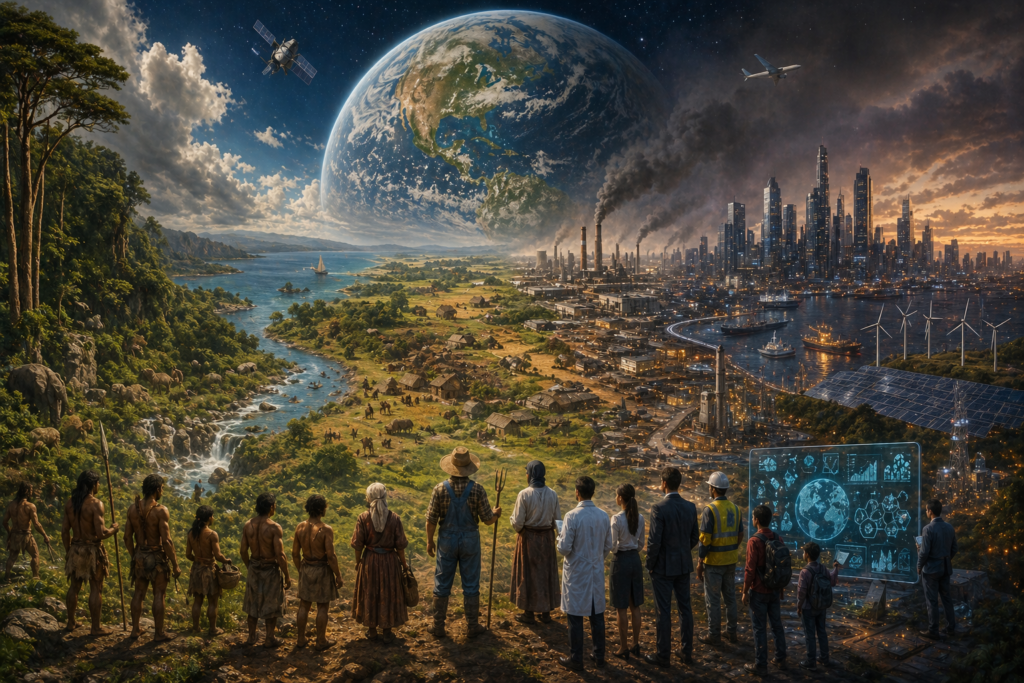
Image Credentials: Image Title: Human societies now act as a force of nature, new study finds Source: (sora.openai). Date: April 2026. Attribution: This image was created using AI-generated imagery (sora.openai) and does not depict a real-world scene.
Open Chronicle | Science & Environment
Humanity has become one of the most powerful forces shaping life on Earth, according to new research that reframes the way scientists understand the modern era. Rather than simply adapting to the natural world, human societies have learned to transform it on a planetary scale, with consequences that are both profound and deeply complex.
The study, led by Erle Ellis of the University of Maryland, Baltimore County, explores how cultural and social systems have enabled humans to reshape ecosystems over thousands of years. Drawing from fields such as archaeology, ecology, and anthropology, the research argues that human influence is now comparable to natural forces that have historically shaped the planet.
The Anthropocene, a human-shaped Earth
At the center of the study is the concept of the Anthropocene, a term used to describe the current geological age in which human activity dominates Earth’s systems. From climate patterns to biodiversity, the imprint of human societies is now visible across nearly every aspect of the natural world.
Ellis, who leads the Anthroecology Lab, emphasizes that this transformation did not happen overnight. It is the result of cumulative innovations, from the controlled use of fire in early societies to the rise of industrial agriculture, global trade networks, and modern cities.
These developments have significantly improved human life, increasing longevity, health, and economic prosperity. At the same time, they have driven environmental challenges on an unprecedented scale.
Progress and its environmental cost
The study highlights a central paradox of human progress. The same innovations that have allowed societies to thrive have also contributed to climate change, widespread pollution, and the rapid loss of species.
Expanding populations and intensified resource use have placed growing pressure on ecosystems, raising urgent questions about sustainability. Scientists increasingly agree that addressing these challenges will require balancing continued human development with the protection of the natural systems that support it.
Moving beyond crisis narratives
While environmental debates often focus on crisis and collapse, Ellis առաջարկ a more nuanced perspective. He argues that the Anthropocene should also be seen as evidence of humanity’s unique ability to cooperate and drive large-scale change.
History shows that societies can mobilize collective action to solve complex problems. According to the research, those same capabilities could be harnessed to address today’s environmental challenges, from restoring ecosystems to reducing emissions.
Rather than viewing the future through a lens of limits, the study suggests that shared ambition and coordinated action may offer a more effective path forward.
The role of culture and cooperation
A key finding of the research is that scientific knowledge alone is not enough to guide the future. Social systems, institutions, and shared values play an equally critical role in shaping outcomes.
Human societies have repeatedly demonstrated their ability to adapt through cultural innovation. These same mechanisms, including governance, cooperation, and collective decision-making, will be essential in building more sustainable relationships with the environment.
Reconnecting with nature
The study also calls for a renewed emphasis on humanity’s connection to the natural world. Strengthening ties between people and ecosystems, whether through technology, conservation efforts, or community initiatives, is seen as a crucial step toward sustainability.
Ellis points to the importance of recognizing shared evolutionary roots among living beings and supporting Indigenous and traditional stewardship of land and water. These approaches are increasingly reflected in global efforts to restore ecosystems and promote biodiversity.
A future shaped by human choice
Ultimately, the research delivers a cautiously optimistic message. The tools and knowledge needed to create a more sustainable future already exist. The challenge lies in mobilizing them effectively.
As human influence continues to define the planet’s trajectory, the study suggests that the future will depend less on technological limits and more on collective will. The same forces that transformed Earth can, if directed wisely, help restore and protect it for generations to come.
Story Source:
Materials provided by the University of Maryland, Baltimore County. Note: Content may be edited for style and length.
Journal Reference:
- Erle C. Ellis. The Anthropocene condition: evolving through social–ecological transformations. Philosophical Transactions of the Royal Society B: Biological Sciences, 2023; 379 (1893) DOI: 10.1098/rstb.2022.0255