
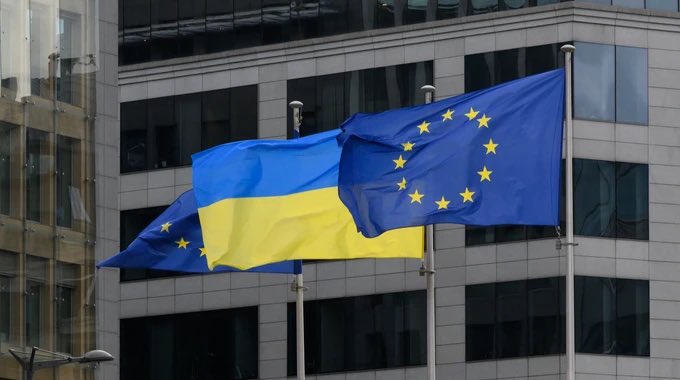
Image: from Vatnik Soup X @P_Kallioniemi
Open Chronicle | Europe & War Economy
The European Union has moved forward with a major financial and geopolitical package, approving a €90 billion loan for Ukraine alongside a new round of sanctions against Russia after Hungary dropped its long-standing opposition.
The measures were endorsed by ambassadors from all 27 member states and are expected to be formally adopted in the coming days, marking a significant shift in intra-EU dynamics after months of political deadlock.
Breakthrough after Hungarian resistance
Hungary, led by Viktor Orbán, had previously blocked both the financial aid package and the sanctions, despite an earlier agreement reached in late 2025. The veto had become a major point of tension within the bloc, raising concerns about unity in supporting Ukraine.
Budapest’s objections were partly tied to disputes over energy flows, after Ukraine reported that damage from a Russian strike had disrupted oil transit through a key pipeline. Hungarian officials argued that the situation risked affecting the supply of Russian oil to Europe.
The decision to lift the veto has now cleared the way for one of the EU’s largest financial commitments since the start of the war.
The €90 billion package is aimed at stabilizing Ukraine’s economy, supporting reconstruction efforts, and maintaining essential government functions as the conflict continues. It underscores the EU’s long-term commitment to Kyiv amid ongoing military and economic pressure from Russia.
Ukrainian President Volodymyr Zelenskyy has been actively engaging with European leaders to secure continued financial backing, emphasizing the need for sustained support to withstand the prolonged war.
New sanctions increase pressure on Moscow
In parallel, the EU has approved its 20th round of sanctions targeting Russia. While details of the latest measures have not yet been fully disclosed, previous packages have focused on restricting financial transactions, limiting energy revenues, and targeting individuals and entities linked to the Kremlin.
The new sanctions are expected to tighten economic pressure on Moscow further, as the EU continues to use financial tools alongside diplomatic and military support for Ukraine.
A test of European unity
The agreement highlights both the challenges and resilience of EU decision-making in times of crisis. While divisions among member states have slowed progress at times, the eventual consensus reflects a shared strategic interest in supporting Ukraine and countering Russian influence.
As the war enters another critical phase, the combined impact of financial aid and санкции is likely to play a key role in shaping the conflict’s trajectory and Europe’s broader geopolitical stance.