
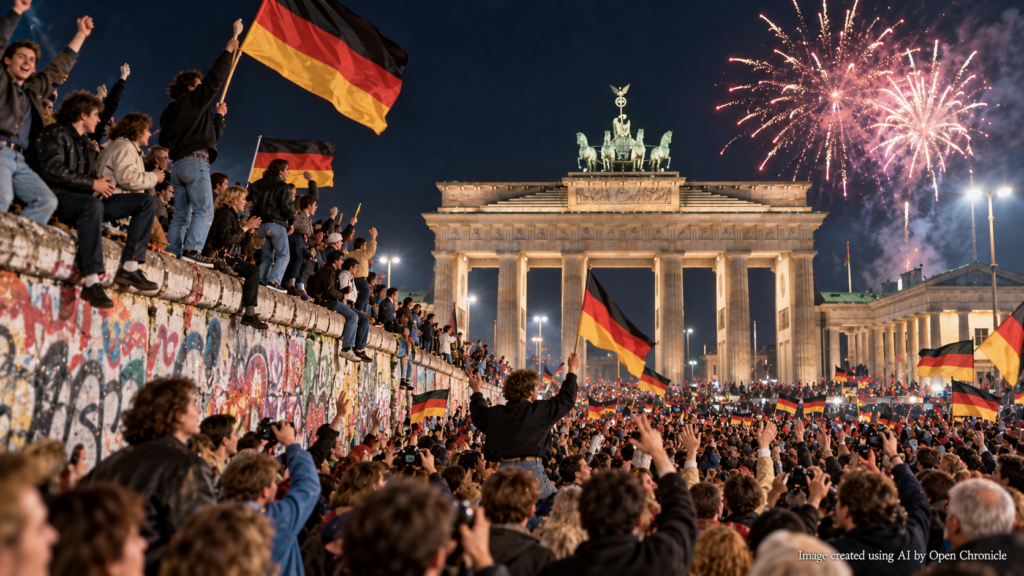
How the fall of the Berlin Wall, a peaceful revolution in East Germany and extraordinary diplomacy brought an end to four decades of division at the heart of Europe
By Open Chronicle History Desk
At midnight on October 3, 1990, a flag rose before the Reichstag in Berlin.
The Freedom Bell sounded.
Hundreds of thousands of people had gathered in the German capital.
For the first time since the aftermath of the Second World War, Germany was politically united.
At that moment, the German Democratic Republic, commonly known as East Germany, ceased to exist as a separate state. Brandenburg, Mecklenburg-Vorpommern, Saxony, Saxony-Anhalt and Thuringia became states of the Federal Republic of Germany, while Berlin was constitutionally reunited. The German Unification Treaty formally made October 3 the country’s national day.
But the reunification of Germany had seemed almost unimaginable only a year earlier.
For more than four decades, the country had stood at the geographical and ideological center of the Cold War.
To understand what happened on October 3, 1990, we have to return to the ruins of 1945.
1. Germany in Ruins
When the Second World War ended in Europe in May 1945, Germany was devastated.
Cities had been destroyed.
Millions were dead.
Millions more were refugees or displaced persons.
The Nazi regime had collapsed after unleashing a war that devastated Europe and carrying out the Holocaust and other mass crimes.
Germany was occupied by the victorious Allied powers.
The United States, Britain, France and the Soviet Union each controlled an occupation zone.
Berlin, although located deep inside the Soviet occupation zone, was itself divided into four sectors.
Initially, this arrangement was intended to administer defeated Germany jointly.
But the wartime alliance was already disintegrating.
The Cold War was beginning.
2. Two German States
Political and economic differences between the Western Allies and the Soviet Union deepened rapidly.
In 1949, the division became institutional.
The western occupation zones became the Federal Republic of Germany, usually called West Germany.
Its capital was established provisionally at Bonn.
The Soviet occupation zone became the German Democratic Republic, or East Germany.
East Berlin became the political center of the GDR, while the status of Berlin as a whole remained internationally complex.
Two German states now existed.
They represented competing political and economic systems.
West Germany developed a parliamentary democracy and market economy closely connected to Western Europe and the United States.
East Germany became a socialist state dominated by the Socialist Unity Party, the SED, and aligned with the Soviet Union.
Germany had become one of the principal frontiers of the Cold War.
3. Berlin Becomes a Cold War Front Line
Nowhere was that confrontation more visible than Berlin.
The western sectors of the city formed an enclave surrounded by East German territory.
In 1948, the Soviet Union attempted to restrict Western access to West Berlin.
The Western Allies responded with the Berlin Airlift, supplying the city by air until the blockade was lifted in 1949.
Berlin became more than a city.
It became a symbol.
Two political systems confronted one another across streets, railway lines and checkpoints.
Yet for years, people could still cross between East and West Berlin.
That created a major problem for the East German government.
4. The Exodus From East Germany
During the 1950s, millions of East Germans left the GDR.
Many travelled through Berlin because movement between the sectors remained comparatively accessible.
Among those leaving were young workers, doctors, engineers and other skilled professionals.
The demographic and economic consequences for East Germany were serious.
The East German leadership wanted to stop the exodus.
The solution would become one of the most recognizable structures of the twentieth century.
5. August 13, 1961
During the night of August 12 to 13, 1961, East German authorities began closing the border through Berlin.
Roads were blocked.
Rail connections were interrupted.
Barbed wire appeared.
Soon concrete barriers followed.
What began as an improvised frontier became the Berlin Wall.
Over time, the border system became increasingly sophisticated.
Walls.
Fences.
Watchtowers.
Floodlights.
Patrol roads.
Anti-vehicle barriers.
Armed guards.
Berlin had been physically divided.
Families were separated.
Workers were cut off from their jobs.
Neighborhoods were split apart.
The Cold War had acquired a concrete frontier.
6. The Wall
The Berlin Wall eventually stretched for more than 150 kilometres around West Berlin.
Its purpose was primarily to prevent East German citizens from leaving the GDR without authorization.
Thousands nevertheless attempted to escape.
Some crossed through tunnels.
Others hid in vehicles.
Some used improvised balloons.
Some tried to swim across waterways.
Others attempted to climb or cross the border installations.
Many succeeded.
Others were arrested.
Some were killed.
The Wall became one of the most powerful symbols of Europe’s division.
And for nearly three decades, it seemed permanent.
7. Two German Societies
As the years passed, East and West Germany developed increasingly distinct institutions.
West Germany experienced rapid postwar economic growth.
It became a founding member of NATO in 1955 and an important participant in European integration.
East Germany joined the Warsaw Pact and developed one of the Soviet bloc’s more industrialized economies.
But political life was tightly controlled.
The Stasi, the Ministry for State Security, developed an extensive surveillance system.
Opposition was restricted.
Travel was controlled.
Yet East German society was more complicated than the institutions governing it.
People built careers, families and communities within the GDR.
By the 1980s, an entire generation had grown up knowing no other Germany.
8. The Cold War Begins to Change
During the 1980s, the international environment shifted.
The Soviet Union faced serious economic difficulties.
In 1985, Mikhail Gorbachev became General Secretary of the Communist Party of the Soviet Union.
He introduced policies associated with glasnost, greater openness, and perestroika, economic and political restructuring.
Most importantly for Eastern Europe, Moscow became less willing to use military force to preserve Communist governments.
The implications were enormous.
Political systems that had survived partly because Soviet power stood behind them suddenly appeared more vulnerable.
9. Hungary Opens a Door
In 1989, Hungary began dismantling barriers along its frontier with Austria.
For East Germans, this created an unexpected route toward the West.
Thousands travelled to Hungary.
Some crossed into Austria and then continued to West Germany.
Others sought refuge in West German embassies in Prague and elsewhere.
The East German government faced a growing crisis.
Its citizens were not merely demanding reform.
Many were physically leaving.
10. Leipzig
Inside East Germany, another movement was developing.
In Leipzig, peaceful demonstrations grew around the Nikolaikirche, St Nicholas Church.
Citizens demanded reform.
Freedom of travel.
Political rights.
Open elections.
The protests became known as the Monday demonstrations.
On October 9, 1989, tens of thousands marched through Leipzig.
There were fears that security forces might violently suppress the protest.
They did not.
The demonstration remained peaceful.
The importance of that moment was enormous.
The government’s ability to intimidate its population was weakening.
The official German government’s historical chronology credits the courage and determination of East German citizens with changing the political system and preparing the way for reunification.
11. The Peaceful Revolution
Demonstrations spread.
More people joined.
The slogan “Wir sind das Volk”, “We are the people”, became associated with demands for democratic legitimacy.
The East German leadership struggled to respond.
Longtime leader Erich Honecker was removed in October 1989.
But changing the leadership could not solve the deeper crisis.
The political system itself was losing authority.
Then came November 9.
12. November 9, 1989
At an evening press conference, East German official Günter Schabowski discussed new travel regulations.
Asked when the regulations would take effect, he gave an answer suggesting they were effective immediately.
The announcement spread rapidly through television and radio.
East Berliners began arriving at border crossings.
Guards were confronted by growing crowds.
They had no clear instructions for handling the situation.
Eventually, crossings opened.
People poured through.
The Berlin Wall had effectively ceased functioning as a closed border.
13. The Night the Wall Opened
The images became unforgettable.
People climbed onto the Wall.
Strangers embraced.
Champagne bottles opened.
West Berliners welcomed people arriving from the East.
Crowds gathered around the Brandenburg Gate.
Some began striking the concrete with hammers and chisels.
For twenty-eight years, the Wall had represented Europe’s division.
Now people were literally dismantling it.
But the opening of the Wall was not yet German reunification.
A much harder question followed:
What would happen to the two German states?
14. Reform or Reunification?
In late 1989, several possibilities remained open.
East Germany might become a reformed democratic socialist state.
The two Germanies might create some form of confederation.
Or they might reunify completely.
Events moved rapidly.
The slogan heard at demonstrations began to change.
From:
“Wir sind das Volk”, “We are the people.”
To:
“Wir sind ein Volk”, “We are one people.”
For growing numbers of East Germans, political reform was no longer enough.
They wanted unity.
15. Helmut Kohl
West German Chancellor Helmut Kohl quickly recognized the possibility of reunification.
In November 1989, he presented a ten-point programme outlining a path toward closer cooperation and potentially German unity.
But reunification was not something Germans could decide entirely by themselves.
The Second World War had left Germany with a special international status.
The four victorious Allied powers still possessed rights and responsibilities concerning Germany and Berlin.
Any final settlement therefore required international negotiation.
16. The March 1990 Election
East Germany held its first free parliamentary election on March 18, 1990.
The result demonstrated strong support for parties advocating rapid reunification with West Germany.
A new government under Lothar de Maizière took office.
Now the process accelerated.
The question was increasingly no longer whether reunification would happen.
It was how quickly it could be accomplished, and under what conditions.
17. One Economy
The economic gap between East and West Germany created enormous pressure for rapid integration.
Many East Germans wanted access to the stable West German currency.
On July 1, 1990, a monetary, economic and social union took effect.
The West German Deutsche Mark became the currency of East Germany.
This was one of the most consequential steps toward political union.
But it also exposed East German industries to direct competition from much more productive Western companies.
The economic consequences would be profound.
18. The Two Plus Four Negotiations
German reunification required agreement not only between East and West Germany but also among the four powers that had occupied Germany after 1945.
The diplomatic formula became known as Two Plus Four.
The two German states:
Federal Republic of Germany.
German Democratic Republic.
And the four Allied powers:
United States.
Soviet Union.
United Kingdom.
France.
The negotiations addressed the external dimensions of reunification, including Germany’s borders, security arrangements, military questions and sovereignty.
The resulting settlement was one of the crucial diplomatic achievements of 1990.
19. The Polish Border
One question carried enormous historical weight.
Germany’s eastern frontier with Poland had shifted dramatically after the Second World War.
Territories east of the Oder-Neisse line had become part of Poland and the Soviet Union.
Millions of Germans had fled or been expelled from former eastern territories.
Poland therefore wanted absolute certainty that a reunified Germany would not revive territorial claims.
The diplomatic settlement surrounding reunification confirmed the existing borders.
The German government records that the Two Plus Four Treaty dealt with the final borders of the reunified German state as part of the international settlement.
20. The Soviet Question
Perhaps the greatest diplomatic uncertainty concerned the Soviet Union.
East Germany was a member of the Warsaw Pact.
Hundreds of thousands of Soviet troops were stationed there.
Would Moscow permit a united Germany to remain within NATO?
This was one of the central questions of the negotiations.
Gorbachev ultimately accepted German reunification within the Western alliance structure.
Germany, meanwhile, accepted military limitations and arrangements for the withdrawal of Soviet forces from the former East Germany.
The final Soviet troops would leave Germany in 1994.
21. The Two Plus Four Treaty
On September 12, 1990, the foreign ministers of the two German states and the four Allied powers signed the Treaty on the Final Settlement with Respect to Germany in Moscow.
The agreement resolved the major external questions connected to reunification.
Germany’s borders were confirmed.
Security arrangements were established.
The path toward full sovereignty was opened.
The German government’s historical record describes the treaty as regulating, among other matters, Germany’s definitive borders, the size of its armed forces and the withdrawal of Soviet troops from eastern Germany.
The international obstacle to reunification had effectively been removed.
22. The Unification Treaty
Meanwhile, East and West German representatives had negotiated the internal legal framework.
The Unification Treaty was signed on August 31, 1990.
It was an enormous legal document.
Its provisions addressed almost every dimension of state integration.
Government administration.
Courts.
Education.
Property.
Finance.
Labor law.
Social security.
Culture.
Broadcasting.
Public institutions.
The treaty specified that reunification would take effect on October 3, 1990.
The date had been chosen.
The countdown began.
23. The Last Day of East Germany
October 2, 1990 was the final full day of the German Democratic Republic.
A state founded in 1949 was disappearing.
Its institutions were being dissolved, transferred or reorganized.
Its armed forces would cease to exist separately.
Its diplomatic missions would close or be incorporated into those of the Federal Republic.
Its citizens would become citizens of a united Germany.
For some, the moment brought celebration.
For others, it also brought uncertainty.
An entire political, economic and social system was ending almost overnight.
24. Midnight
Then the clock reached midnight.
October 3, 1990.
The Unification Treaty entered into force.
The German Democratic Republic ceased to exist as a separate state.
The Basic Law of the Federal Republic now applied in Brandenburg, Mecklenburg-Vorpommern, Saxony, Saxony-Anhalt, Thuringia and throughout Berlin.
Germany was united.
25. Berlin Celebrates
Hundreds of thousands gathered around the Reichstag and Brandenburg Gate.
At midnight, the Freedom Bell sounded.
A large German flag was raised before the Reichstag.
Fireworks illuminated the sky.
Political leaders from both former German states attended the celebrations.
The German government’s photographic archive records the flag raising at precisely midnight and the crowds that celebrated into the early morning.
Forty-five years after the Second World War, Germany’s postwar division had formally ended.
26. Berlin Becomes the Capital
The Unification Treaty established Berlin as the capital of Germany.
But another question remained unresolved.
Where should parliament and government actually sit?
Bonn had served as West Germany’s capital for four decades.
Berlin carried immense historical and symbolic significance.
In June 1991, the Bundestag voted to move the seat of parliament and much of the federal government to Berlin.
The physical transfer would take years.
The restored Reichstag eventually became the home of the Bundestag.
A building associated with Germany’s turbulent twentieth century acquired a new democratic role.
27. Reunification Was Not the End of the Story
Political unity could be achieved through treaties.
Social and economic unity was far more difficult.
East and West Germany had developed under fundamentally different systems for more than forty years.
Productivity differed.
Wages differed.
Infrastructure differed.
Property systems differed.
Professional institutions differed.
Entire industries in the East suddenly confronted market competition.
Many enterprises collapsed or were restructured.
Unemployment rose sharply in numerous regions.
Large numbers of people moved westward.
The economic transition created both opportunity and profound disruption.
28. The Treuhand
A major institution in this transformation was the Treuhandanstalt.
Its task was to manage and privatize thousands of East German state-owned enterprises.
The scale was extraordinary.
Factories that had employed entire communities were sold, reorganized or closed.
Supporters of rapid privatization argued that many East German companies were economically uncompetitive and required fundamental restructuring.
Critics argued that the process destroyed viable industries, undervalued assets and intensified unemployment and social dislocation.
The debate remains an important part of German memory of reunification.
29. The Human Dimension
Statistics alone cannot describe reunification.
Millions of people experienced dramatic changes in everyday life.
New currencies.
New laws.
New employers.
New consumer goods.
New political parties.
New educational systems.
New travel possibilities.
New uncertainties.
For many East Germans, reunification brought freedoms that had previously been restricted.
But it could also mean unemployment, loss of professional status or the disappearance of institutions that had structured everyday life.
History rarely divides itself neatly into triumph and tragedy.
German reunification was no exception.
30. The Stasi Files
The collapse of East Germany also opened the archives of the Stasi.
The scale of state surveillance became increasingly visible.
Millions of files documented monitoring of citizens, political opponents and ordinary social relationships.
Access to these records created extraordinary possibilities for historical research.
But it also confronted individuals with painful questions.
Who had informed on whom?
Which friends had cooperated?
Which colleagues had reported private conversations?
The end of a surveillance state did not erase the consequences of surveillance.
31. Germany and Europe
Reunification also transformed the European political order.
Some neighboring countries initially worried about the return of a large, unified German state at the center of Europe.
German leaders therefore emphasized that national unity would remain embedded within European integration and the Western alliance.
On October 3, Chancellor Kohl sent a message to governments around the world stating that united Germany intended to serve peace and advance European unity.
Over subsequent decades, Germany would become one of the central political and economic powers of the European Union.
32. The End of the Cold War
German reunification was not the single event that ended the Cold War.
But it was one of its clearest symbols.
For decades, Germany had been divided because Europe was divided.
NATO and the Warsaw Pact faced each other across German territory.
Berlin had been surrounded by geopolitical confrontation.
Then, within an extraordinary period between 1989 and 1991, the entire structure changed.
The Berlin Wall opened.
Communist governments across Eastern Europe fell.
Germany reunited.
The Warsaw Pact dissolved.
The Soviet Union itself disappeared in December 1991.
A geopolitical order that had defined Europe for nearly half a century was gone.
33. A New Germany
The Germany created on October 3 was not legally an entirely new state.
The Federal Republic continued, enlarged through the accession of the eastern Länder under the constitutional mechanism then provided by the Basic Law.
This distinction matters.
The event is commonly called German reunification because two German societies and territories were brought together politically.
Legally, however, the process occurred through the accession of the GDR to the Federal Republic rather than the simultaneous dissolution of both states and creation of a completely new republic.
The Unification Treaty itself established the mechanism and date.
34. Memory of the GDR
The disappearance of East Germany created another historical question.
How should the GDR be remembered?
As a dictatorship?
As a society in which millions of people nevertheless lived ordinary lives?
As a Soviet satellite?
As a distinct German historical experience?
These interpretations are not mutually exclusive.
The political system restricted fundamental freedoms and maintained extensive mechanisms of surveillance and control.
At the same time, the lives of East Germans cannot be reduced entirely to the institutions of the state.
Families, friendships, workplaces, cultural experiences and personal memories continued to shape how people understood their own past.
Reunification therefore created not only a single German state.
It created a continuing debate about German memory.
35. East and West After 1990
More than three decades after reunification, differences between eastern and western regions have narrowed substantially in many areas, while disparities and differences in political attitudes, demographics, wealth and economic structure have persisted in others.
This is one reason October 3 has more than ceremonial importance.
It invites Germans to consider not simply whether political reunification occurred.
That question was settled in 1990.
The deeper question is what social unity means across generations shaped by very different historical experiences.
36. Why October 3 Matters
October 3, 1990 was the culmination of an extraordinary sequence of events.
The peaceful demonstrations in East Germany.
The opening of Hungary’s border.
The refugee crisis.
The Monday demonstrations.
The fall of the Berlin Wall.
East Germany’s first free parliamentary election.
Economic union.
Two Plus Four diplomacy.
The Unification Treaty.
None of these events alone produced reunification.
Together they transformed what had appeared to be one of Europe’s permanent geopolitical realities.
The German government’s own chronology describes unity as the product of the Peaceful Revolution, democratic decisions and treaty agreements.
That combination is essential to understanding October 3.
October 3, 1990: Midnight at the Reichstag
Imagine Berlin shortly before midnight.
The Wall that had divided the city for twenty-eight years had already been breached and partially dismantled.
The Brandenburg Gate was open again.
People from East and West stood together.
Before the Reichstag, an enormous crowd waited.
Then midnight arrived.
The Freedom Bell sounded.
The German flag climbed the mast.
Fireworks illuminated the sky above Berlin.
A state disappeared.
Another expanded.
A city was reunited.
And one of the most visible political divisions created by the Second World War finally came to an end.
Yet the significance of the moment stretched far beyond Germany.
For decades, maps of Europe had been divided into East and West.
Germany lay directly across that frontier.
Berlin had become its most powerful symbol.
On October 3, 1990, that map changed.
Not through another European war.
Not through the conquest of Berlin.
But through peaceful protest, democratic elections, international negotiation and political agreement.
The country that had once stood at the center of Europe’s division was united again.
And the Cold War world was disappearing with astonishing speed.
Historical Sources and Further Reading
German reunification was the culmination of the Peaceful Revolution
in East Germany, the opening of the Berlin Wall, democratic elections,
negotiations between the two German states and an international
settlement involving the four Allied powers. The following official
German government records document the events of October 3, 1990,
the legal framework of reunification and the political process that
brought more than four decades of German division to an end.
October 3, 1990: Unity Becomes Reality
The Federal Government’s historical account of the moment German
reunification formally took effect. It documents the transition from
the German Democratic Republic and the Federal Republic of Germany
to a unified German state and provides the institutional context for
the celebrations of October 3, 1990.
Treaty on the Establishment of German Unity
The official Unification Treaty between the Federal Republic of Germany
and the German Democratic Republic. Signed on August 31, 1990, the
agreement established the legal framework through which German unity
would take effect on October 3 and addressed the institutional
integration of the two German states.
The Road to German Unity · 1989–1990
An official chronology tracing the dramatic sequence from the
Peaceful Revolution in East Germany and the opening of the Berlin Wall
to free elections, negotiations between East and West Germany and the
diplomatic process that made reunification possible.
German Reunification in Pictures
The Federal Government’s photographic record of the reunification
period, documenting the political ceremonies, public celebrations
and symbolic moments surrounding the restoration of German unity.
The collection provides a visual complement to the diplomatic and
legal records of 1989 and 1990.
Open Chronicle History distinguishes between the opening of the Berlin
Wall on November 9, 1989 and the legal reunification of Germany on
October 3, 1990. German unity emerged through a combination of peaceful
civic protest in East Germany, democratic elections, negotiations
between the two German states and international diplomacy involving
the United States, Soviet Union, United Kingdom and France. The social
and economic integration of eastern and western Germany continued long
after the constitutional process of reunification was completed.