
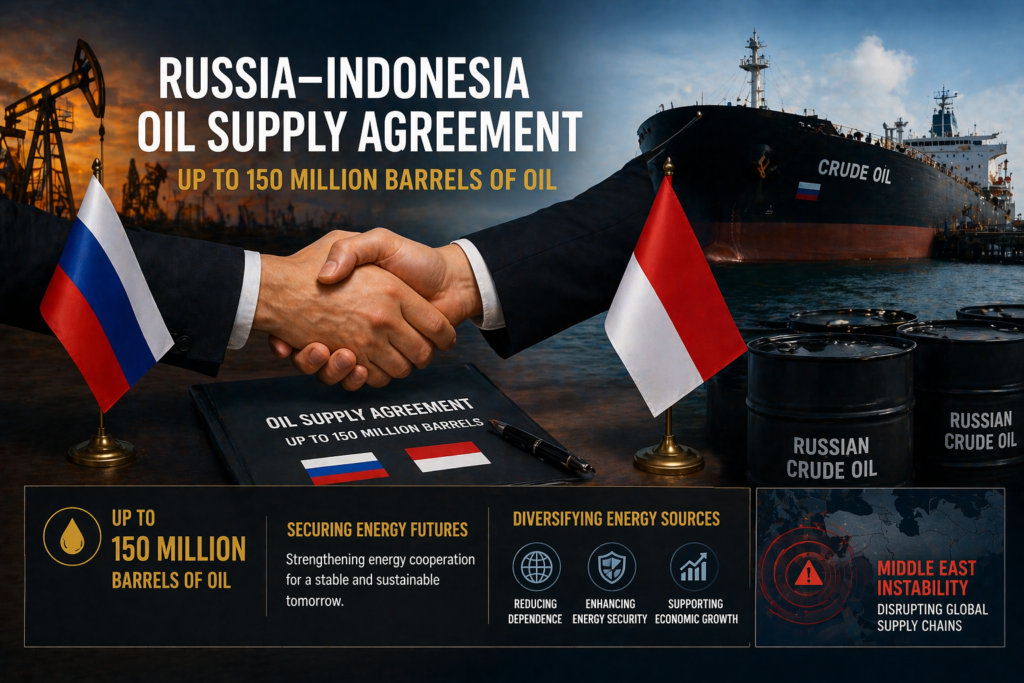
Image Credentials: Image Title: Russia to supply up to 150 million barrels of oil to Indonesia amid global disruptions. Source: (chatgpt.com) Date: April 2026. Attribution: This image was created using AI-generated imagery (chatgpt.com) by Open Chronicle and does not depict a real-world scene.
Open Chronicle | Energy & Geopolitics
Russia has agreed to supply up to 150 million barrels of oil to Indonesia, marking a significant step in Jakarta’s effort to secure alternative energy sources as instability in the Middle East continues to disrupt global supply chains.
The agreement follows a recent visit to Moscow by Indonesian President Prabowo Subianto, where he met with Russian President Vladimir Putin to discuss expanding cooperation, particularly in the energy sector.
Securing energy stability
Indonesia has been actively seeking to diversify its oil imports as rising geopolitical tensions, especially around the Strait of Hormuz, threaten traditional supply routes. A significant portion of Indonesia’s crude imports, roughly 20 to 25 percent, typically comes from the Middle East and transits through this critical chokepoint.
By turning to Russia, Jakarta aims to reduce its vulnerability to disruptions and stabilize domestic energy supplies.
According to officials, the proposed deal would also allow Indonesia to build up strategic reserves, helping cushion the economy against price volatility and supply shocks.
Strategic reserves and long-term planning
Hashim Djojohadikusumo, a senior advisor and special envoy for energy, said the country could store up to 150 million barrels under the agreement. This would significantly strengthen Indonesia’s capacity to manage fluctuations in global oil markets.
The move reflects a broader strategy to enhance energy security through diversification and increased storage capabilities.
Global pressures and sanctions context
The agreement comes at a time when Russia’s energy exports are facing mounting pressure from Western sanctions linked to the war in Ukraine. The European Union has recently expanded its sanctions framework, targeting infrastructure connected to Russian oil flows.
One such measure includes the listing of Indonesia’s Karimun oil terminal, highlighting the پیچیده intersection between global energy trade and geopolitical tensions.
Market impact and uncertainty
Oil prices have already reacted to the broader situation in the Middle East, with recent increases driven by concerns over restricted access through the Strait of Hormuz. Iran’s stance on keeping the route closed under certain conditions has further intensified uncertainty in global markets.
Despite the scale of the agreement, key details remain unclear, including delivery timelines and pricing structures.
A shifting energy landscape
The Russia-Indonesia deal underscores how countries are adapting to a rapidly changing energy environment shaped by conflict, sanctions, and supply risks.
As traditional routes become less reliable, new partnerships and supply chains are emerging, reshaping global energy dynamics in the process.