
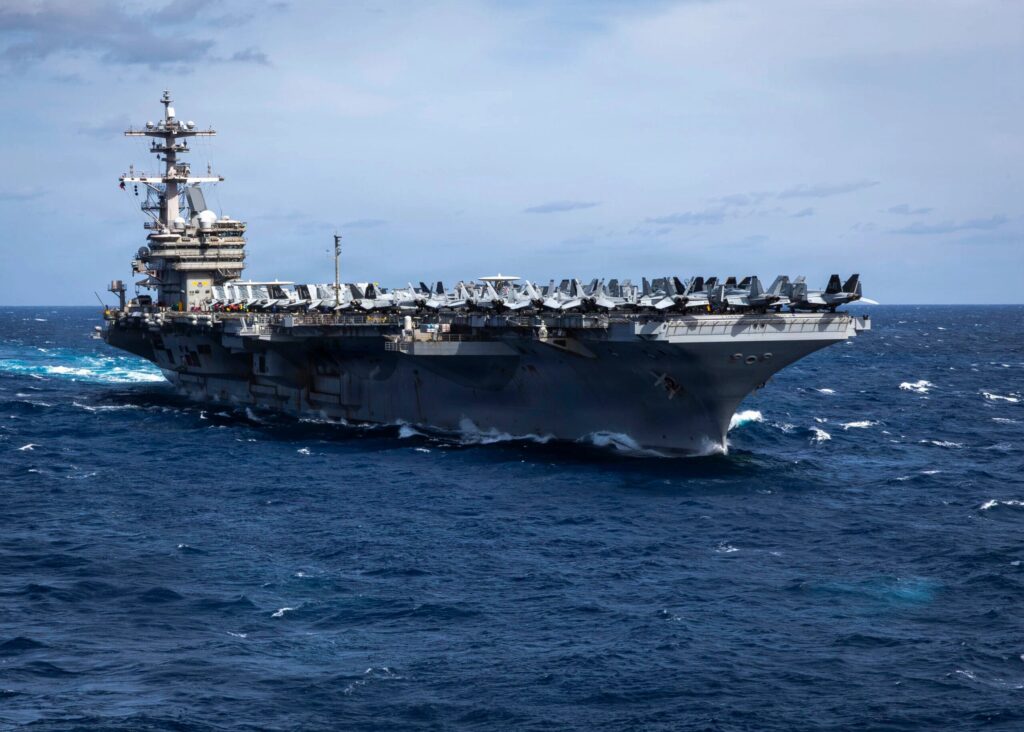
Images: from OSINT Portugal X @osintpt
The United States has significantly increased its military footprint near Iran with the arrival of a third aircraft carrier, the USS George H.W. Bush, as tensions in the region remain high despite an ongoing ceasefire.
The carrier strike group, accompanied by multiple warships and thousands of personnel, is now operating in the Indian Ocean, according to U.S. Central Command.
A major escalation in force posture
The deployment marks one of the largest U.S. naval buildups in the region in recent years. The USS George H.W. Bush joins two other carriers already positioned nearby, the USS Gerald R. Ford and the USS Abraham Lincoln, forming a powerful tri-carrier presence.
Together, these groups provide expanded air defense, strike capabilities, and operational flexibility as Washington continues to pressure Tehran over its nuclear program and regional actions.
Military officials say the deployment enhances readiness should hostilities resume, even as diplomatic efforts remain underway.
Pressure campaign continues
The increased naval presence comes alongside a broader U.S. strategy aimed at isolating Iran economically and militarily. A central element of that strategy is the enforcement of a maritime blockade targeting Iranian ports and oil exports.
U.S. forces have already turned away dozens of vessels attempting to move through restricted waters, disrupting Iran’s ability to export energy resources via the Strait of Hormuz.
The strait, a critical global shipping route, typically handles around 20 percent of the world’s oil supply, making its disruption a key factor in rising global energy prices.
Reinforcements and readiness
In addition to naval assets, thousands of U.S. Marines and additional forces are expected to arrive in the region in the coming weeks, further strengthening the American military posture.
Officials say these deployments are designed to maintain pressure while preserving the option for rapid escalation if negotiations fail.
Ceasefire under strain
Although a ceasefire has been in place since early April, the growing military buildup underscores the fragile nature of the truce. Both Washington and Tehran have continued to take actions that test its limits, including ship seizures, blockades, and competing security measures in regional waters.
Analysts warn that the concentration of military assets increases the risk of miscalculation, particularly in a highly contested environment like the Persian Gulf.
Strategic uncertainty
The arrival of the USS George H.W. Bush signals that the United States is preparing for multiple scenarios, from continued negotiations to renewed conflict.
While diplomatic channels remain open, the scale of the military deployment highlights the stakes involved and the uncertainty surrounding the next phase of the crisis.