
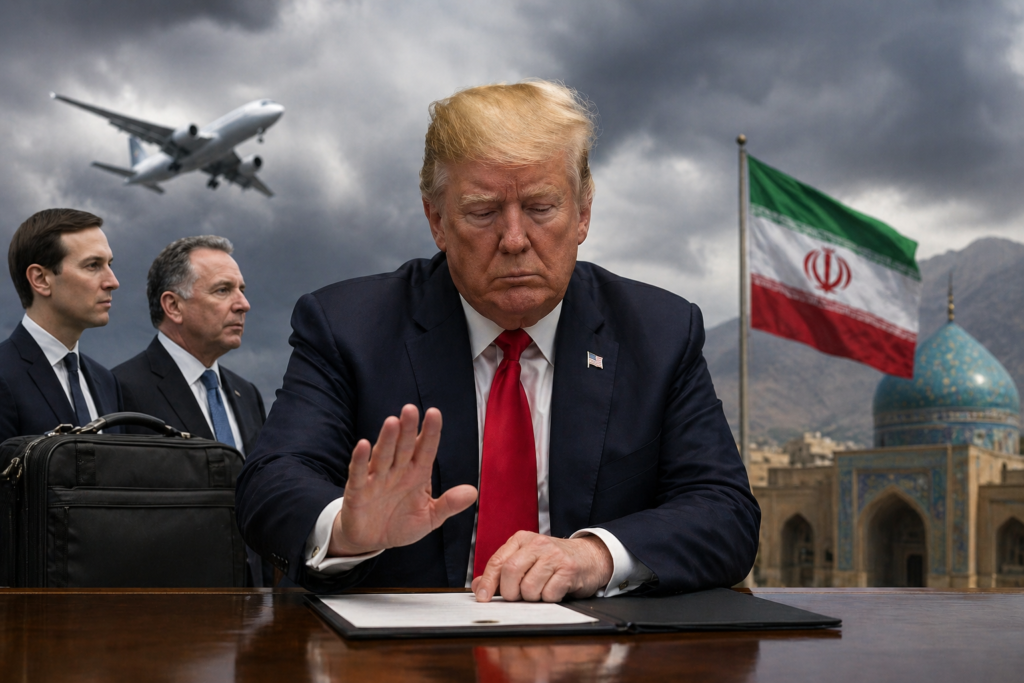
Image Credentials: Image Title: Trump cancels Pakistan trip by envoys, casting doubt over Iran peace efforts. Source: (chatgpt.com) Date: April 2026. Attribution: This image was created using AI-generated imagery (chatgpt.com) by Open Chronicle and does not depict a real-world scene.
Open Chronicle | Geopolitics
U.S. President Donald Trump has abruptly cancelled a planned diplomatic mission to Pakistan involving senior envoys, dealing a fresh blow to already fragile efforts to de-escalate tensions with Iran.
The visit, which was expected to include special envoy Steve Witkoff and presidential adviser Jared Kushner, had been seen as a key step toward reviving stalled negotiations mediated by Islamabad. Instead, Trump cited internal divisions within Iran’s leadership as the primary reason for halting the trip.
“Too much time wasted on traveling, too much work,” Trump said in a social media post, adding that there was “tremendous infighting and confusion” in Tehran. He insisted that the United States held the upper hand and that any dialogue would require Iran to initiate contact.
The decision comes at a delicate moment in the diplomatic process. Iran’s Foreign Minister Abbas Araghchi had just concluded a visit to Islamabad, where he met Prime Minister Shehbaz Sharif and other senior officials. While Araghchi described the talks as “very fruitful,” no concrete progress toward a breakthrough was announced.
Shortly after leaving Pakistan, Araghchi traveled to Muscat for further consultations, signaling continued regional diplomatic engagement. However, Tehran has made clear it will not enter direct negotiations with Washington under current conditions, rejecting what it describes as “maximalist demands.”
The standoff between the United States and Iran remains deeply entrenched. A temporary ceasefire is in place following weeks of conflict that began with U.S. and Israeli strikes on Iran in late February. Since then, Iran has responded with attacks targeting Israel, U.S. positions, and regional actors, escalating fears of a broader confrontation.
At the center of the dispute is the Strait of Hormuz, a critical global energy corridor through which roughly one-fifth of the world’s oil and liquefied natural gas supplies pass. Iran’s restrictions on the waterway, combined with a U.S. naval blockade on Iranian exports, have severely disrupted shipping and driven energy prices to multi-year highs.
Washington has expressed cautious optimism in recent days. White House Press Secretary Karoline Leavitt noted signs of limited progress, while Vice President JD Vance remained on standby to join talks if conditions improved. Vance had previously led an earlier round of negotiations in Pakistan that ended without agreement.
Despite these efforts, both sides remain far apart. Iranian officials have emphasized their conditions for a lasting settlement, including the lifting of blockades and guarantees against further military action. Meanwhile, the United States continues to press for broader concessions, including limits on Iran’s regional activities and strategic capabilities.
The cancellation of the Pakistan trip underscores the volatility of the diplomatic track. With mistrust deepening and economic pressures mounting globally due to energy disruptions, the path toward a durable agreement appears increasingly uncertain.