
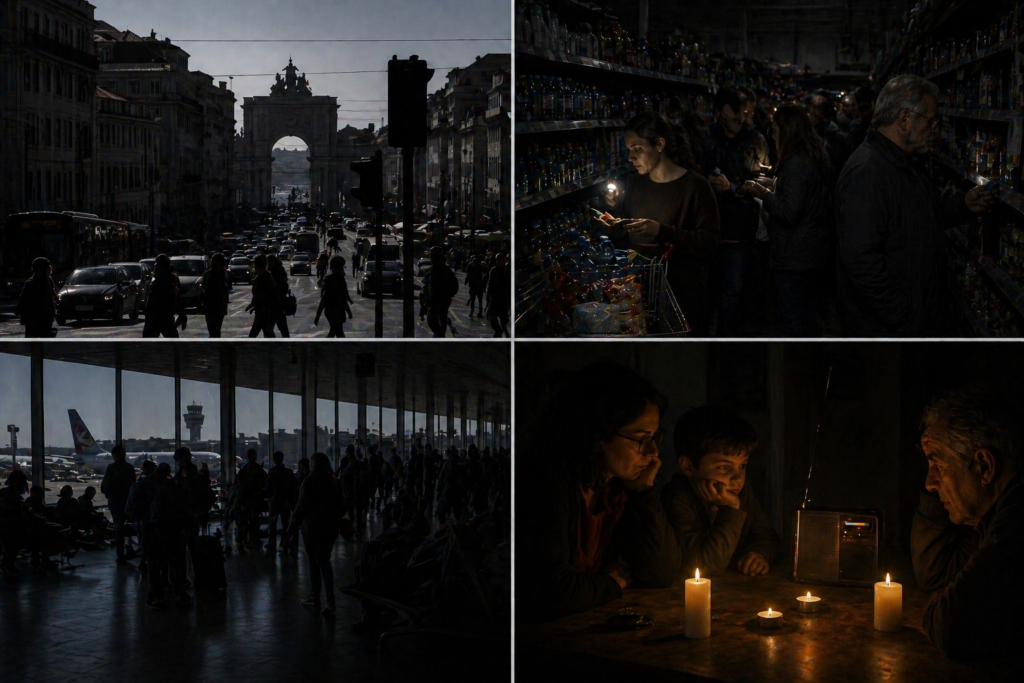
Image Credentials: Image Title: One Year On: The Day Portugal Went Dark and Nearly Stood Still Source: (chatgpt.com) Date: April 2026. Attribution: This image was created using AI-generated imagery (chatgpt.com) by Open Chronicle and does not depict a real-world scene.
By Open Chronicle with Agencies
It has been one year since Portugal experienced one of the most disruptive moments in its recent history, when a sudden and total collapse of the Iberian electrical network plunged the country into darkness in the middle of the day.
At exactly 11:33 a.m., mainland Portugal lost synchronisation with the European grid, triggering a nationwide blackout that brought daily life to an abrupt halt. Within minutes, public transport systems stopped, traffic lights went out, and major cities descended into widespread congestion and confusion.
The impact was immediate and far-reaching. Payment terminals failed, internet access disappeared, and communication networks were severely disrupted. With uncertainty spreading quickly, many people rushed to supermarkets and fuel stations, anticipating prolonged disruption.
Air travel was also heavily affected. By early afternoon, operations at Lisbon Airport were suspended, while airports in Porto and Faro managed to maintain limited activity thanks to backup generators. Even so, hundreds of flights were delayed or cancelled, adding to the growing sense of disruption.
In the absence of digital communication, traditional media regained critical importance. Public radio continued broadcasting using emergency power systems, becoming a vital source of information for a population suddenly cut off from online updates.
The restoration process proved complex. It took approximately 12 hours to fully reestablish the system, with power only returning across the country around 11:20 p.m. The recovery relied on the two blackstart facilities available at the time, located at Castelo de Bode and Tapada do Outeiro, which were capable of restarting the grid from zero.
The blackout exposed vulnerabilities in Portugal’s energy infrastructure and highlighted the importance of resilience and redundancy in modern power systems. In the months that followed, authorities moved to strengthen capacity, including expanding the number of blackstart-capable plants.
A year later, the event remains a stark reminder of how dependent modern societies are on an uninterrupted energy supply, and how quickly normal life can unravel when that system fails.